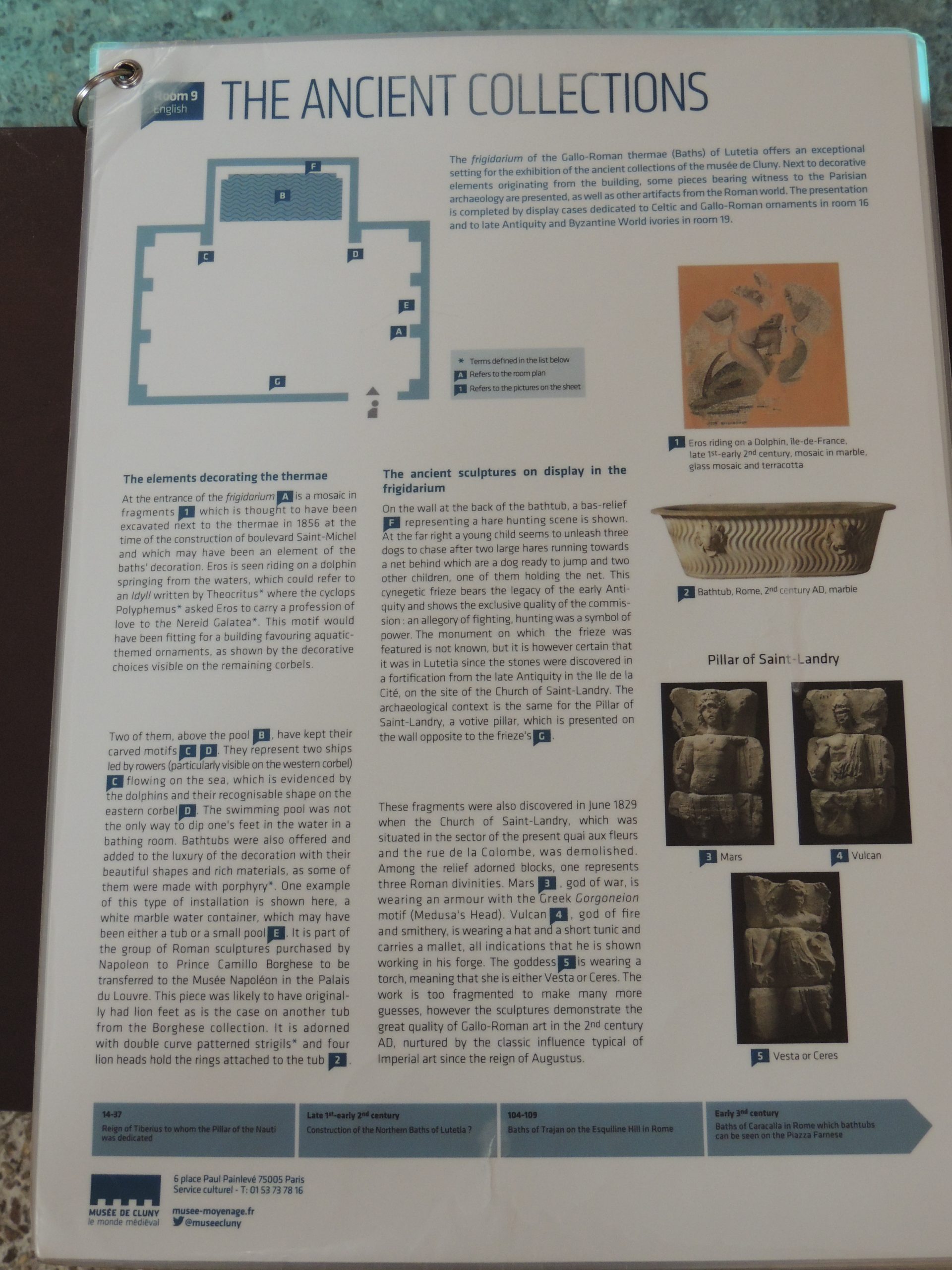
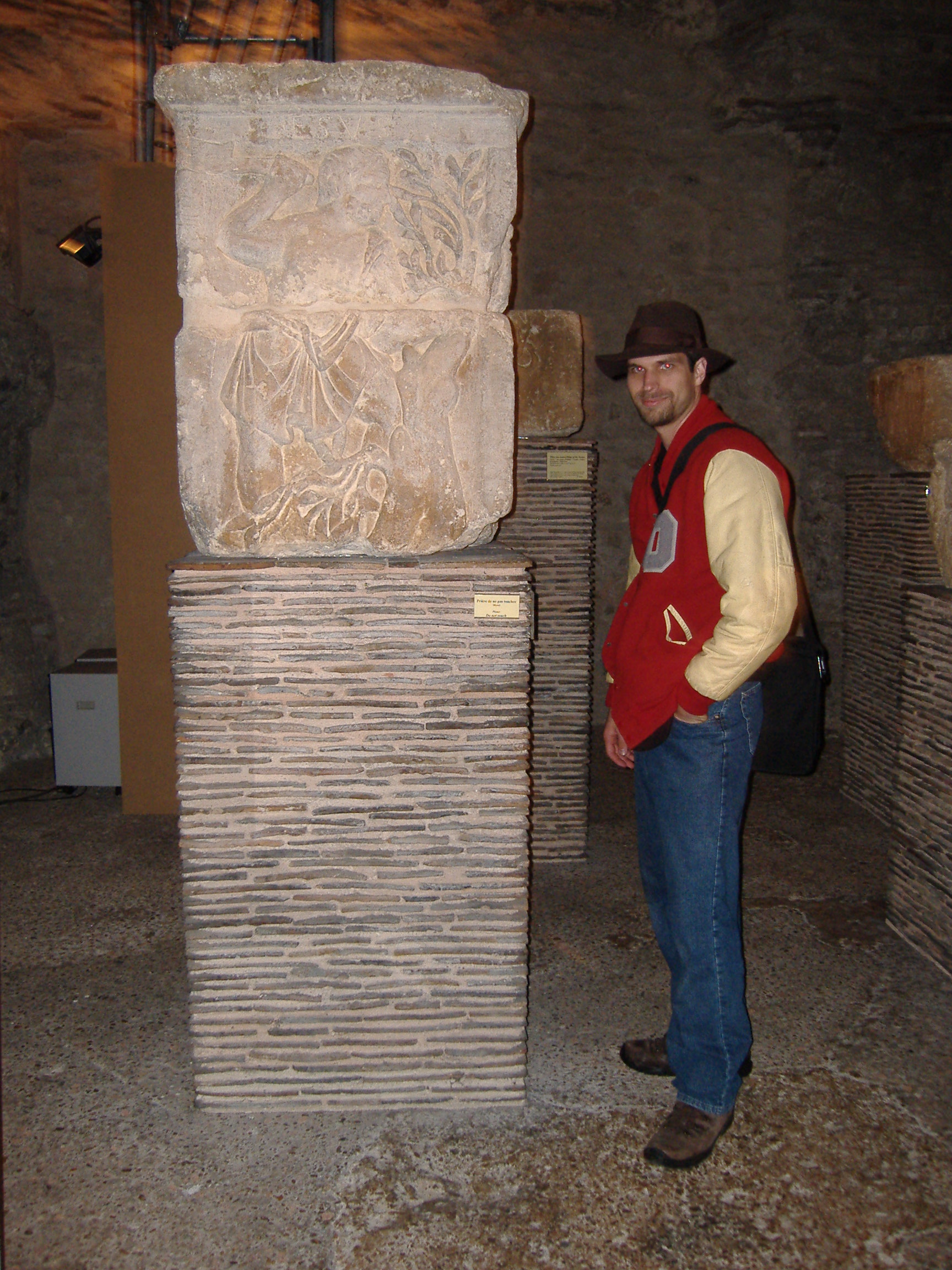
In 2005, I was passing through Paris on my way to Salzburg for Walking with Fire, and I had just long enough of a layover to stop with my travel companion, Meghan, at the Musée de Cluny to see a god. We went in and found him in the Frigidarium (the Musée de Cluny is built on an old Roman bath house).
I was well aware of what was in store for me, as I’d been writing and researching Esus and Tarvos Trigaranus for years at this point, but I was still in awe wandering around the pillar, taking photos of the blocks and all of their faces. The museum allows you to wander up to the blocks, with no velvet rope to stand behind, no glass to cast reflections, and nothing between you and the images. That sort of access comes with a huge responsibility, however: as tempting as it is, we must keep our hands to ourselves, and flash photography is prohibited in the museum.
In 2017, I was privileged to return, and with the ability to take more photos. The old page no longer served its purpose, and I wanted to update it, but had not done so until the release of this new webite. The original page was somewhat sparse in terms of information, mostly being a page of photos, but there is so much more to explore here. Adding to this is the poor state of the Wikipedia page for the pillar, which is also in sore need of an update. (Fortunately, the Musée’s own page has some good photos, though not of all faces.)
With my 2017 trip, I took many more photos, with a much better camera (and more camera-knowledge). My mother and brother were with me on that trip, sitting quietly while I wandered among the stones and took photos again, and added some video to my private archive.
When I returned from that trip, I created a short tour video, which you can find on YouTube, that includes almost all the photos.
But to show you what the pillar looks like up close, you’re going to want to see all of the photos outside the video, and get deeper into the history of the pillar itself.
The Discovery (and Care) of the Pillar
It is generally assumed that the pillar once stood on the island in the Seine where the famous Cathedral of Notre Dame now stands, in the heart of Paris. We know that sacred sites are often built on older sacred sites, and this particular site seems to have been no exception.
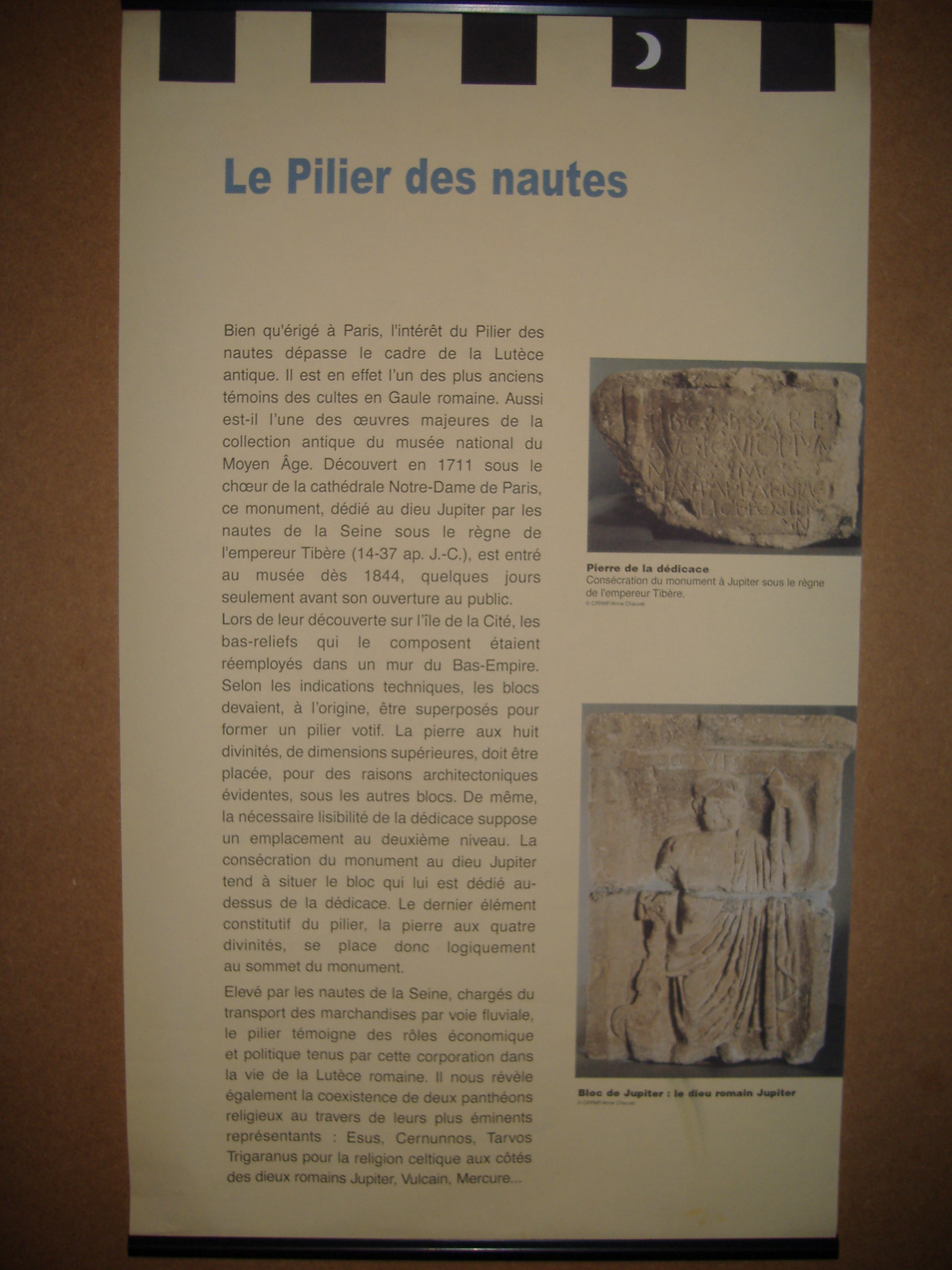
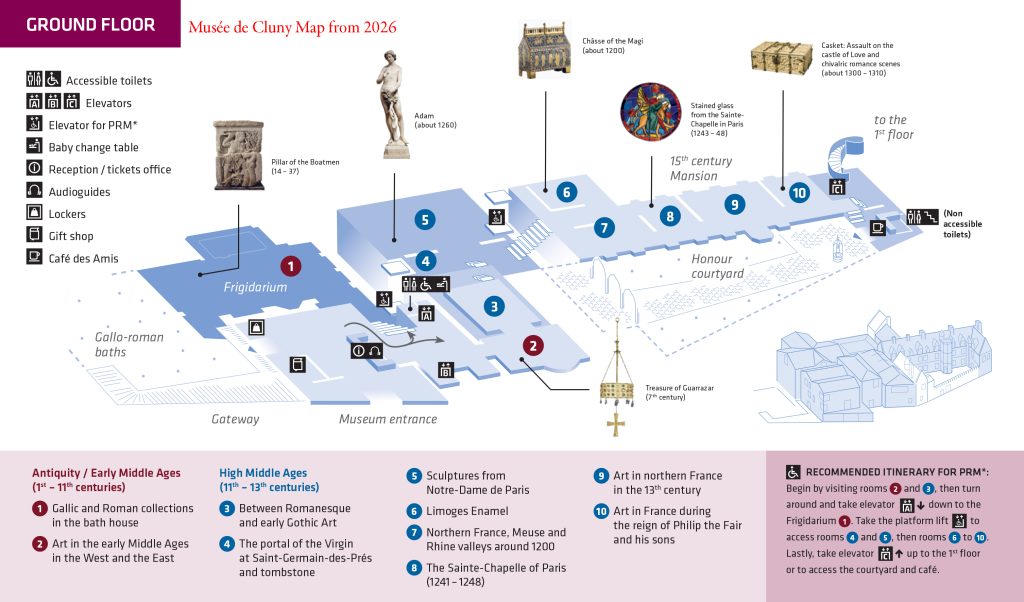
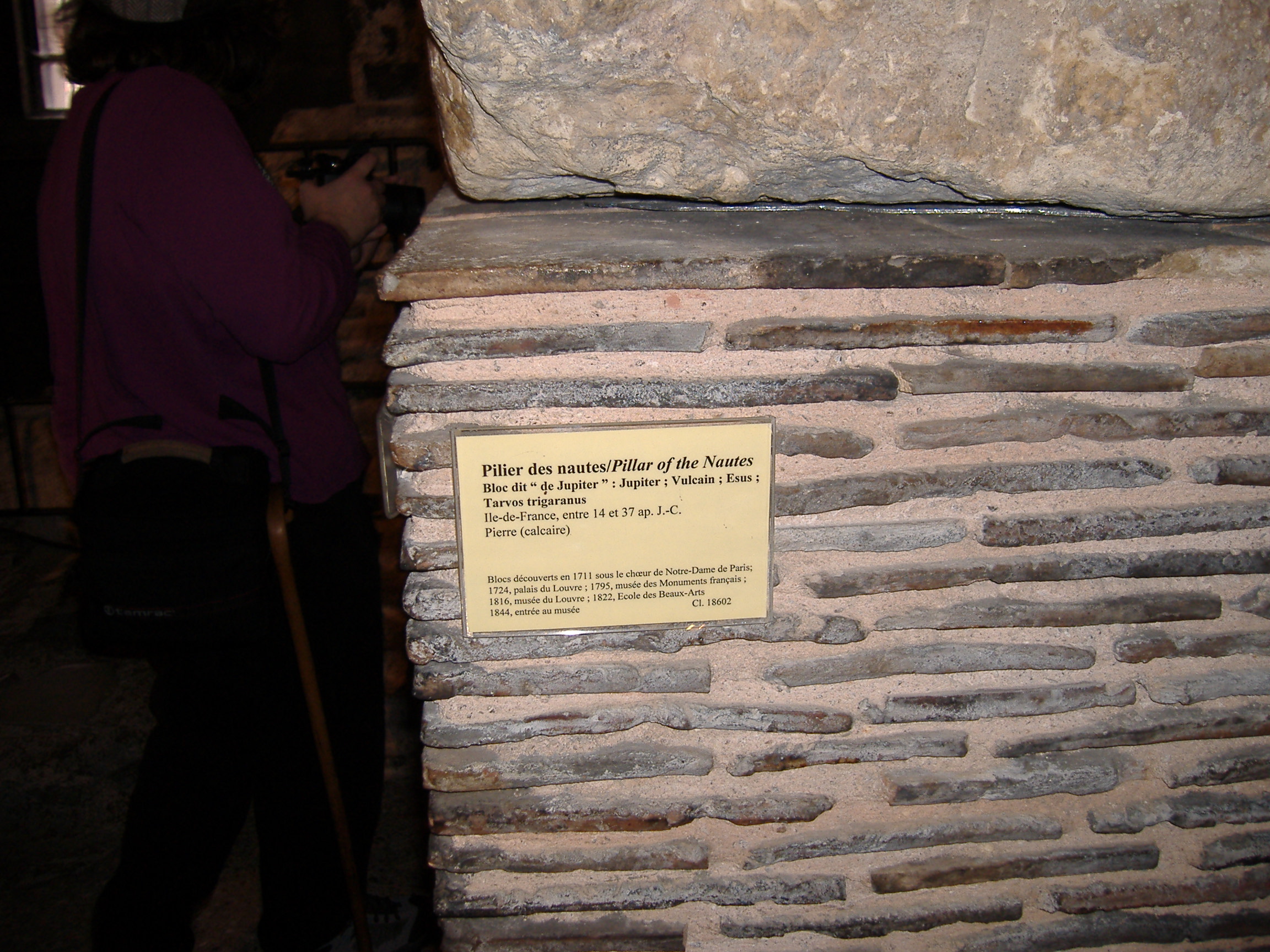
In 1699, during the reign King Louis XIV, a new altar was commissioned for Notre Dame cathedral to fulfill a vow by Louis XIII that resulted in an heir to his throne. Under the choir, while creating new crypt space for archbishops, a wall was demolished, which revealed a second, parallel wall that included the blocks that constitute the pillar. The date these blocks were found is given variously as 1710 and 1711; a paper in 1725 fixes the date as March 16, 1711. It moved through various museums, including the cloister of the Saint-Denis-du-Pas church nearby, the Louvre, the nationalized Petits-Augustins convent (later the Museum of French Monuments), then to the Louvre’s Jardin de l’Infante, then back to the Petits-Augustins convent (now an annex of the Beaux-Arts de Paris), and finally to the Musée de Cluny 8 days before it opened in March 1844, where the blocks have stayed since in the Frigidarium. (If you need a map, the Musée de Cluny provides one, with an accessible route to the Frigidarium.)
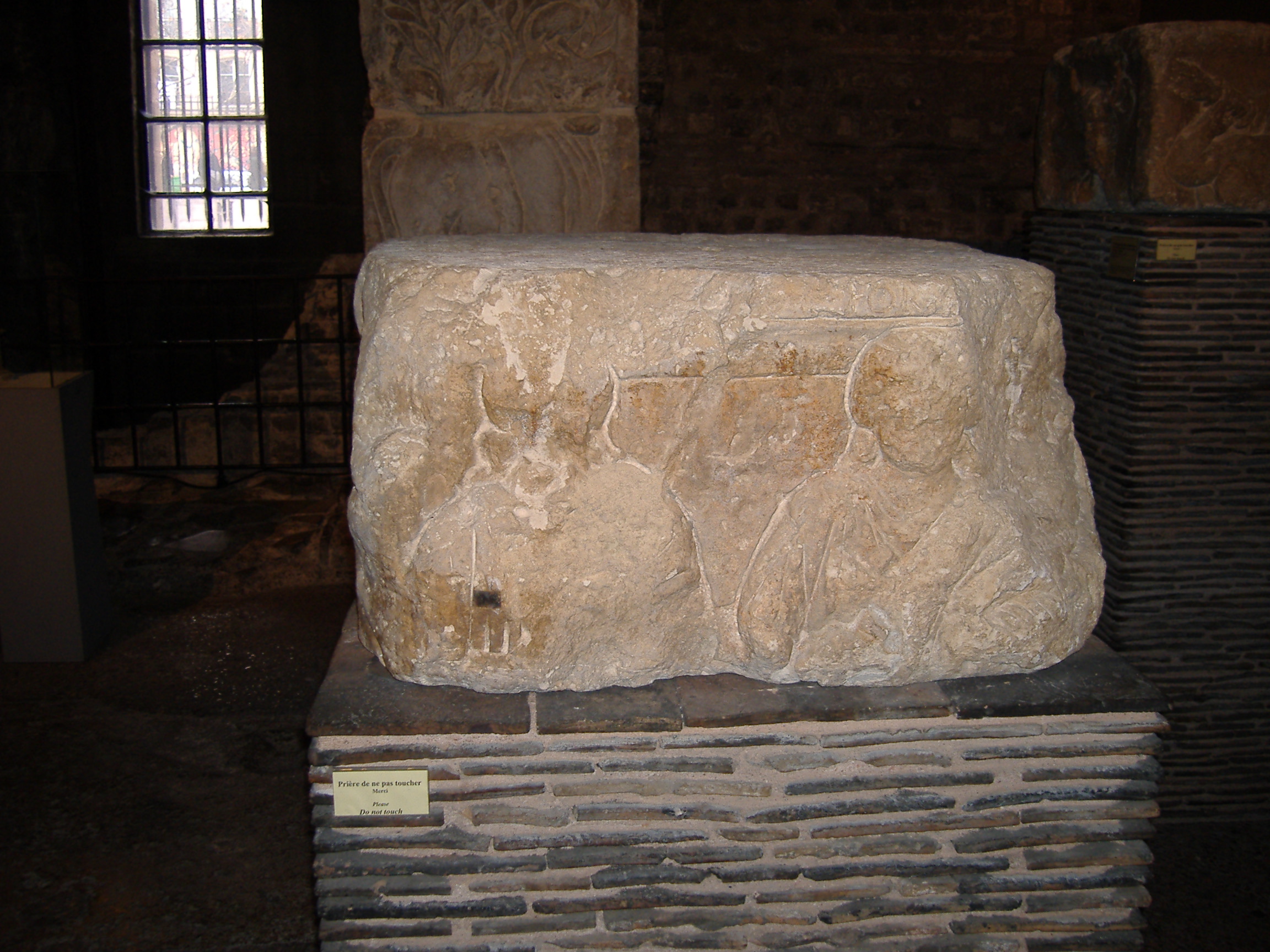
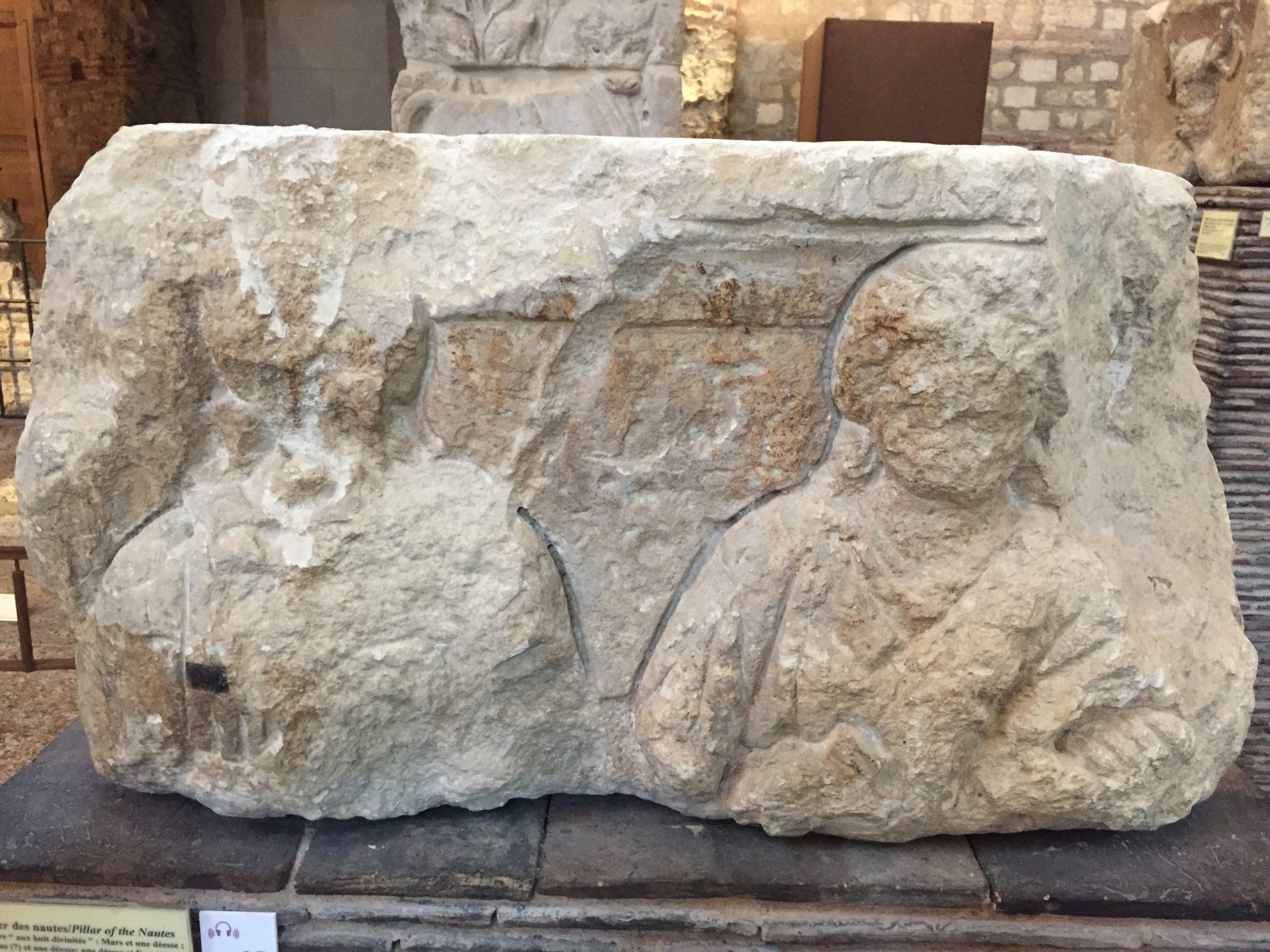
I first saw the pillar after its restoration in 2003 (it was off display for 4 years, apparently, while they cleaned the blocks with lasers), so my photos are fairly clear and clean; prior to this cleaning, the blocks were black and covered in grime from environmental exposure. You can see black rectangles that were left unrestored on a couple of faces (Smertrios, Tarvos Trigaranus, and Fortuna, specifically) that show how dingy they were before this work was done. In the 20 years since I first saw them, they appear to be holding up quite well in the Frigidarium that is their home.
General Description of the Pillar
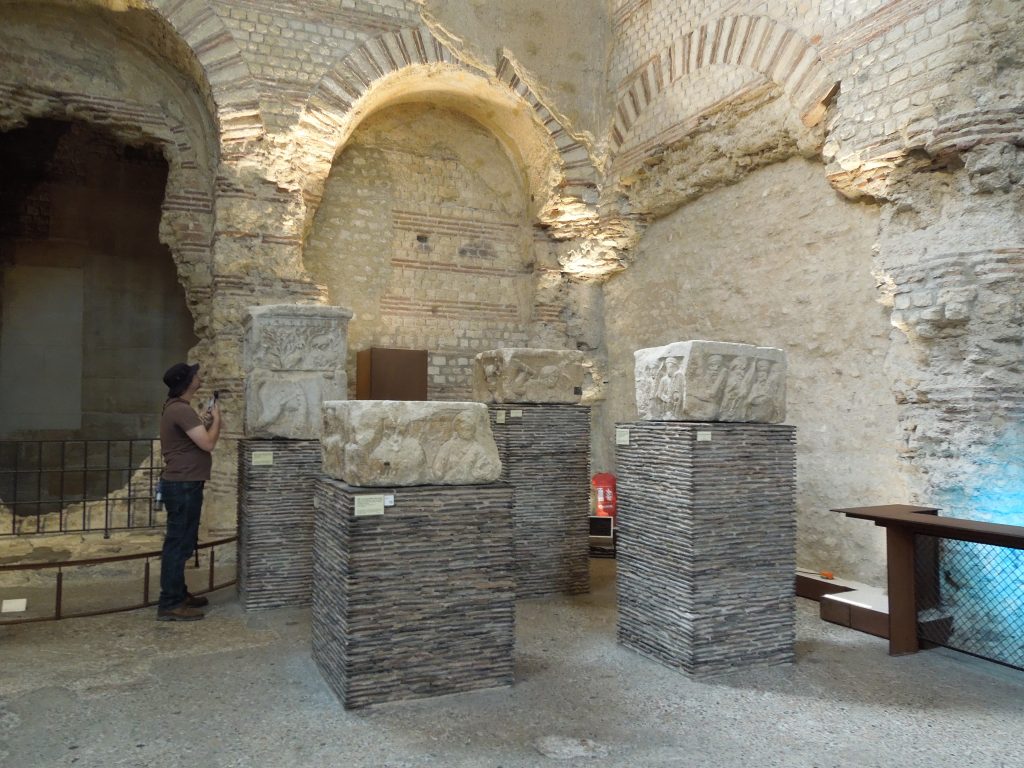
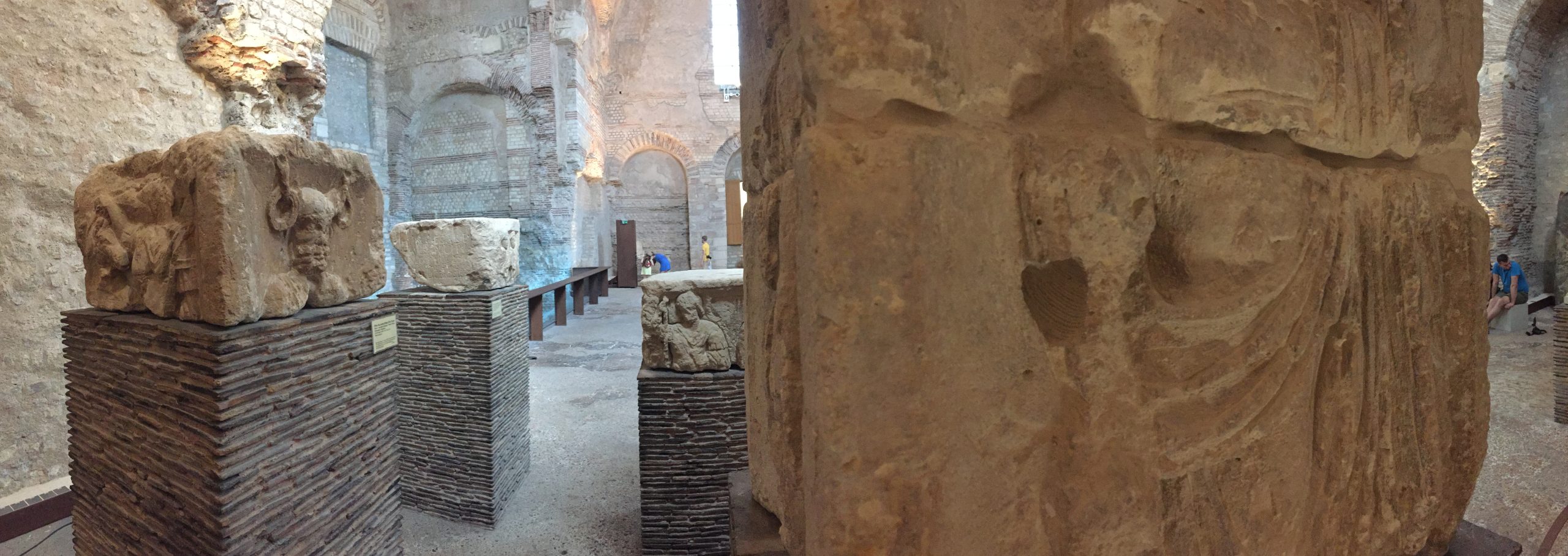
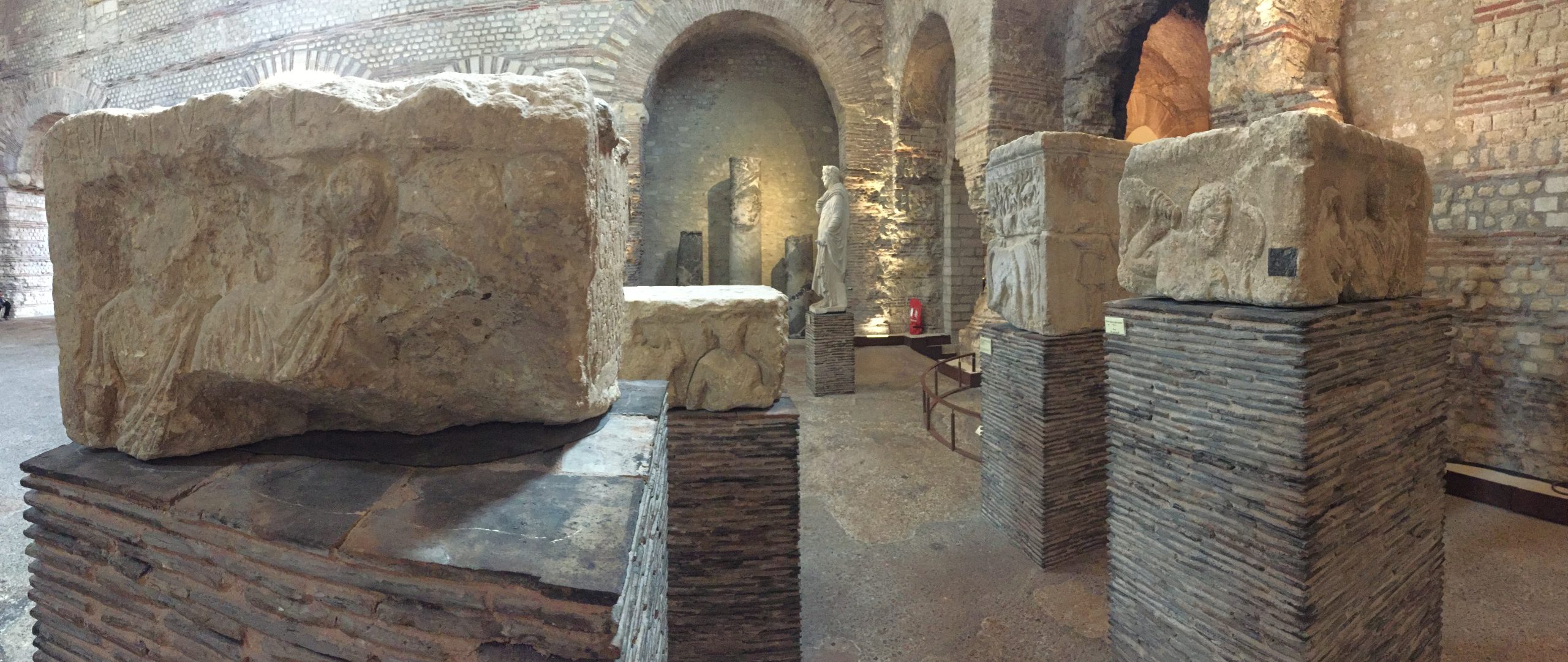
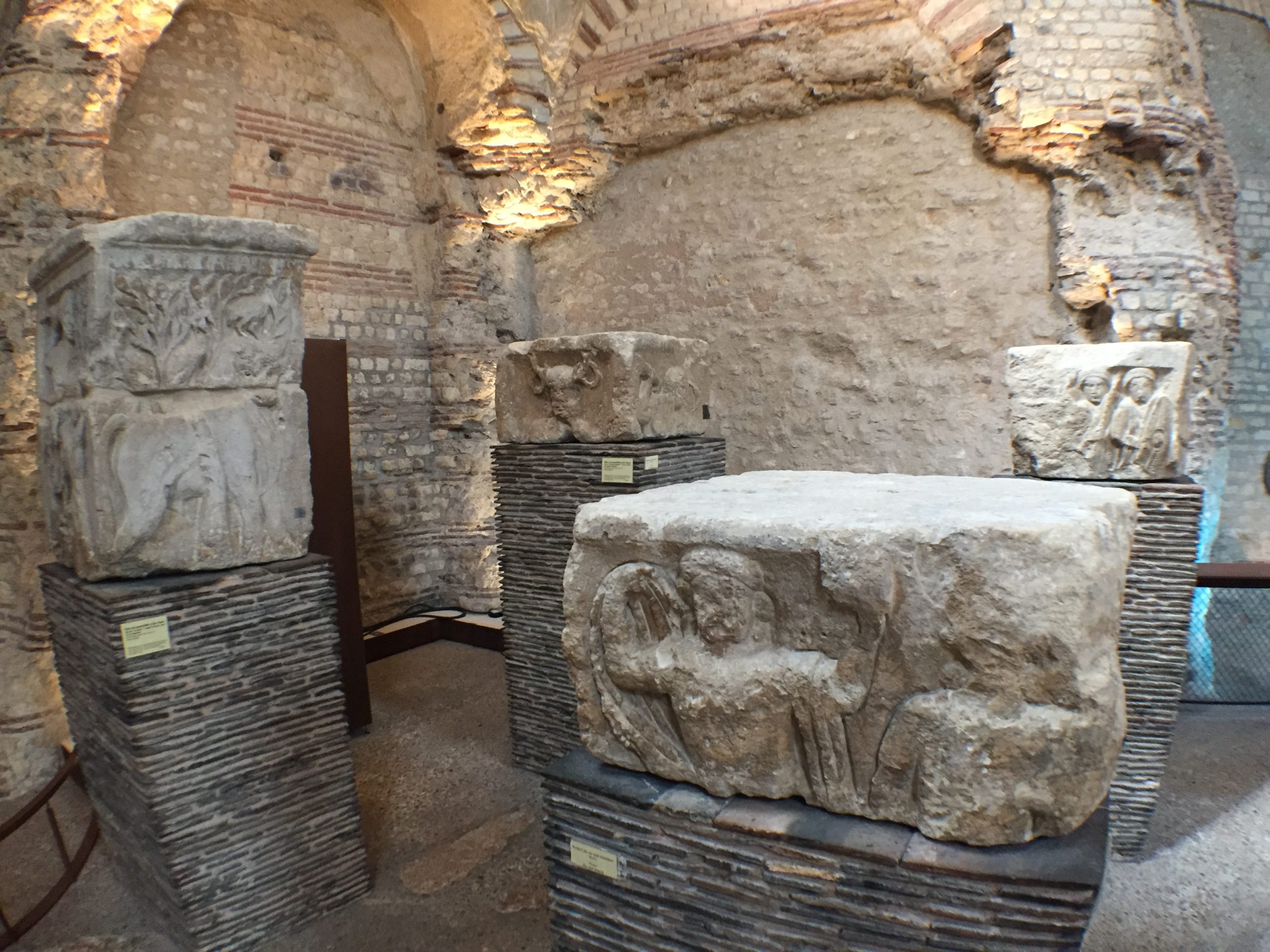
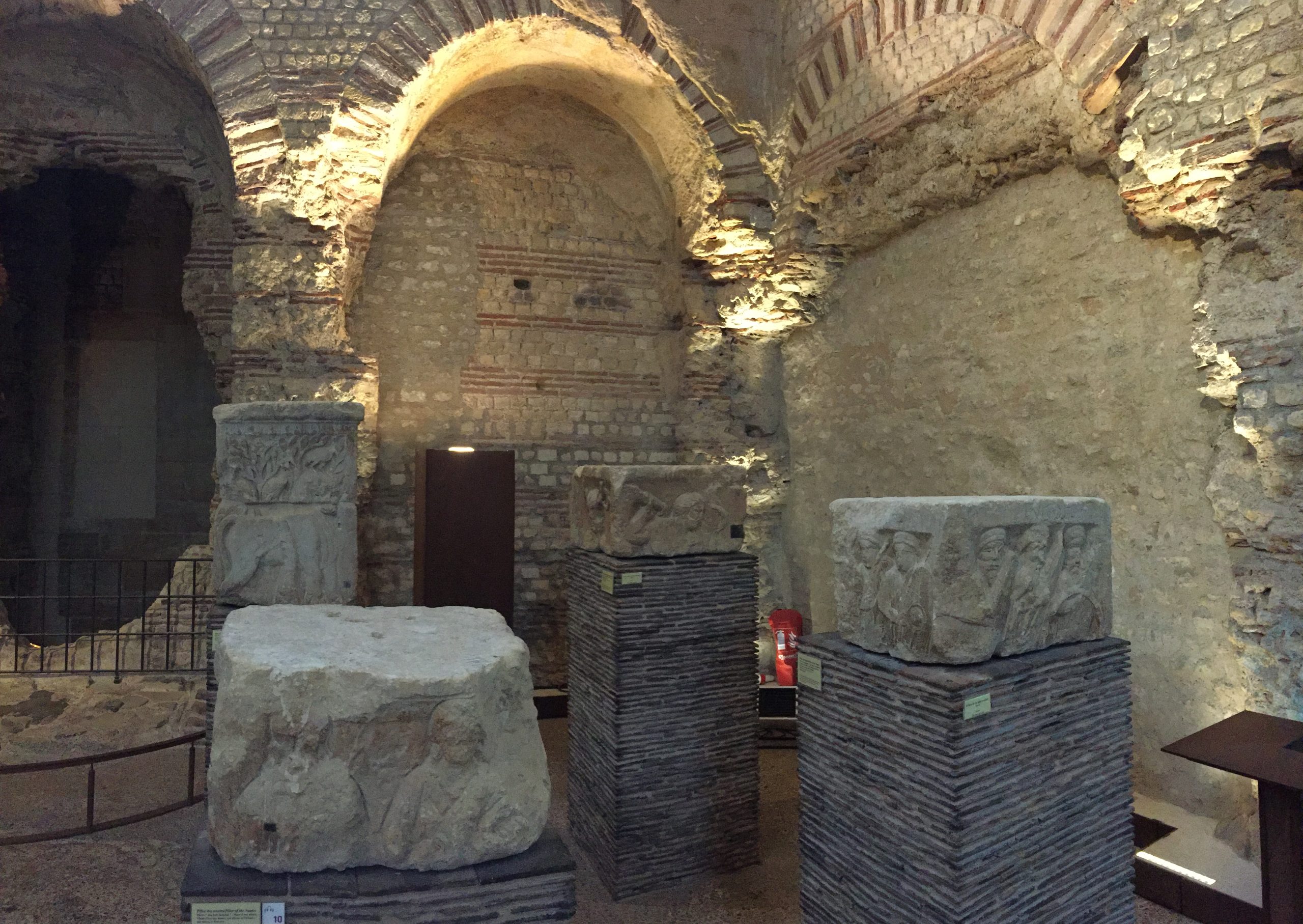
The pillar itself is situated in the Frigidarium of the Musée de Cluny, as mentioned before, with each block set on its own stand. You can walk through the pillars and view all sides up close, and take your own photos from any angle you like.
We’ll start with the blocks themselves: they all appear to be carved from the same yellow-white limestone, which contains fossilized ditrupa bartonensis tubes (among other fossils). In the Gallo-Roman period, this sort of stone was quarried near the river Oise, which flows into the Siene just northwest of Paris (in modern Conflans-Sainte-Honorine).
As we work through the various blocks, we’ll start at the (presumed) top and work our way down as they seem to have been stacked originally. It’s estimated the pillar likely stood 524 CM tall (5.24m, or just about 17’4″ tall). This height assumes a base (there are sources that refer to a sixth, undecorated block, now lost) and reconstructs half of three of the blocks, as they are lost; only one block is complete, the Block of Jupiter, re-attached to itself after discovery of both halves. There have been suggestions that perhaps a statue stood atop the pillar at one time, but we do not have any evidence of that in the archeological record.
On two of the extant four blocks, there are two adjoining faces of Gaulish deities, and two adjoining faces of Roman deities. The images on the dedication block don’t seem to be deities at all (though text appears on this block in what is likely both Latin and Gaulish), and several of the eight deities on the final block are difficult to identify.
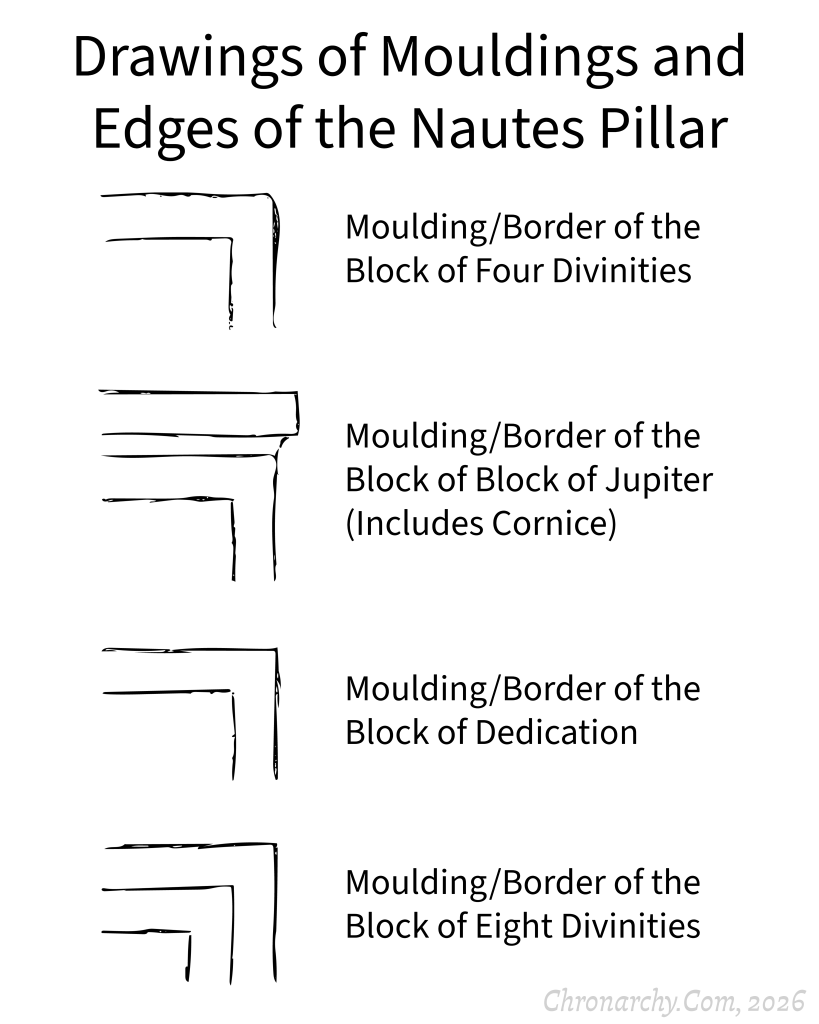
The borders and mouldings are different between the four blocks as well; while the Blocks of Dedication and Four Divinities are similar and simple, the Block of Jupiter has a cornice, and the Block of Eight Divinities has a sort of frame moulding. It’s possible they all had cornices (the above height suggestion takes cornices into account), but we just don’t have them.
The Block of Four Divinities
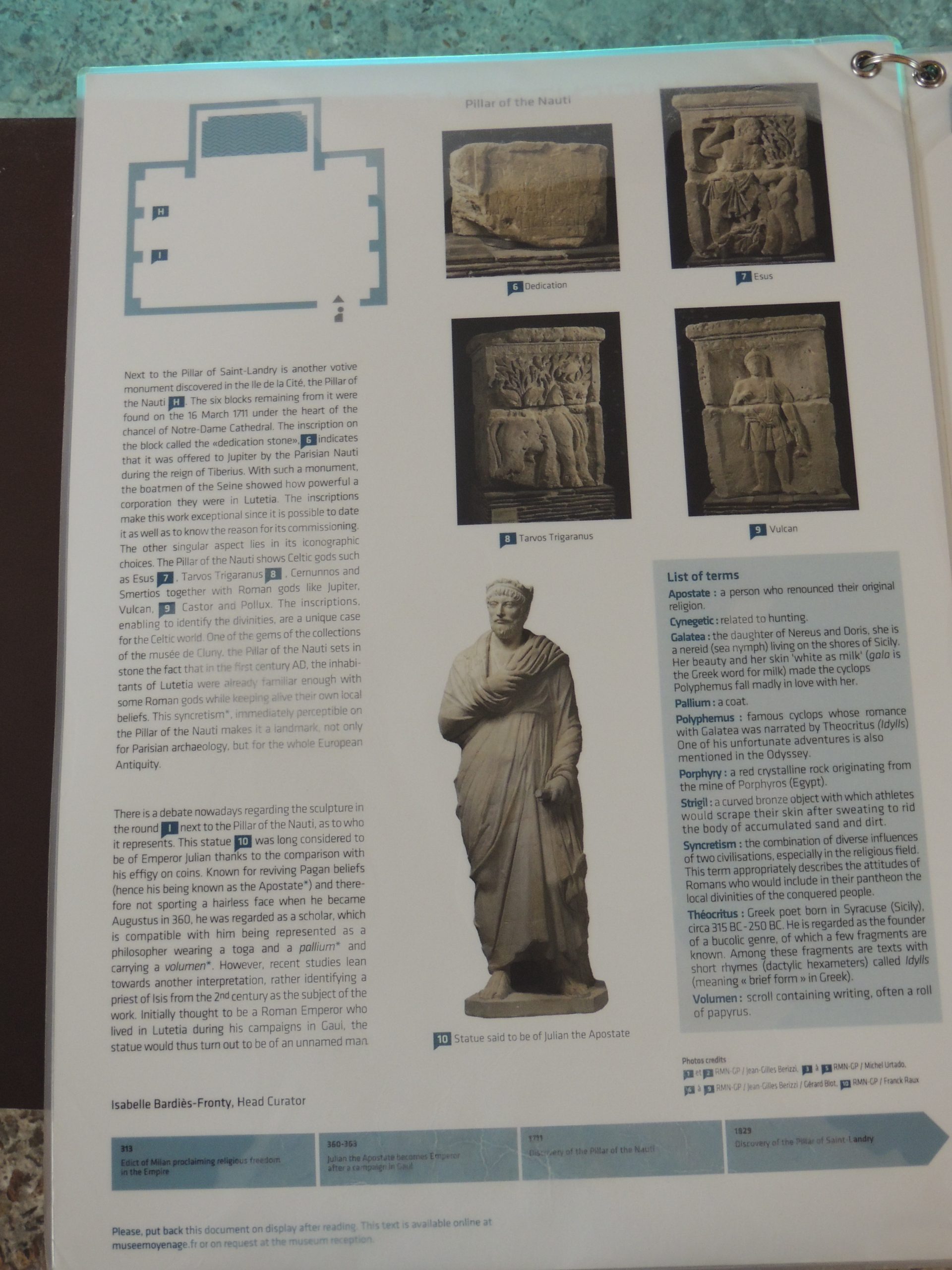
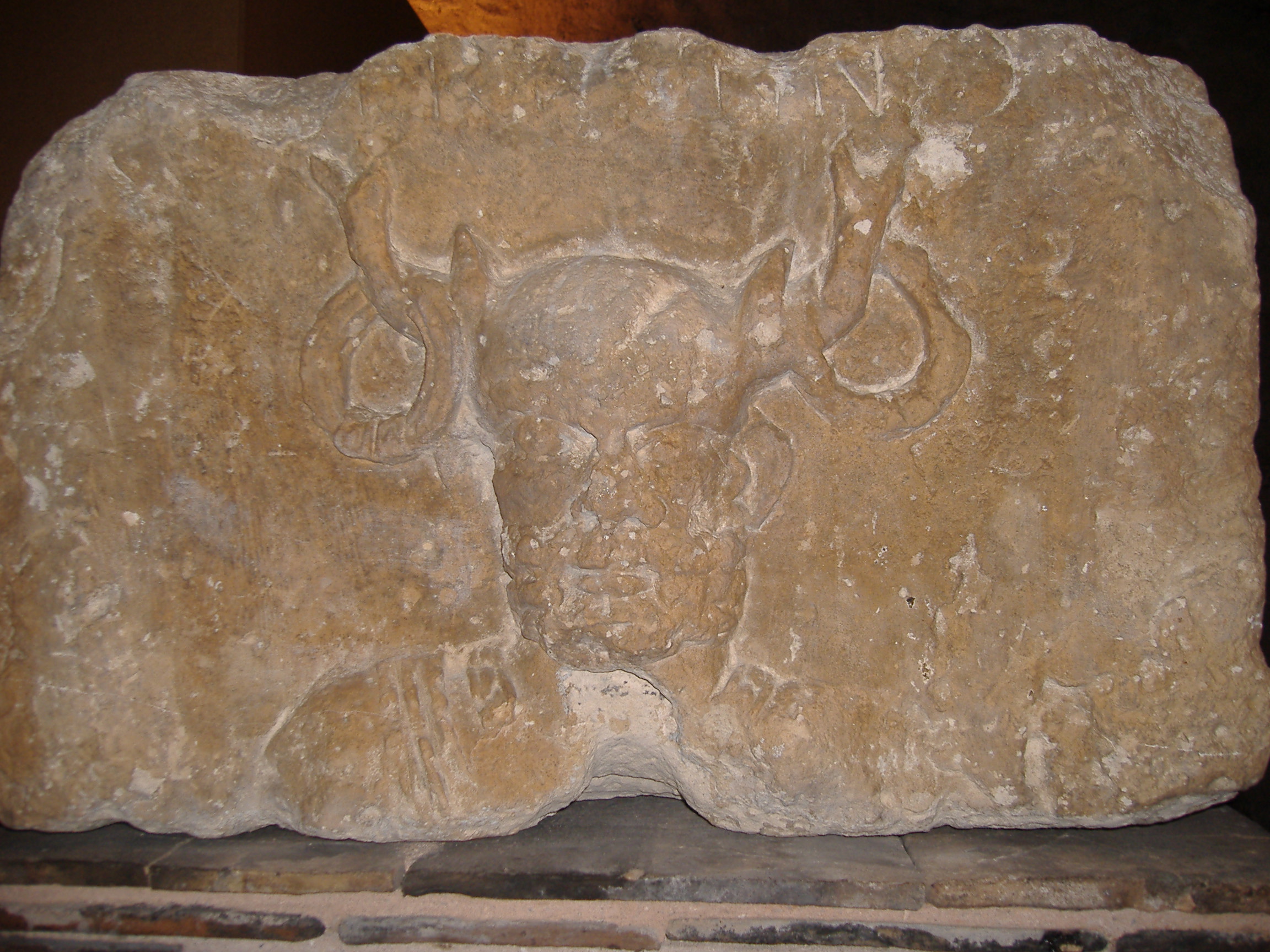
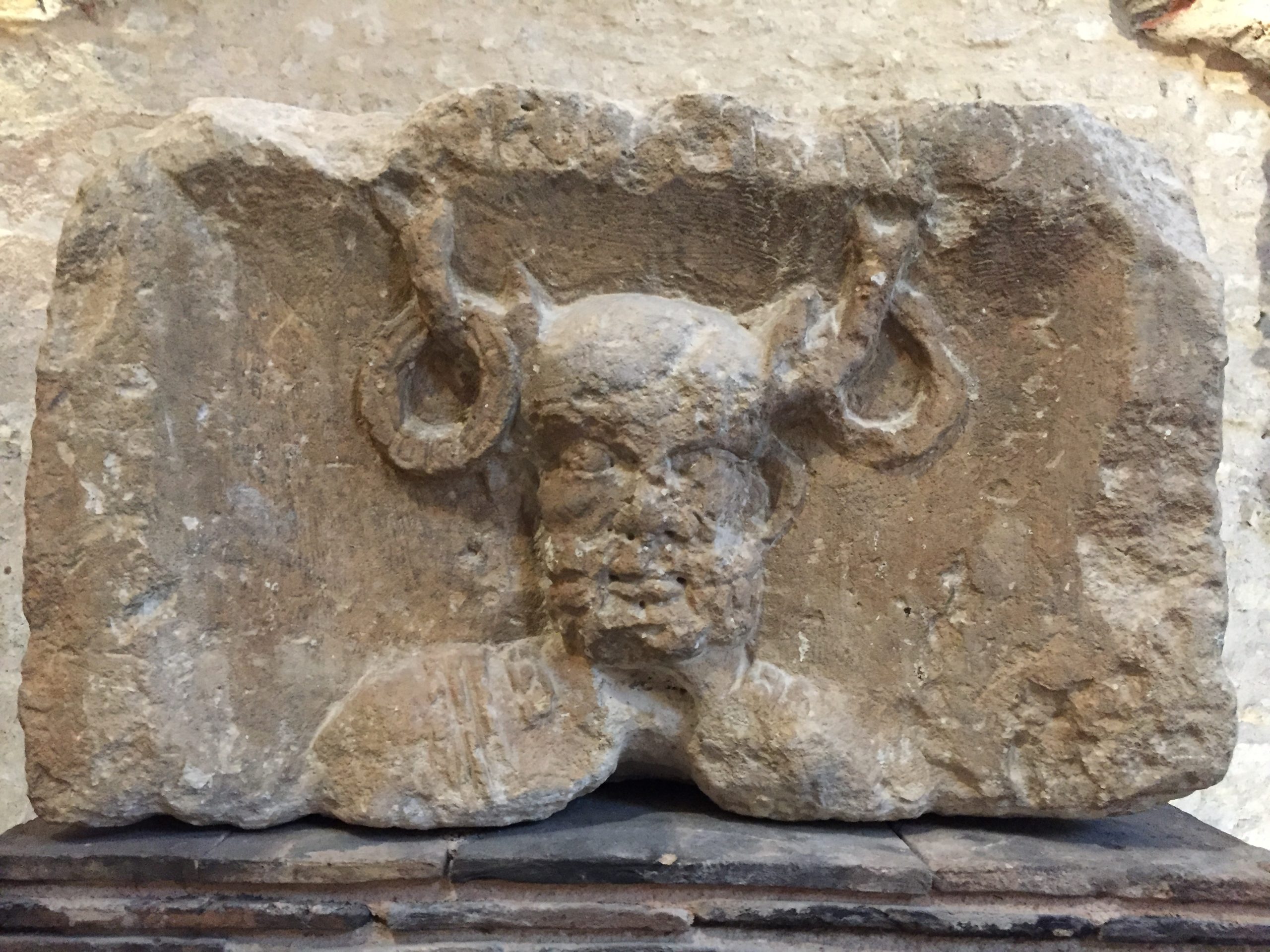
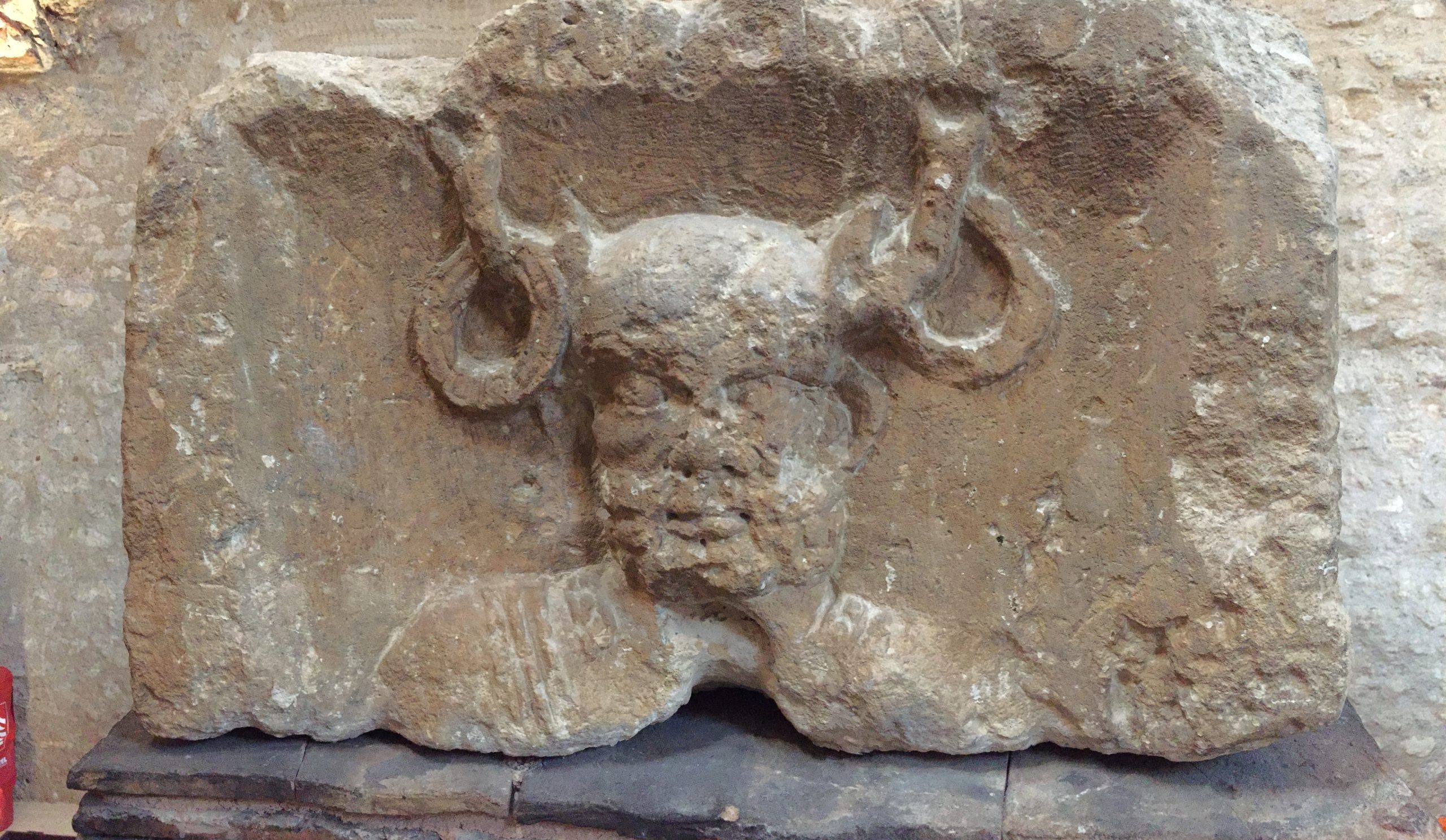
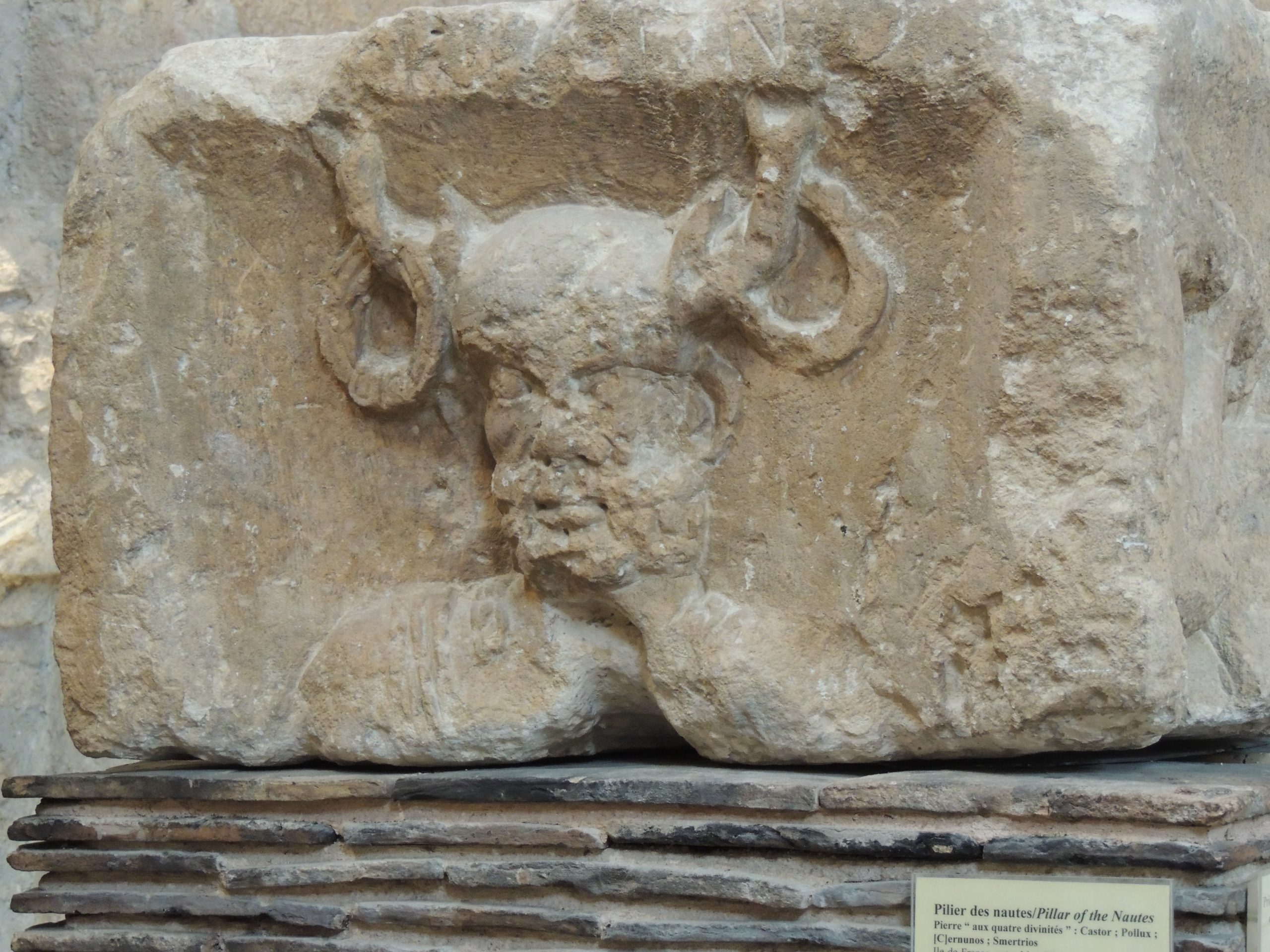
First, there is the Block of the Four Divinities, named because on the four faces of the stone are four different divinities: Cernunnos, Smertrios, Castor, and Pollux. This block sits at the top in reconstructions, and there is about 46cm of the top of the block left.
The Cernunnos Face
Most people are interested in the Cernunnos image on this block, over the other three divinities, so I’ll start there.
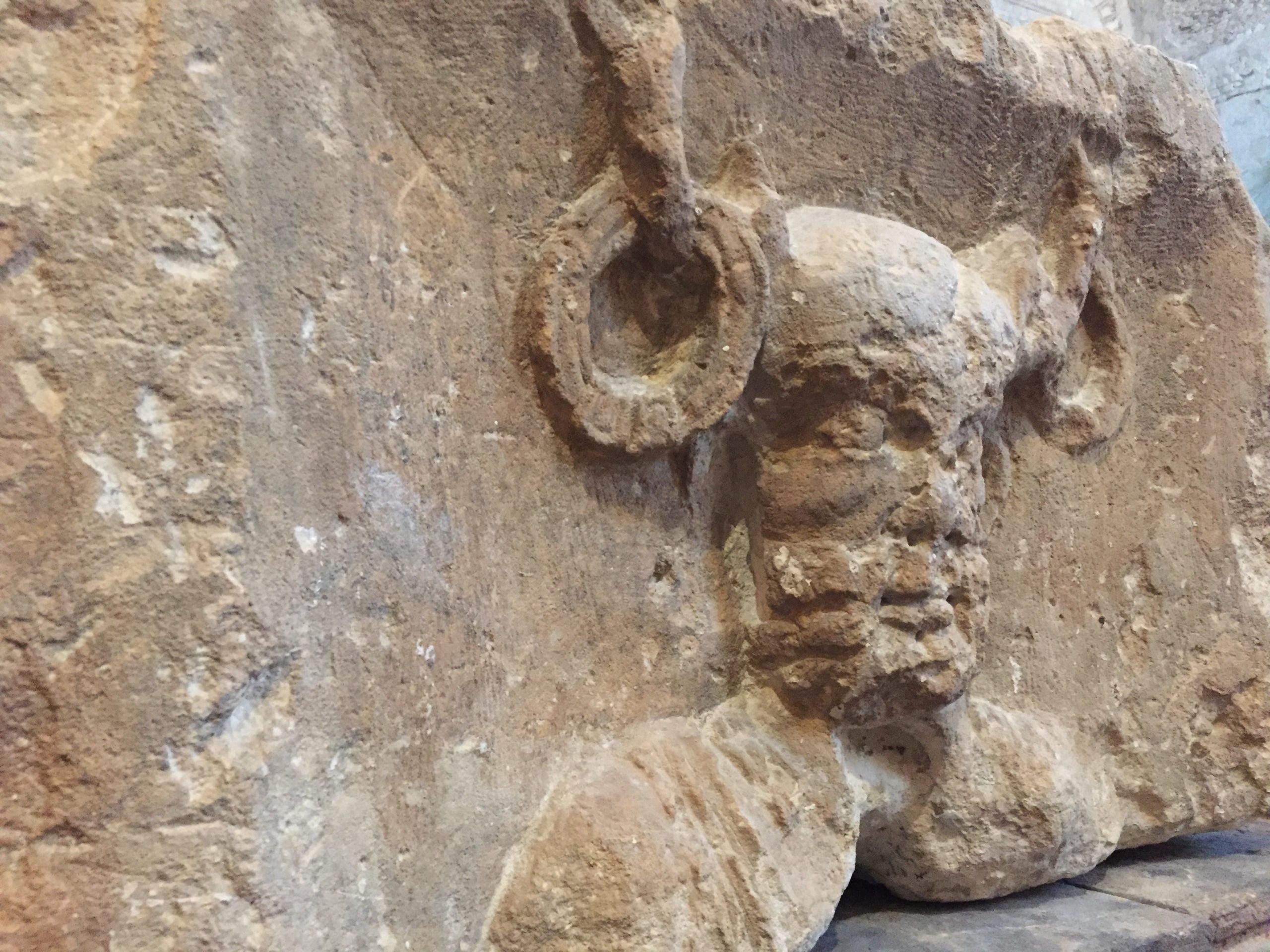
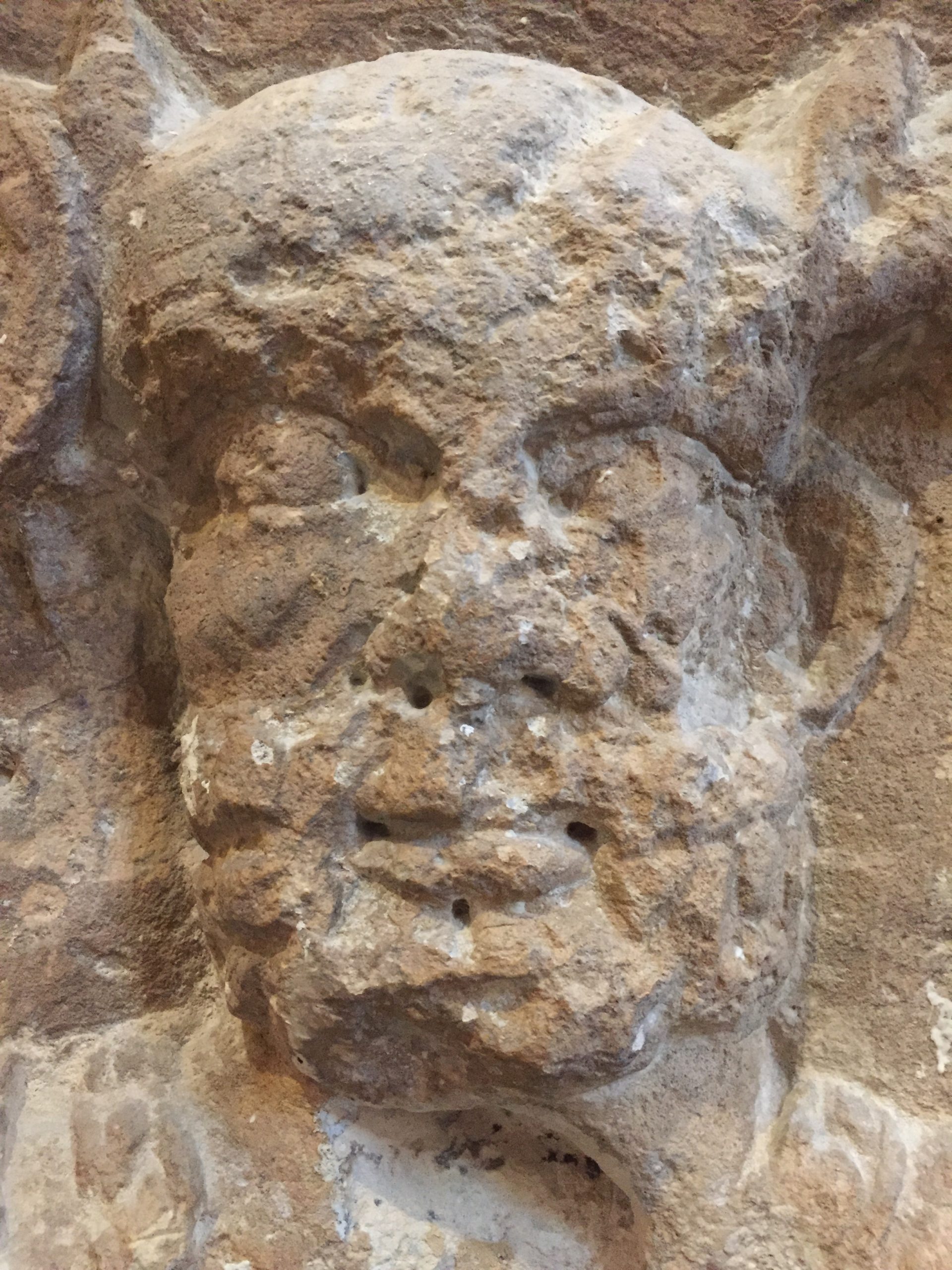
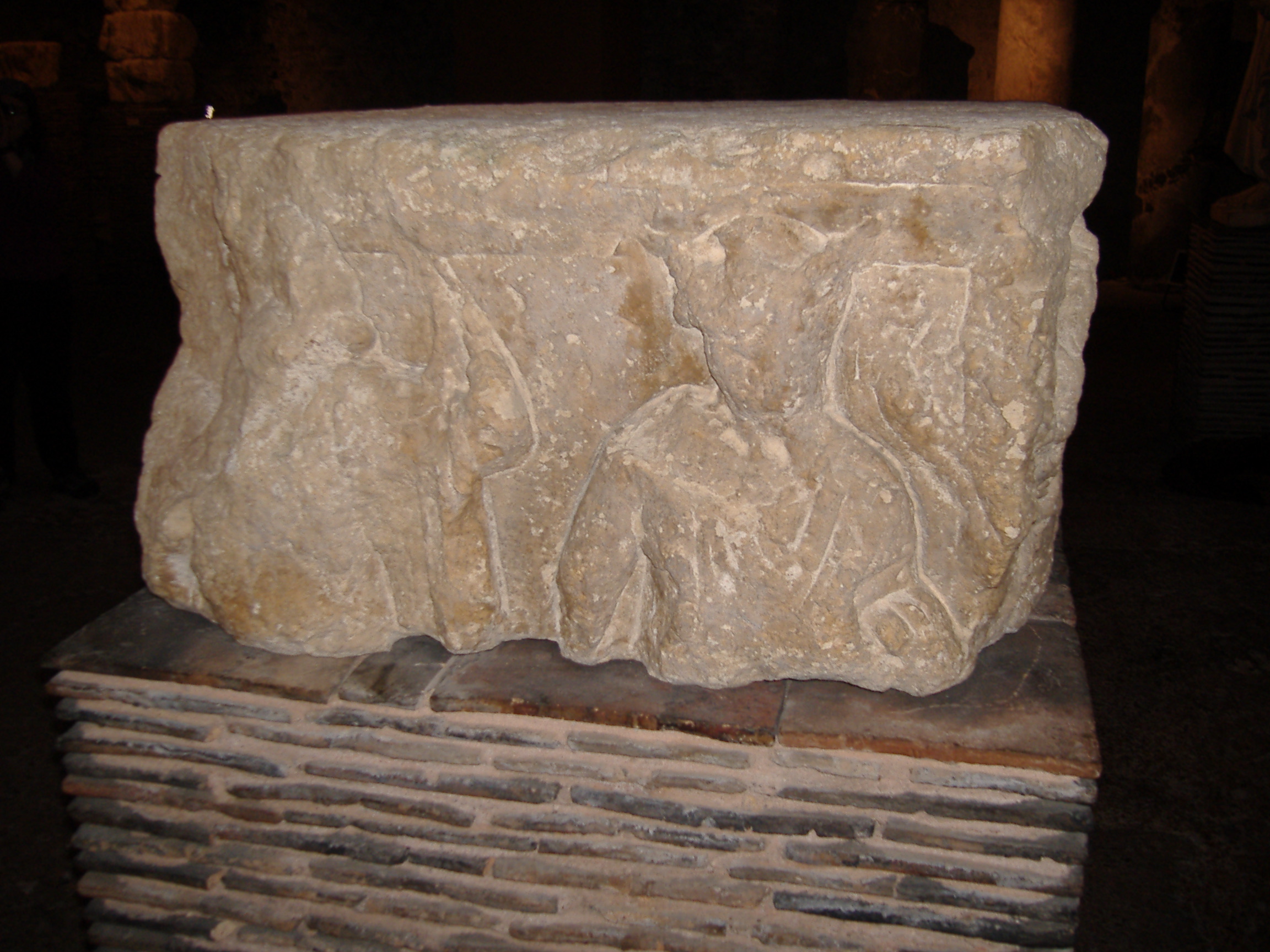
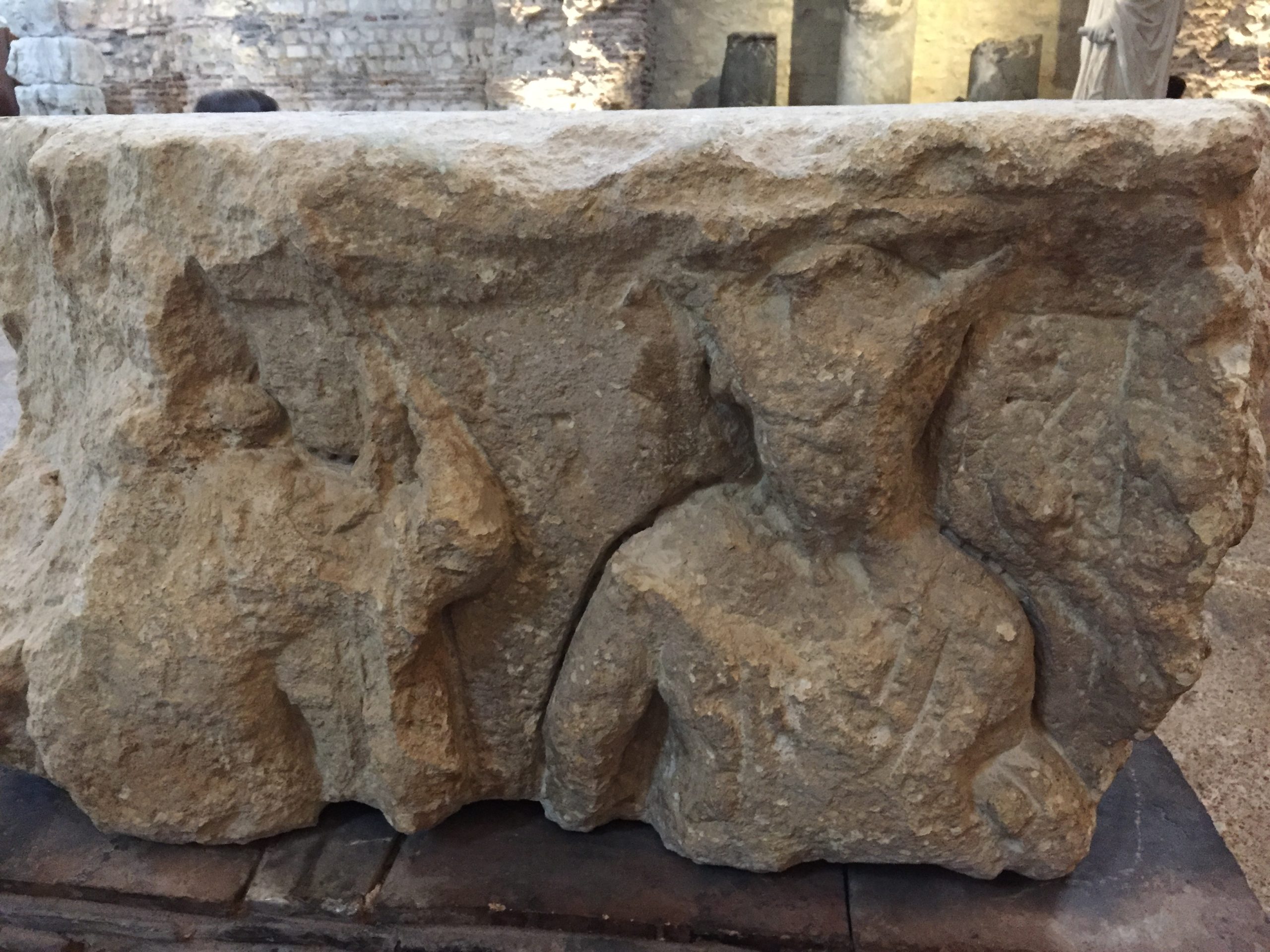
This block includes an image of a figure from the shoulders up, a bearded man with antlers and torcs that hang from the tines, with another around his neck. As the lower half of the block is missing, we cannot tell if there is additional iconography (or if he is seated cross-legged, as he appears on the Gundestrup cauldron), but it is worth noting that he is depicted as larger than the other figures on this block, who are all seen to include portions of their torsos that go down under their arms and occasionally to their waists. As a result, it is possible that Cernunnos was likely not standing, as the other deities seem to be.
This is also our primary text that links the name “Cernunnos” to the image of this antlered god; there are other inscriptions with the name “Cernunnos” out there: there are two (identical) ones from Luxembourg, one from Montagnac, and one from Polenza in Italy (see Mary Jones’ Celtic Encyclopedia for references to these). This one is incredibly clear, however, matching up all the elements we associate with Cernunnos with the name, inscribed here as “ERNVNNO” across the damaged top of the block.
The Smertrios Face
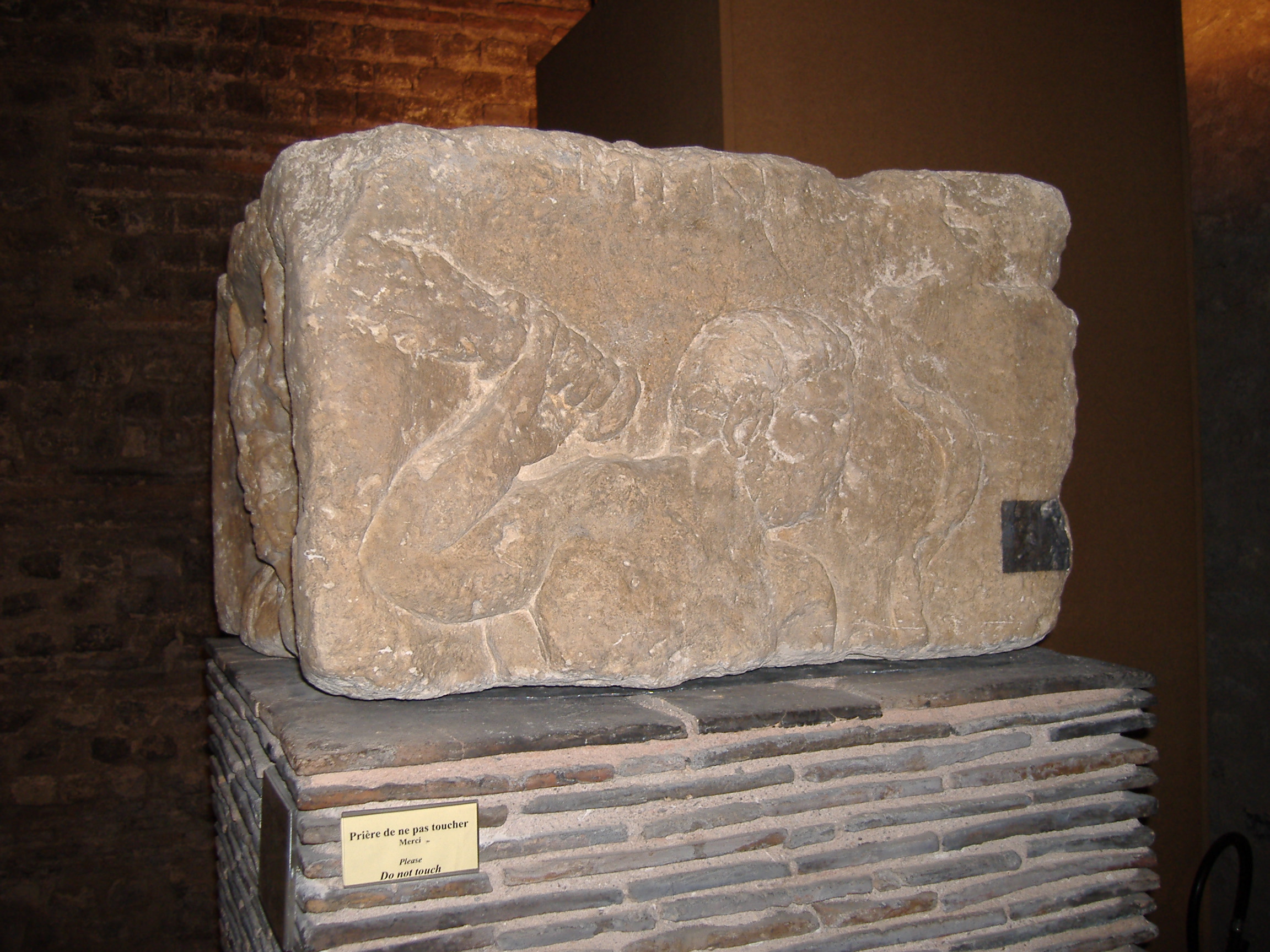
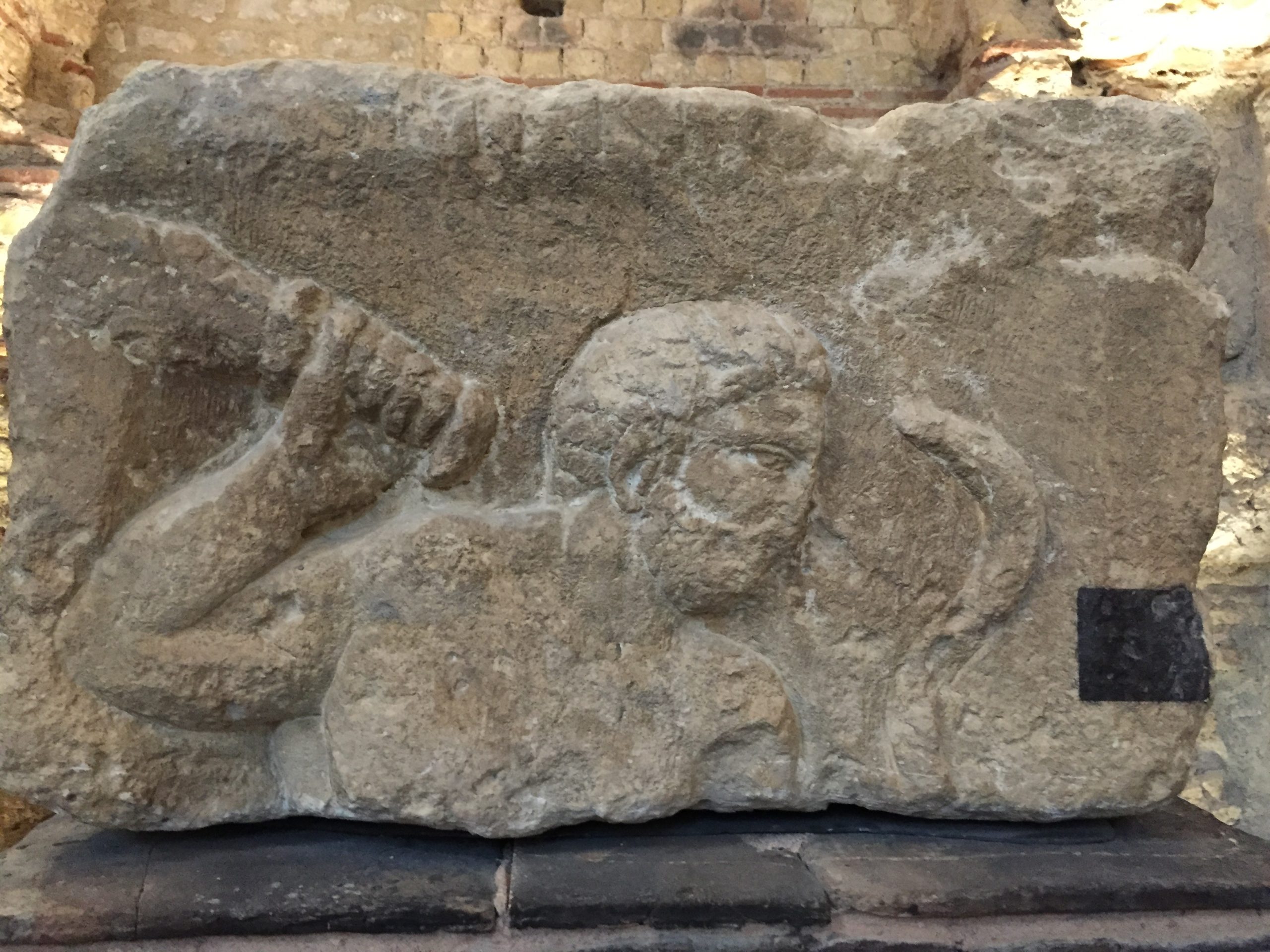
Traveling to the right around the block, next to Cernunnos, is the figure of a bearded man in profile, wielding a club or torch in his right hand. In his left hand, some commentators see a bow, or a snake he is about to strike. The letters “SMER” are all that remain at the top of the block for a name, and he is commonly identified as Smertrios, occasionally linked in the Interpretatio Romana as either Hercules, or Mars (there is a spring dedicated to Mars-Smertrius near Trier, a place that will come up again).
The image seems to be an odd shape for a bow (recurve bows were known, and appear in contemporary art), but if it is a serpent, it appears to have no head to strike. It’s worth noting that the skill of the artist (and thus what he intended this item to be) might be questioned a little, considering the hand holding the club or torch is depicted backwards. We are left to speculate to our best ability on this item.
There is supposition that Smertrios is kneeling here, to match with Cernunnos’ (presumed) cross-legged height, but without the rest of the block, we will not know if this is the case (nor will we be able to confidently identify the object in his left hand).
The Castor Face
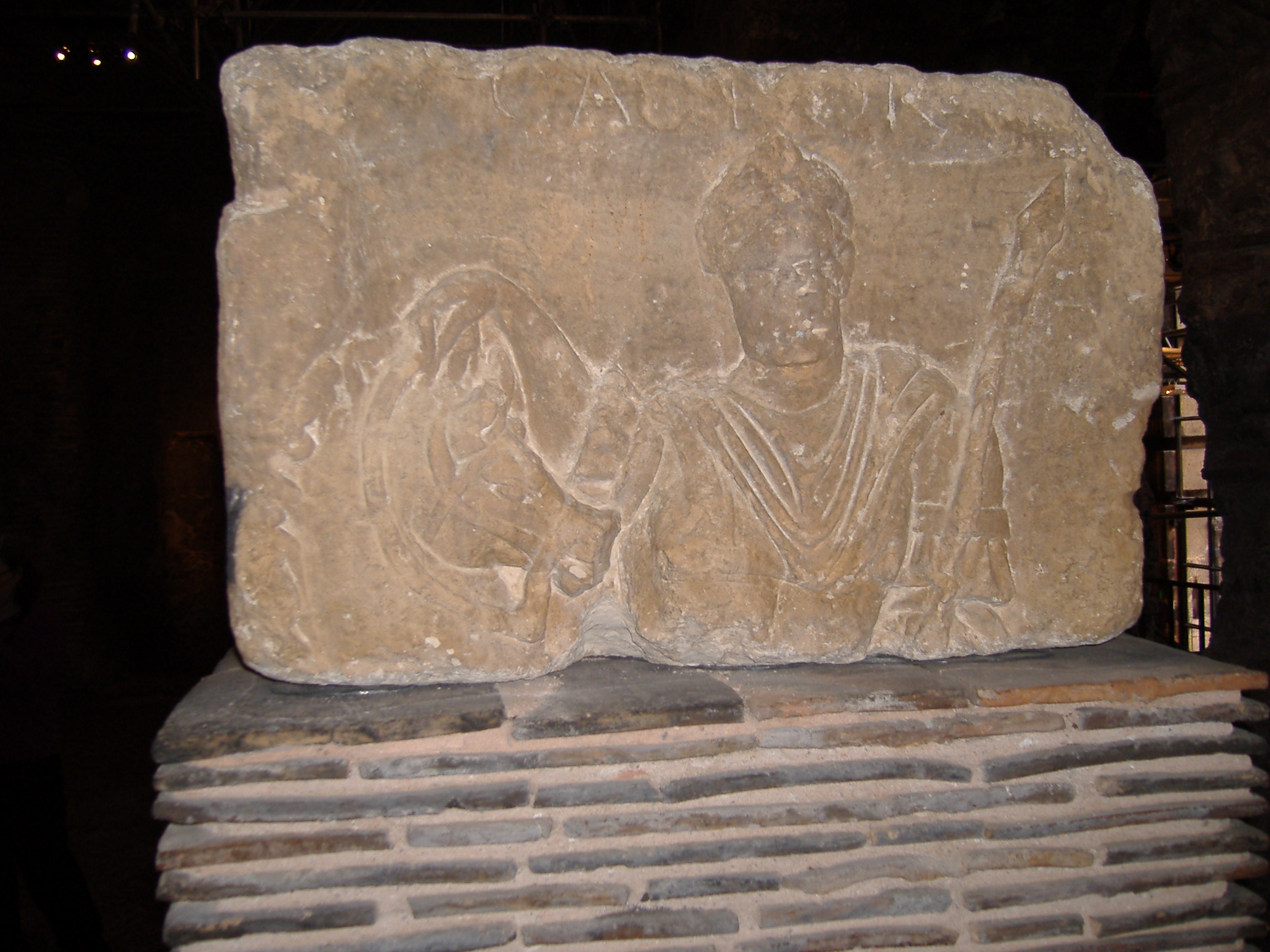
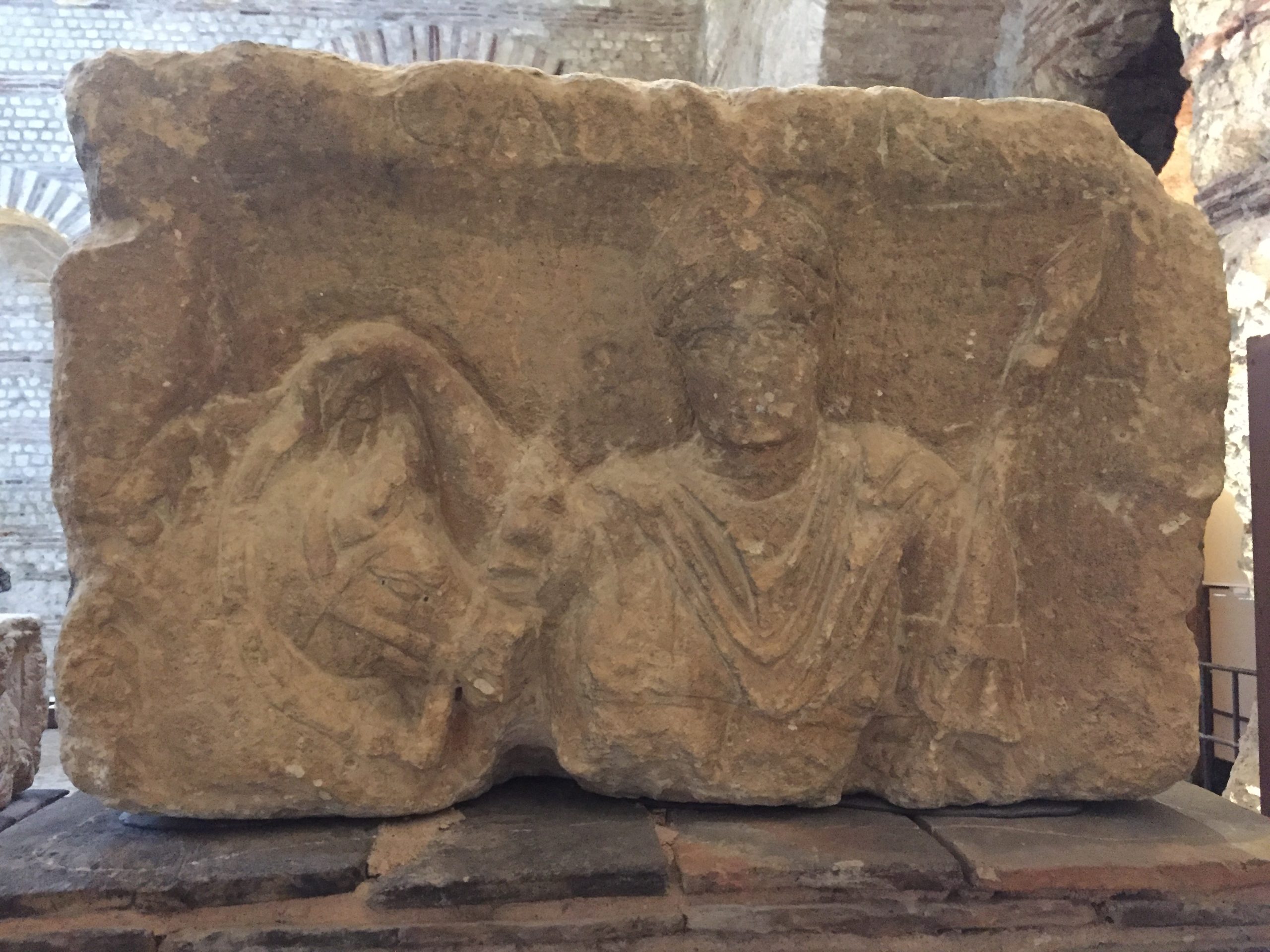
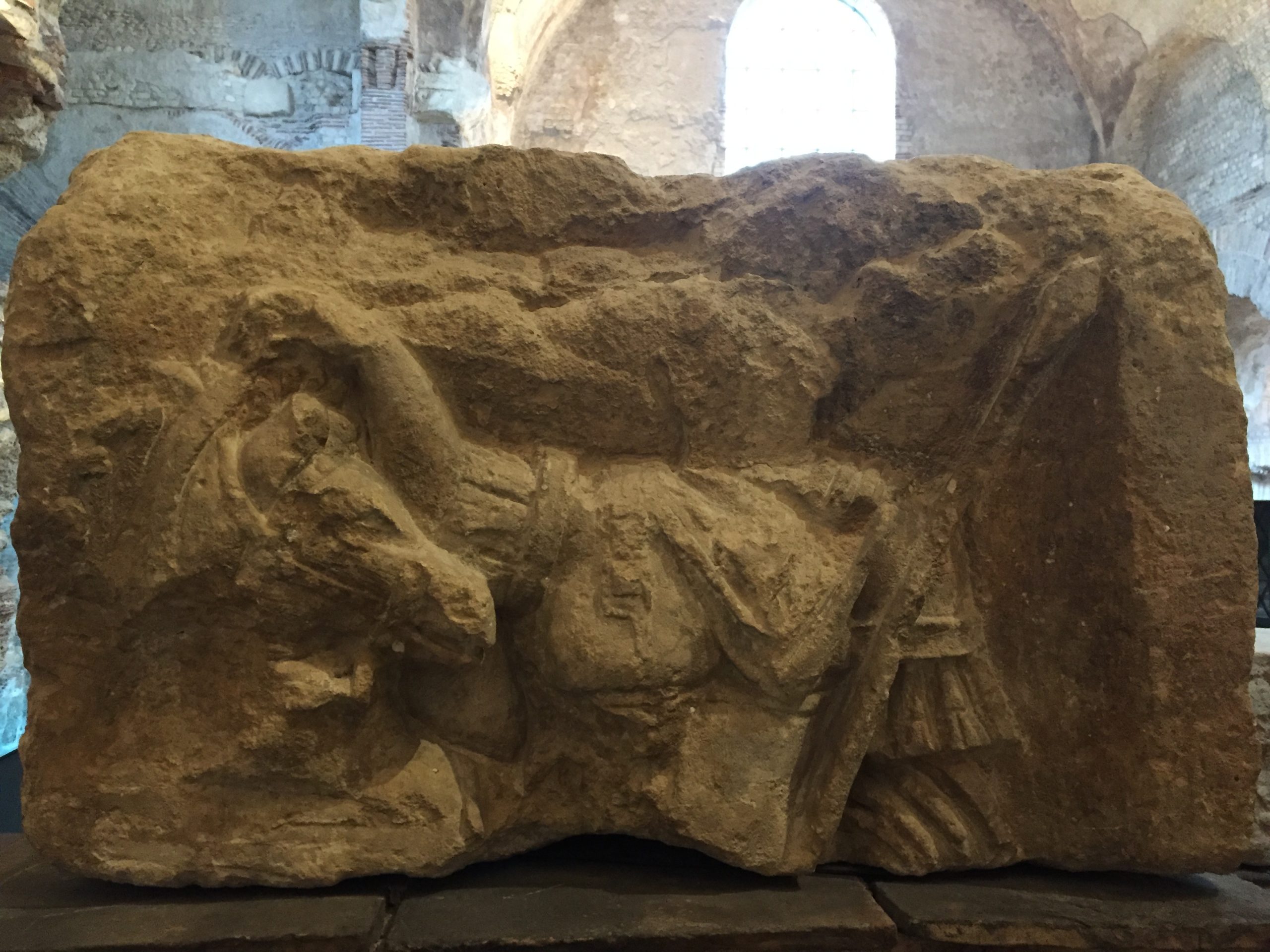
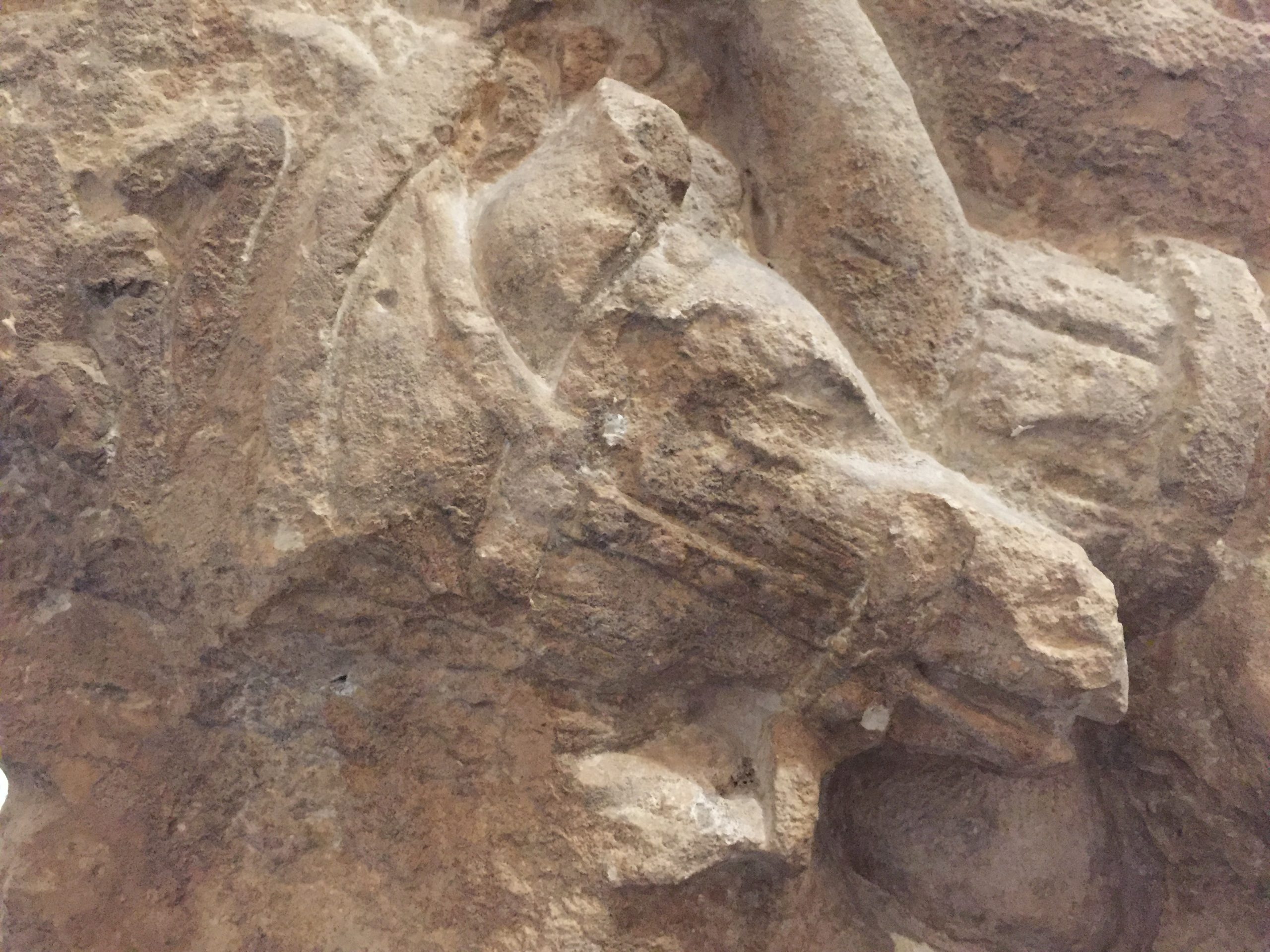
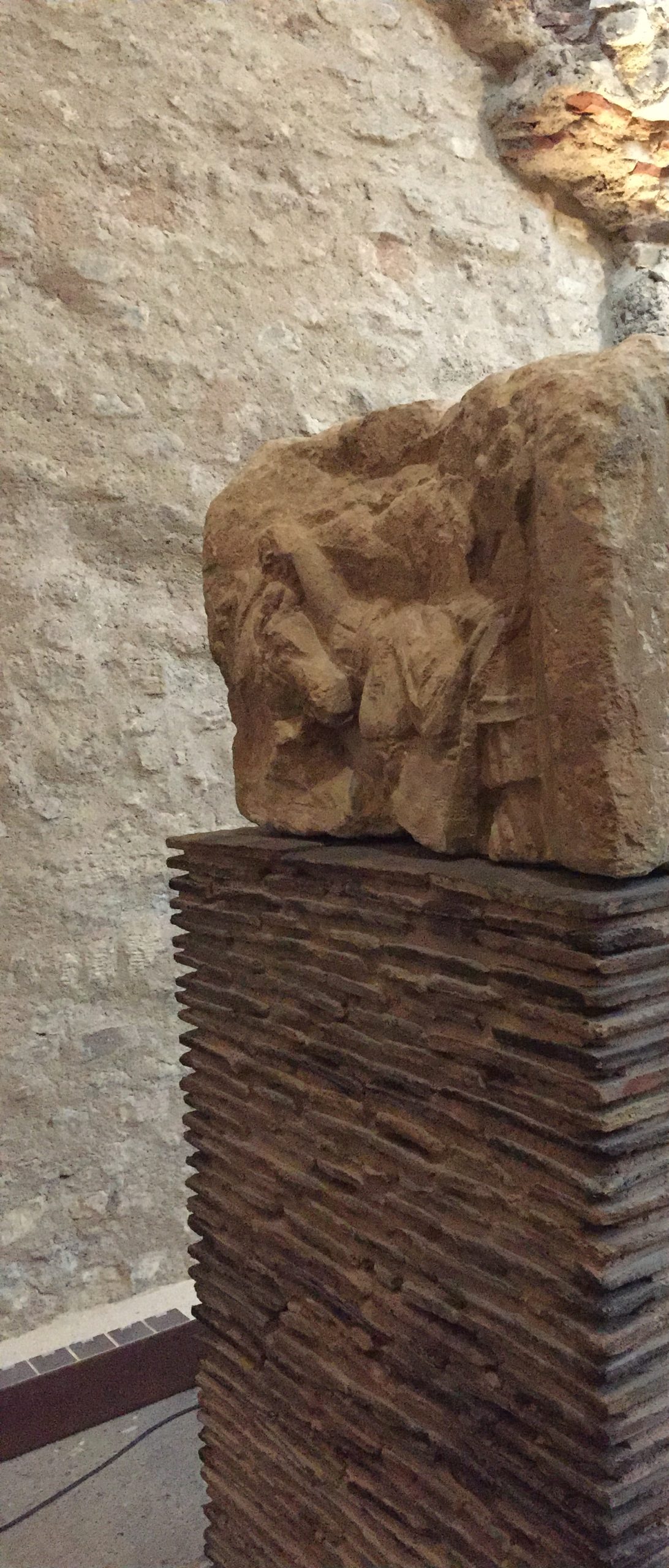
Continuing around to the right, we come to a male figure, wearing a breastplate, cloak, and a pointed cap. He carries a lance, and an inscription across the top labels him as CASTOR, one of the Polydeuces or Dioscuri.
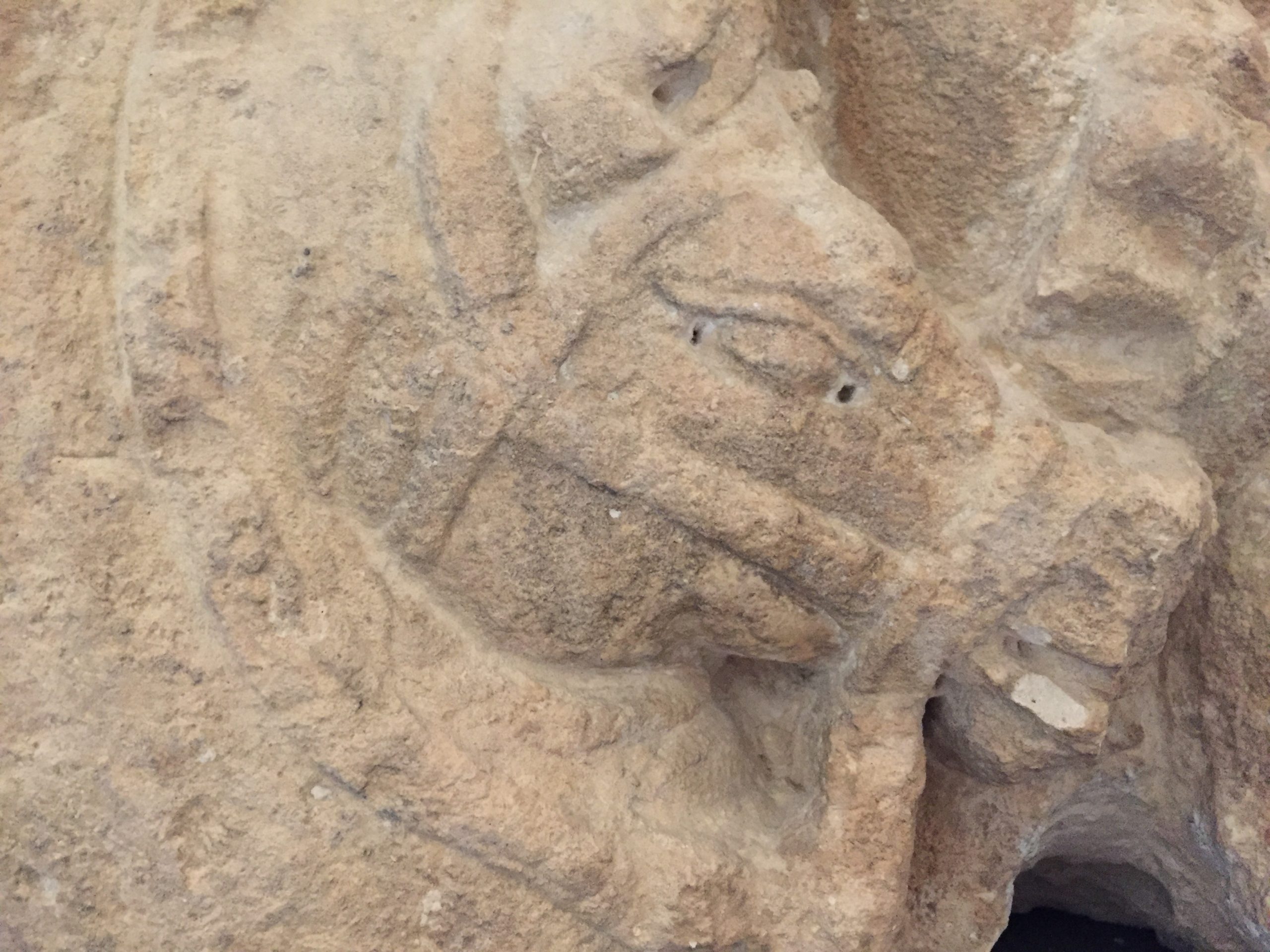
We cannot tell if he is astride his horse or beside it (horses are sometimes weirdly contorted in art in an effort to make the two-dimensional look three-dimensional, so it’s possible that he is on the horse).
The Pollux Face
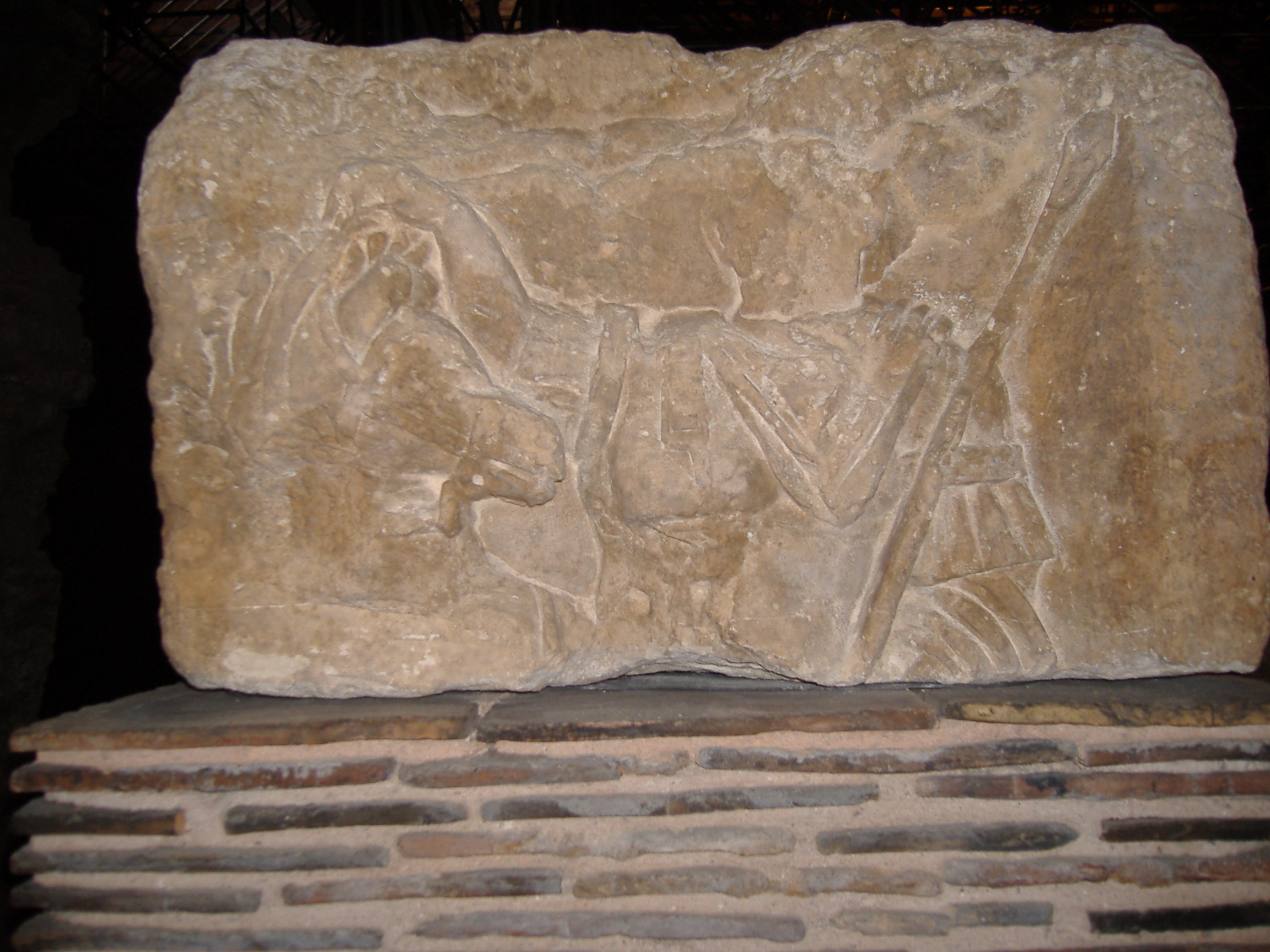
It is through a bit of luck that we can identify this face, as the Castor face is rather intact; this one is not. There is not any part of the name of this deity along the top, which is entirely gone. Still, we can tell that this is obviously a companion to the Castor piece, which makes identifying this as Pollux a somewhat elementary guess. Though the figure’s face is entirely destroyed, we can easily make out the horse, the armor, and the lance, which means that this is the second of the divine twins.
The Block of Jupiter
The Block of Jupiter, so named because it includes the Roman god Jove to whom this pillar is dedicated, is now complete, having been reattached to the bottom after it was hewn in half to be used as building materials, and includes a cornice that the other blocks do not have. My primary interest is in the Esus and Tarvos Trigaranus blocks, so I’ll start there. It also makes some sense to line up the Gaulish gods and the Roman gods, as they continue to be adjoined on this block.
The Esus Face
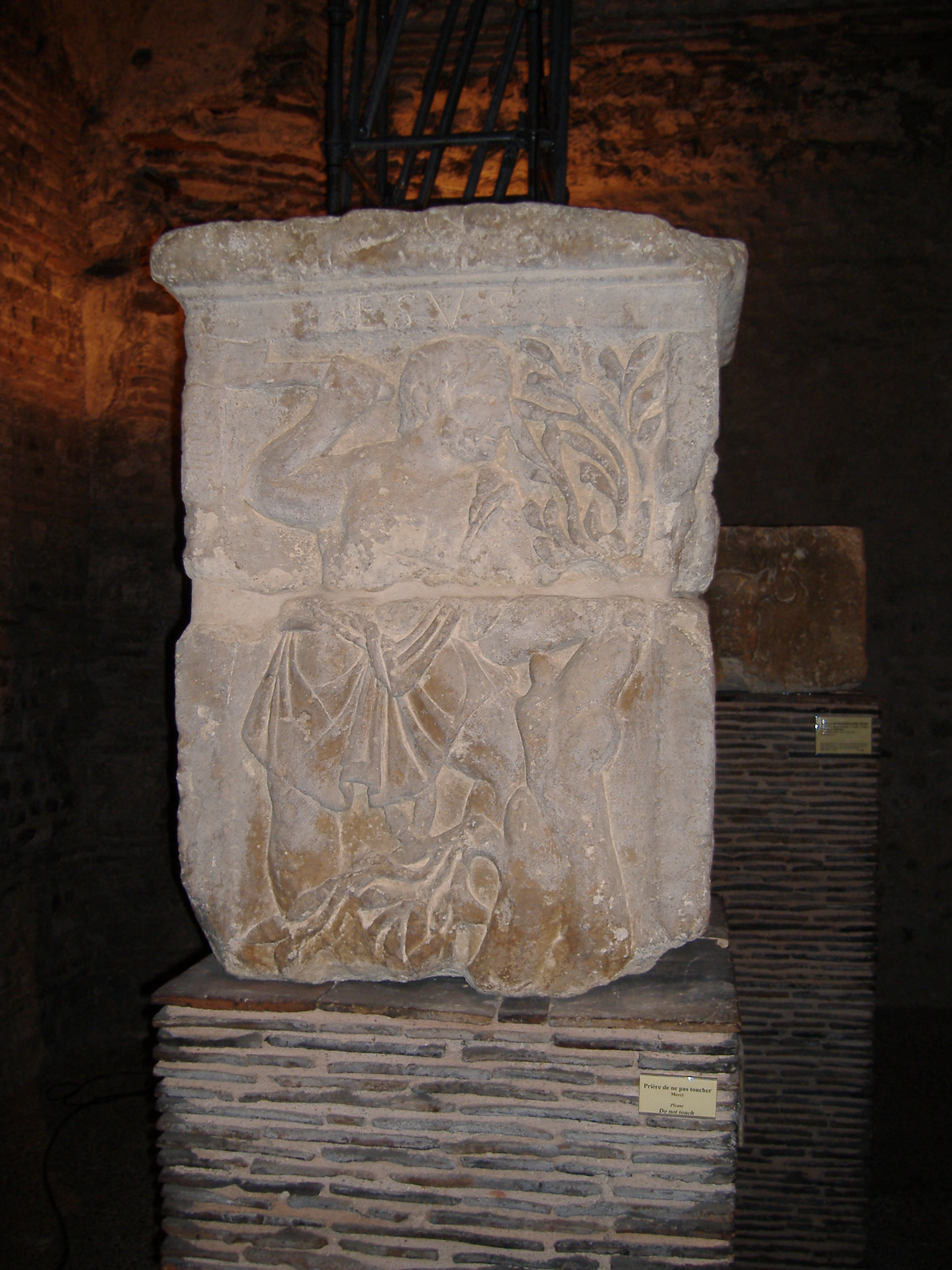
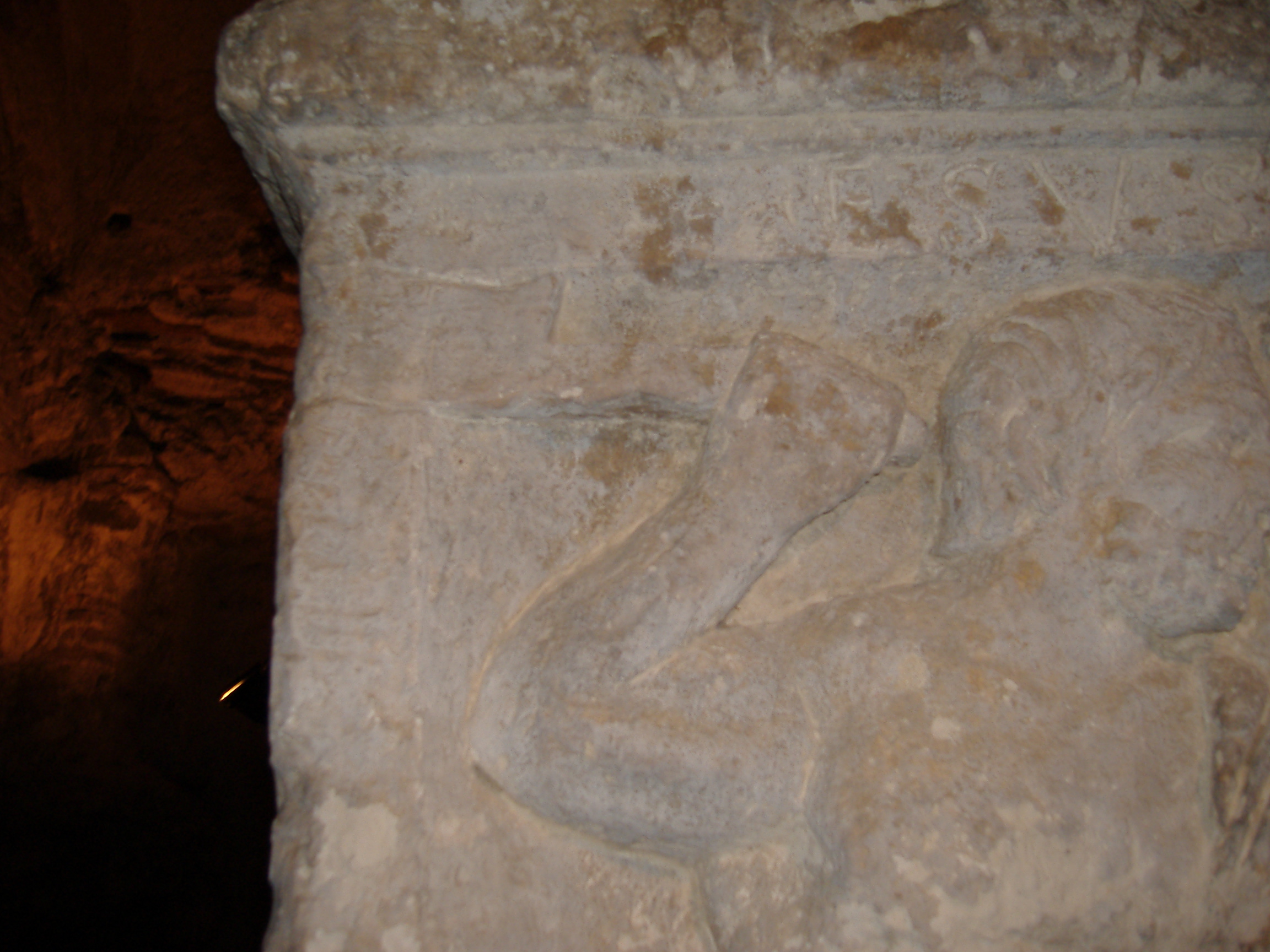
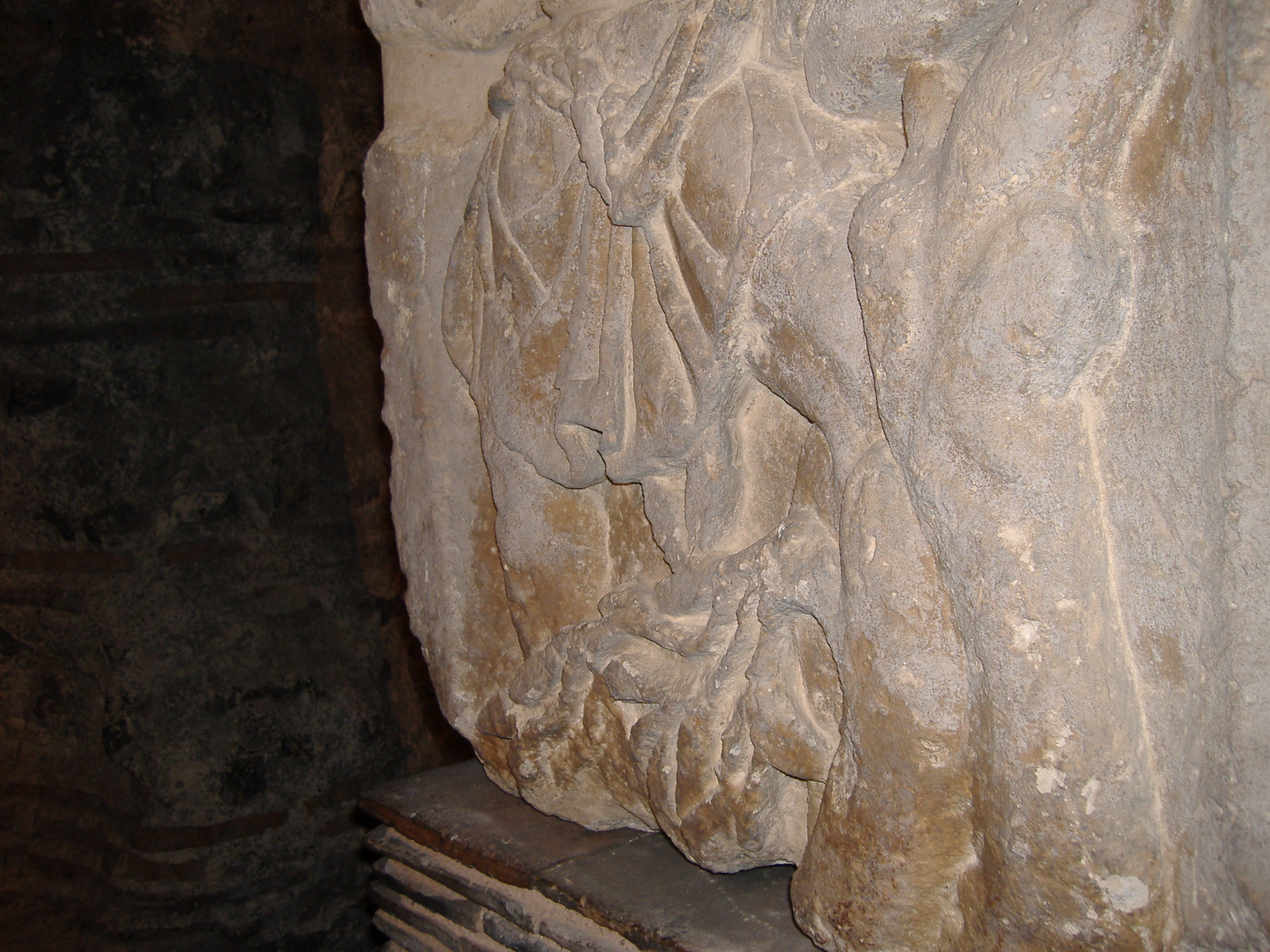
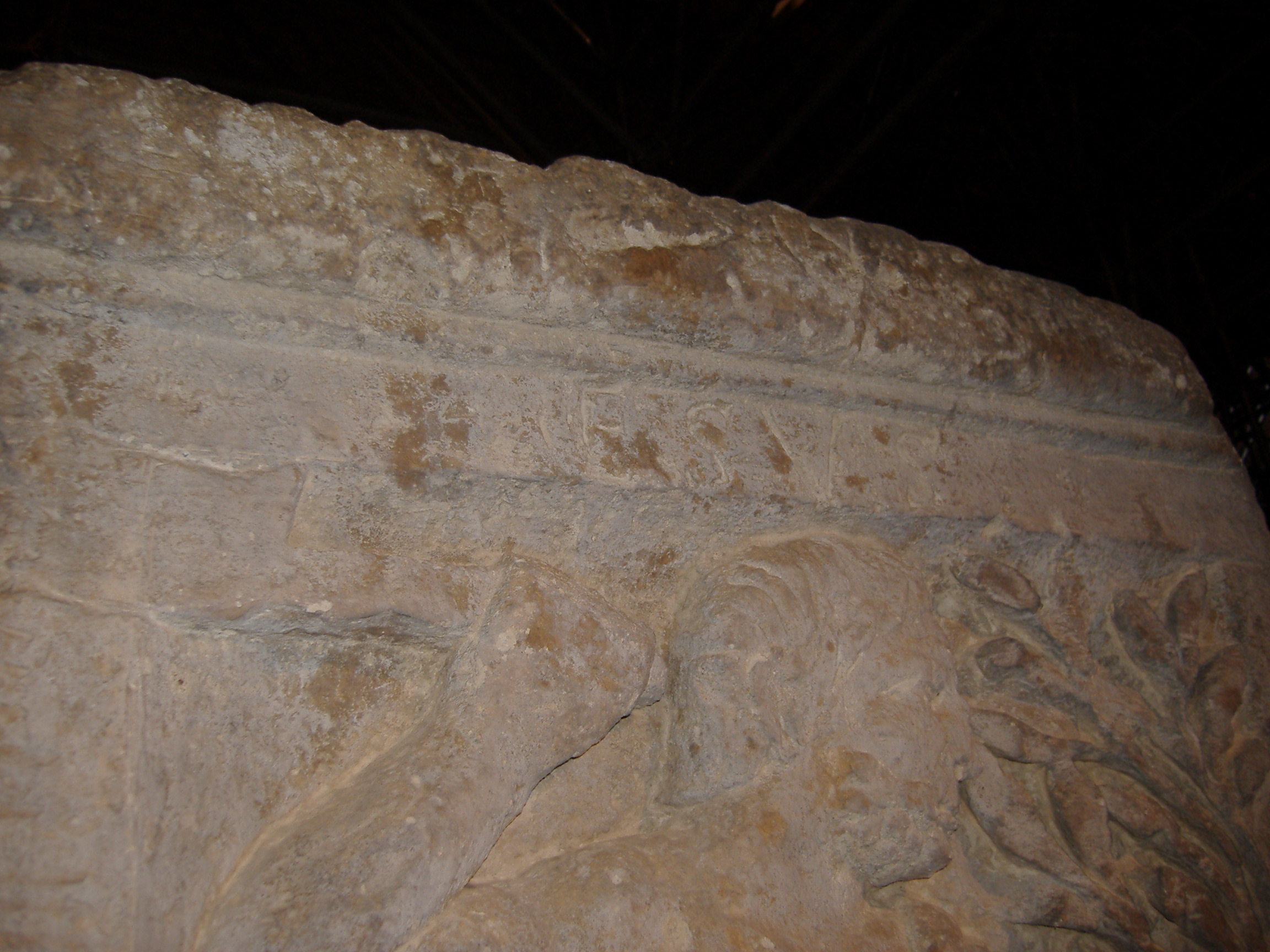
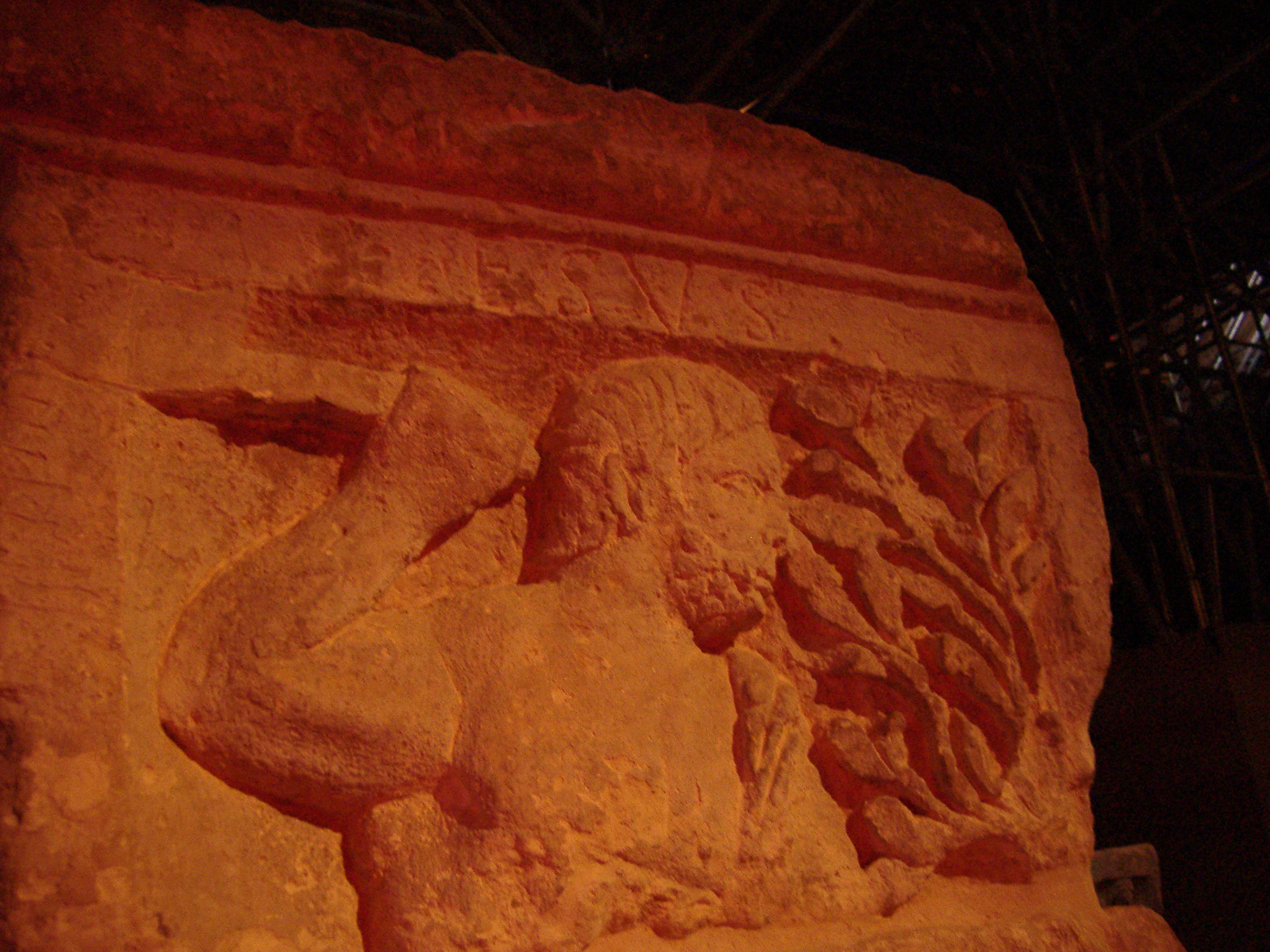
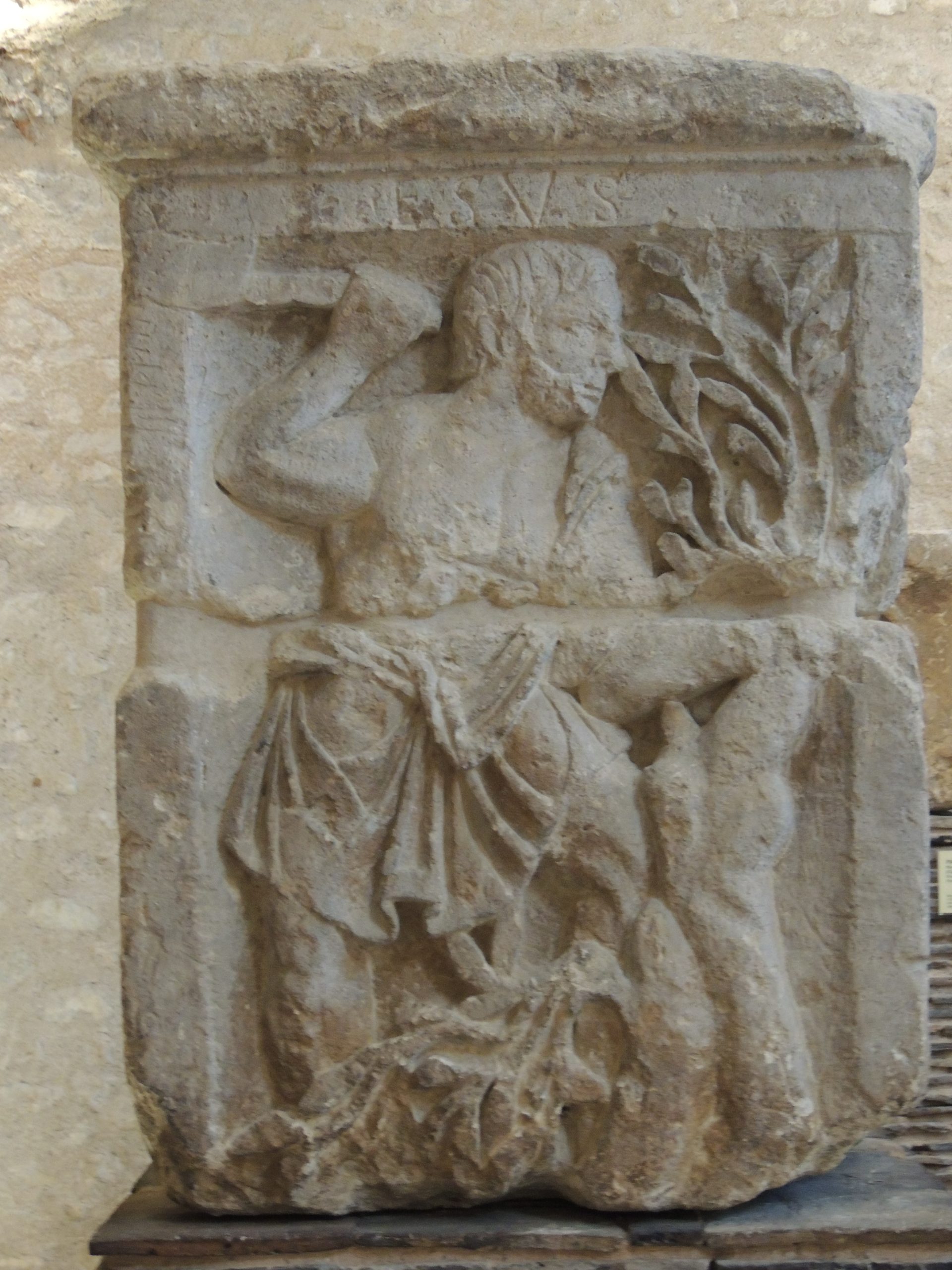
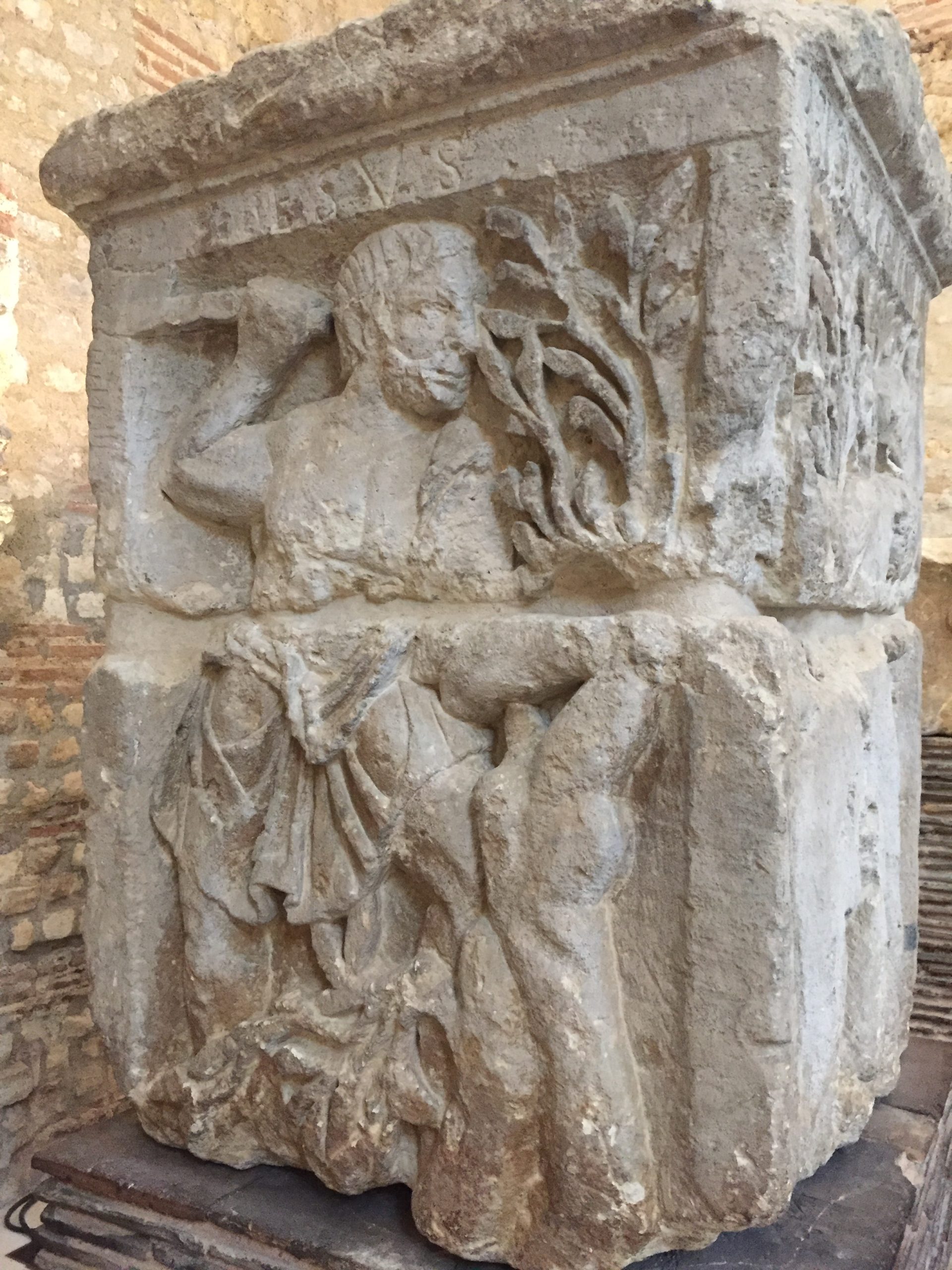
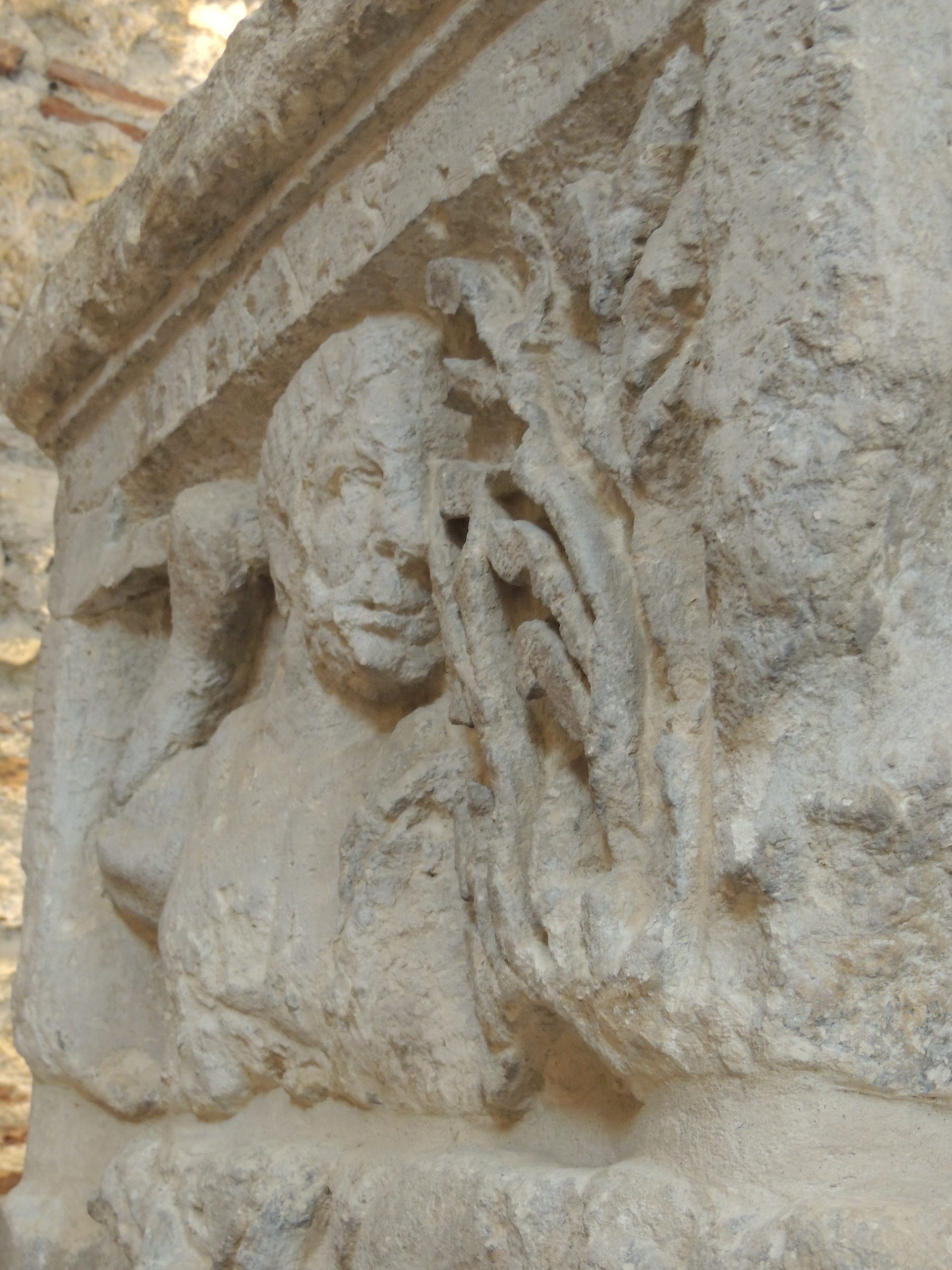
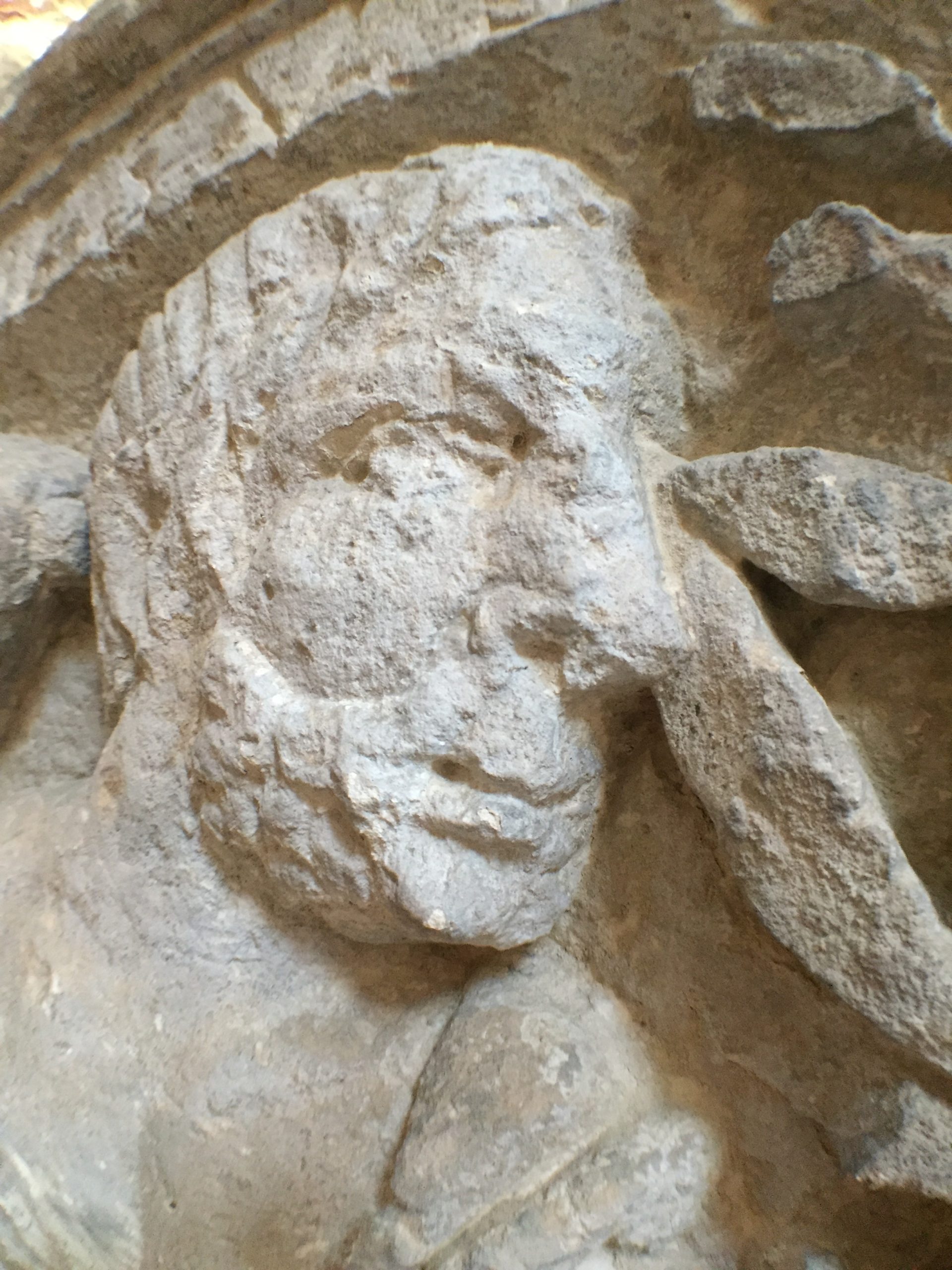
Turned out into the center of the Frigidarium is the Esus face, where Esus’ name is written across the top of the block (ESVS). On this block, a bearded man works bare-chested, holding an ax or a billhook in his right hand, and grasping a willow tree that has been sheared of some branches in his left hand.
The tool is speculated on quite a bit: if it is an axe, it would appear he is working to fell the tree. If it is a billhook, it is possible he is harvesting the tree’s branches, either to maintain it or to cut poles from it. The sailors who dedicated this stone likely would have used willow to make the shallow boats needed to navigate the river; the Seine, completely navigable through locks and deeper-drafted ships today from Paris to the Sea, was much shallower at this time.
The Tarvos Trigaranus Face
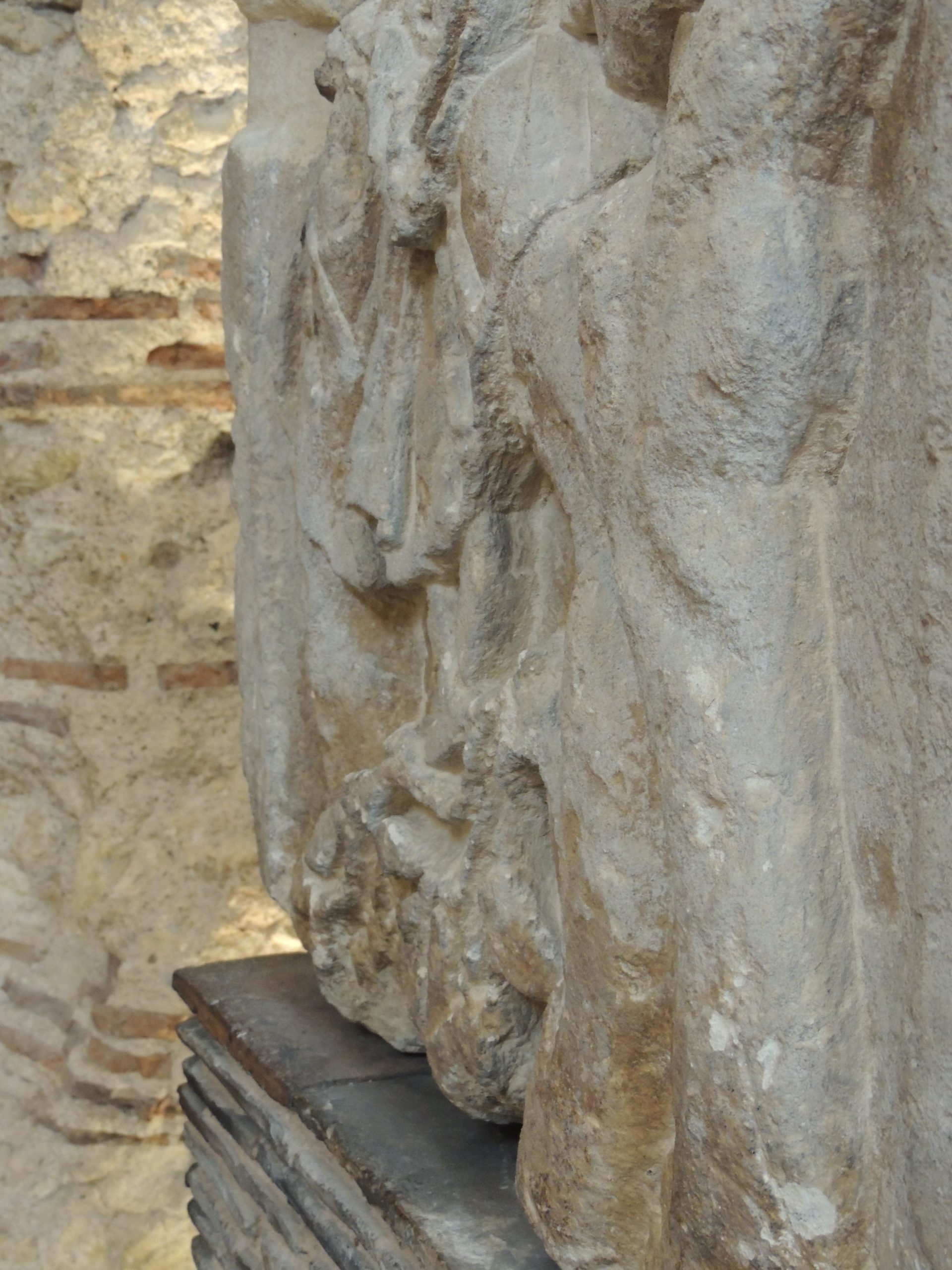
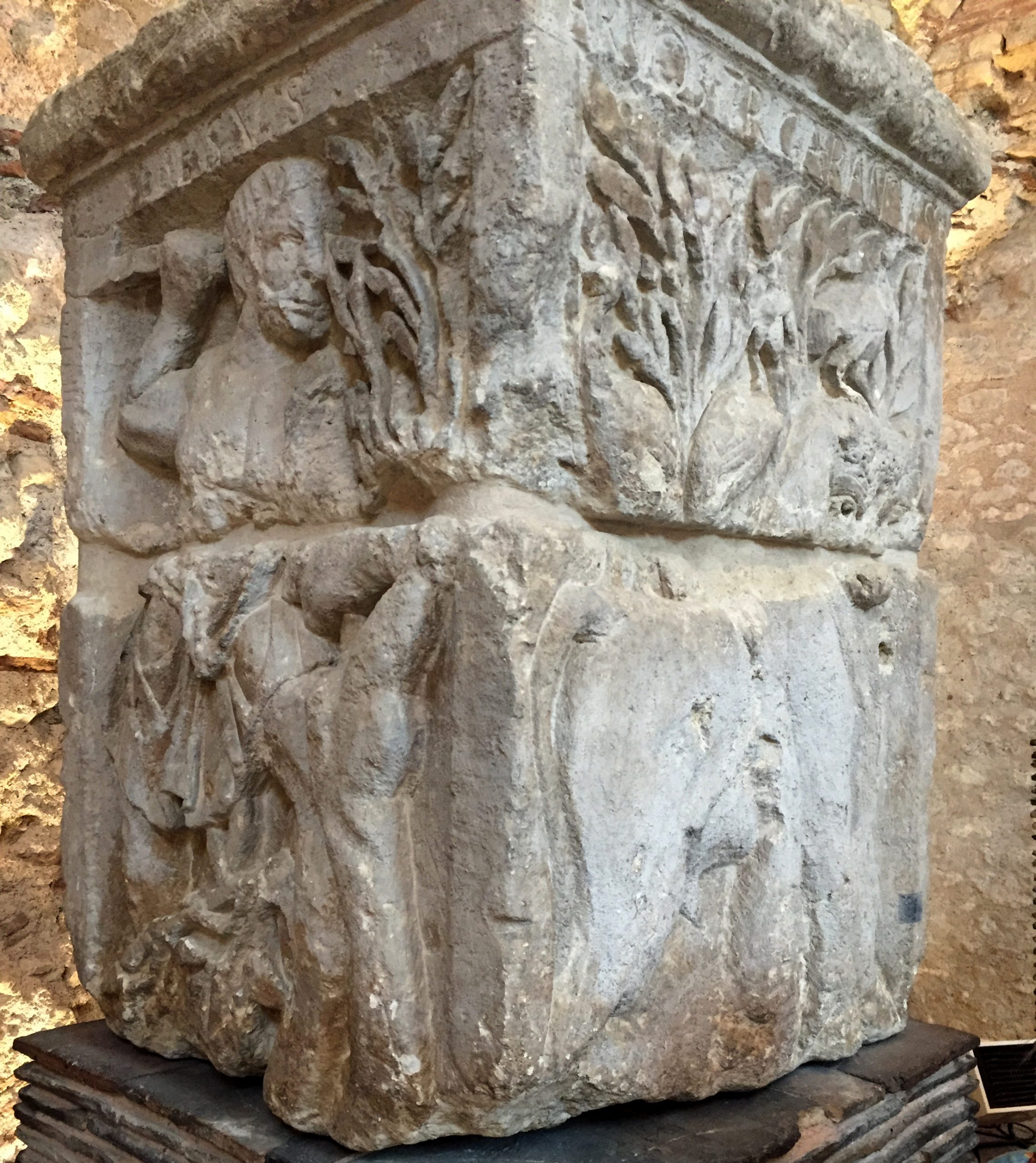
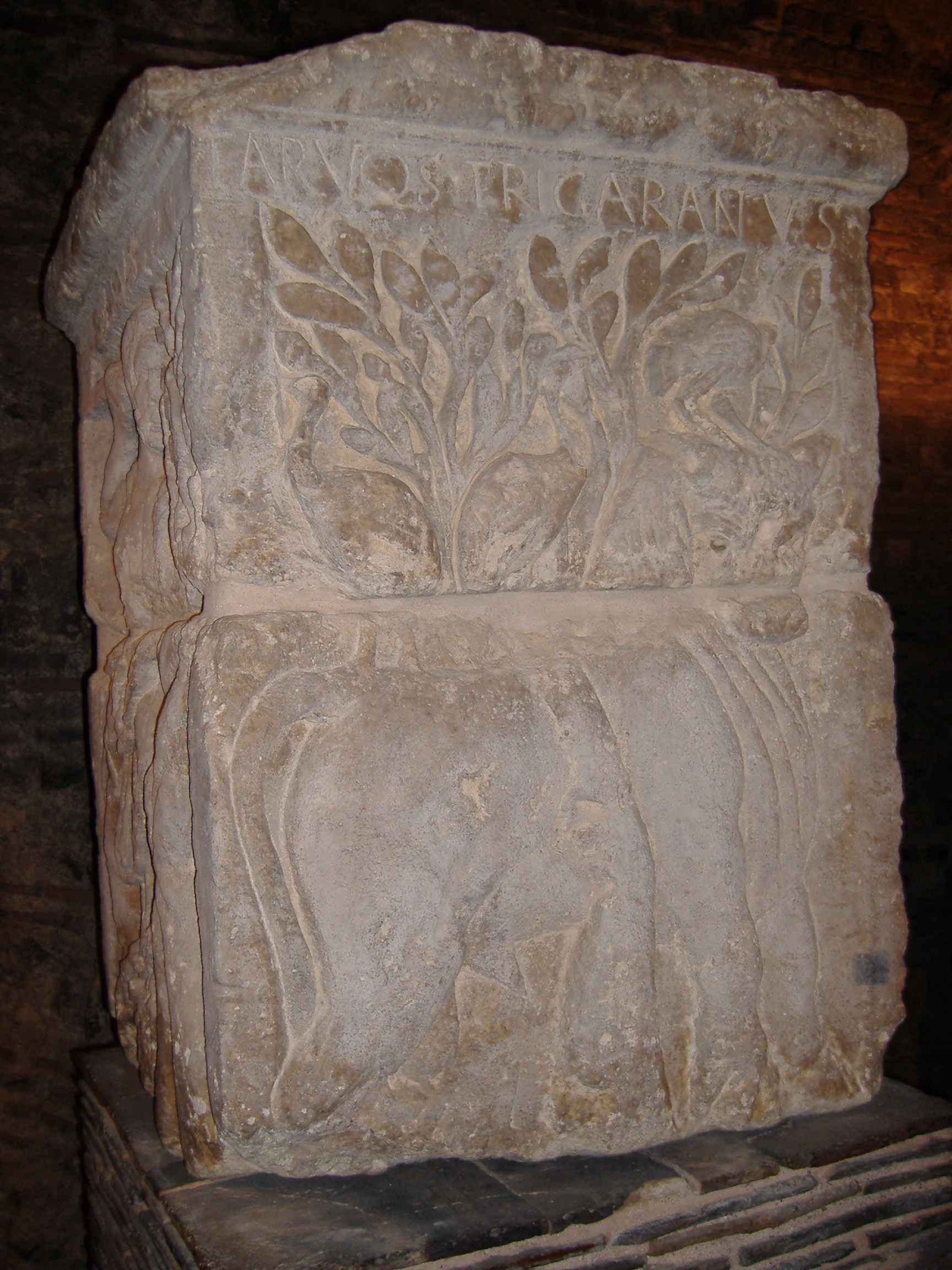
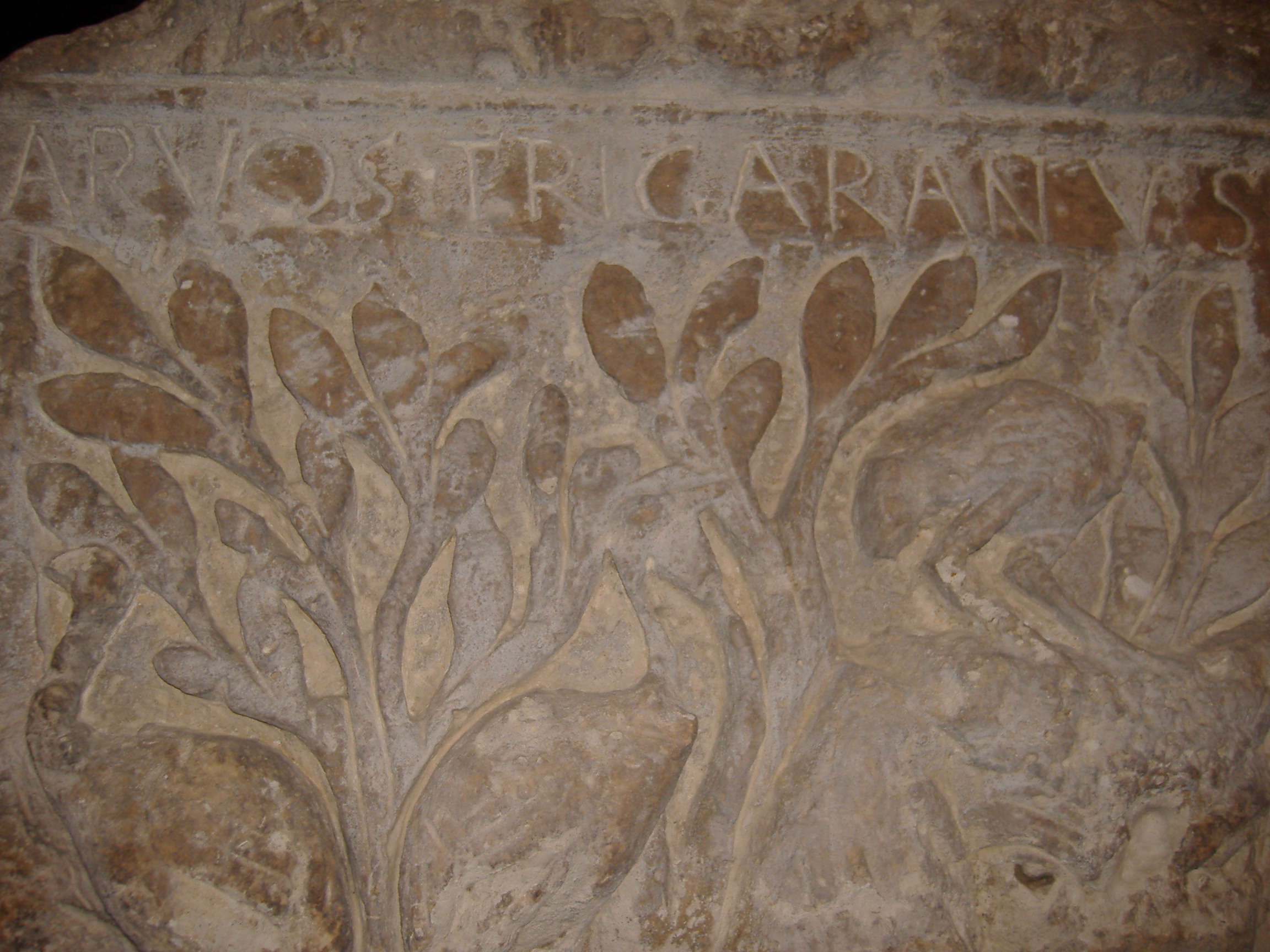
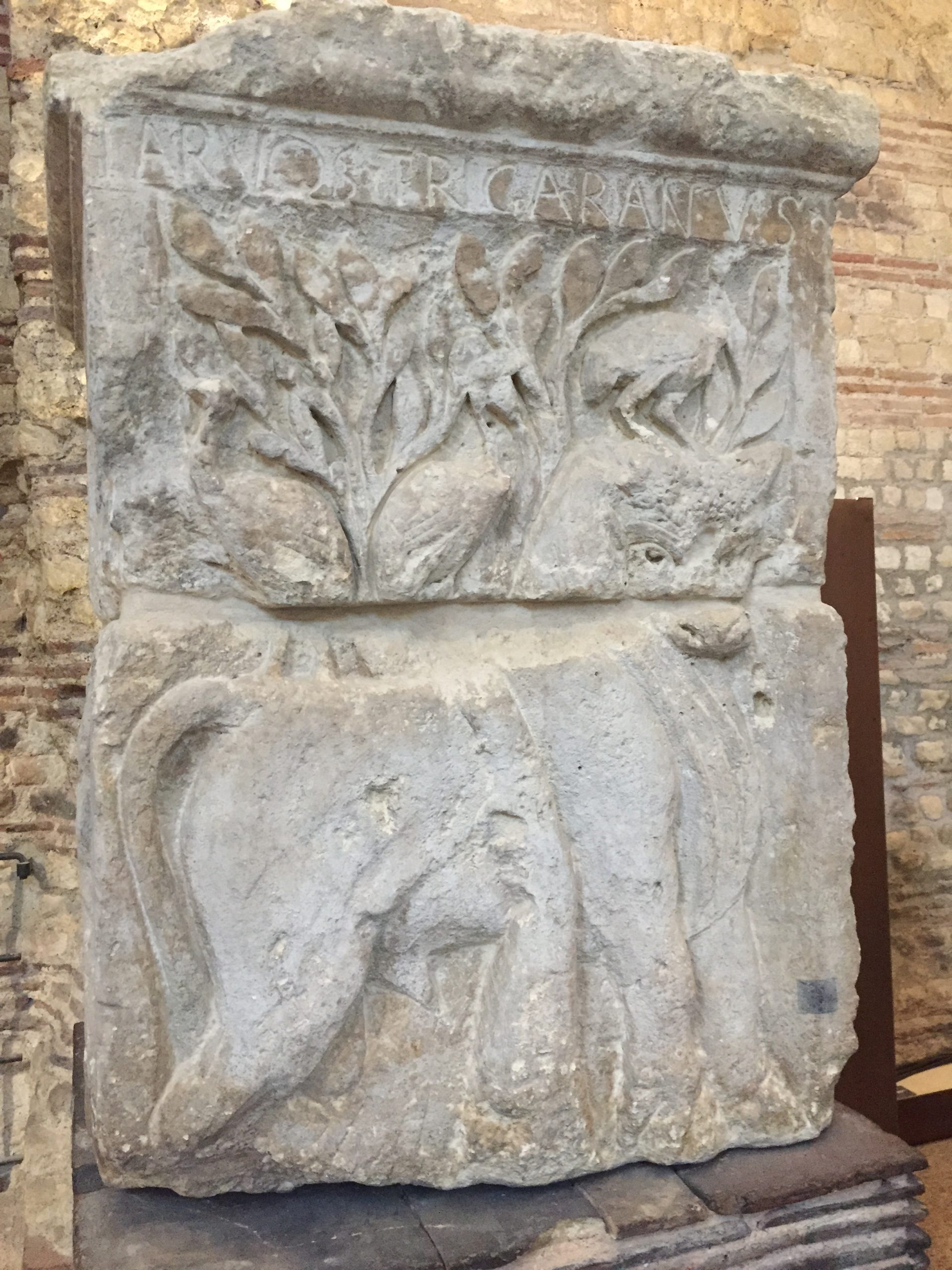
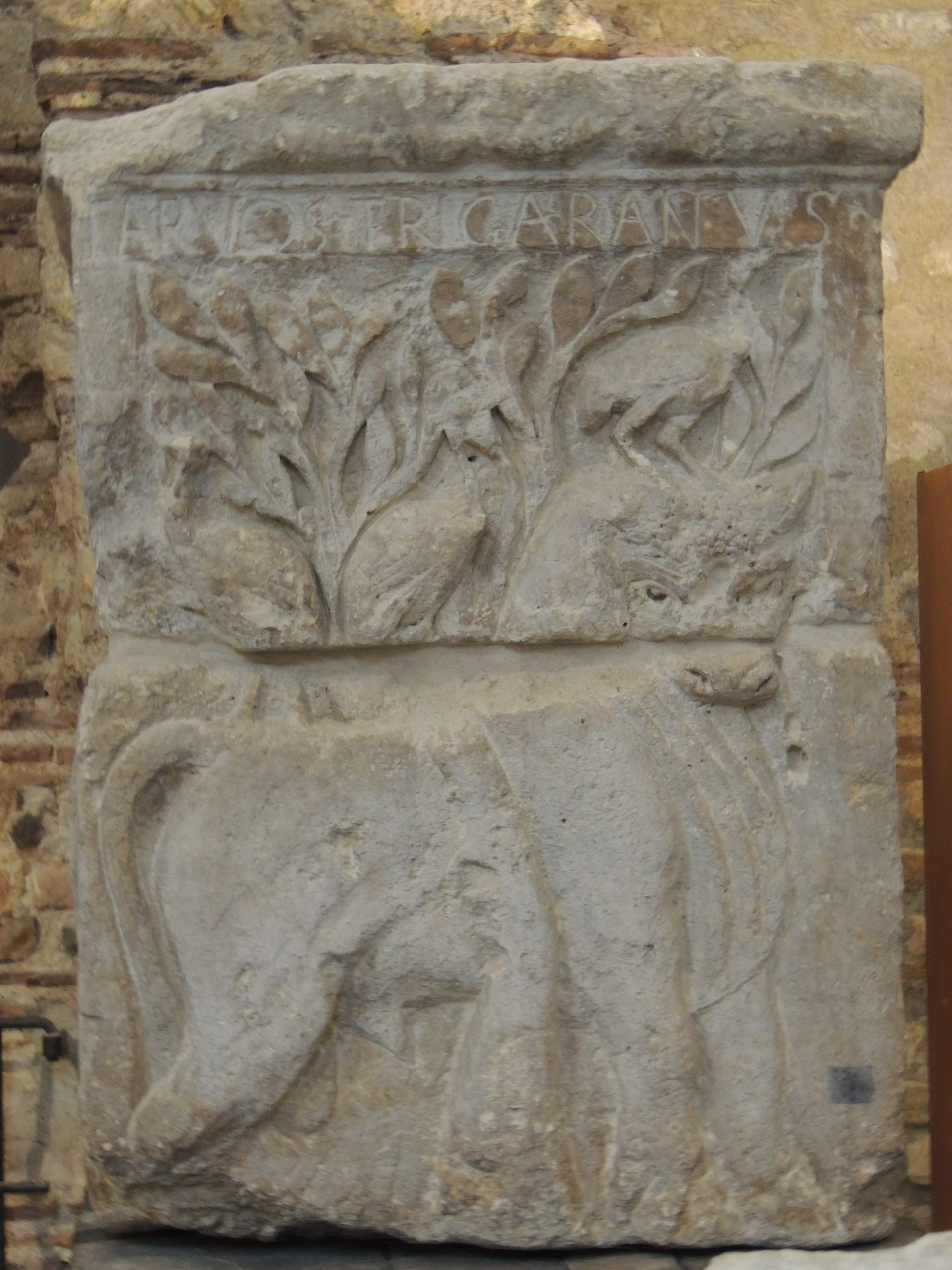
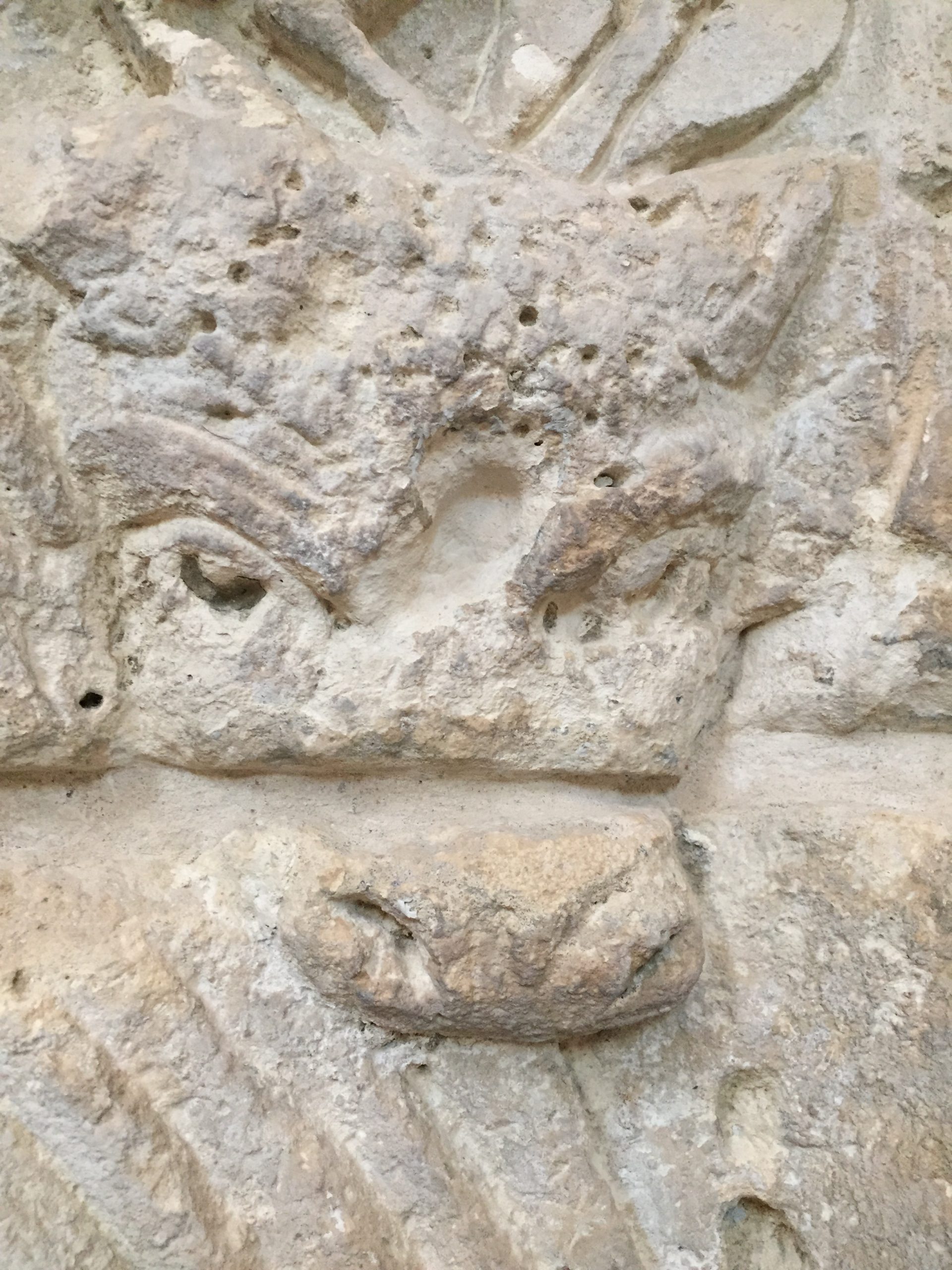
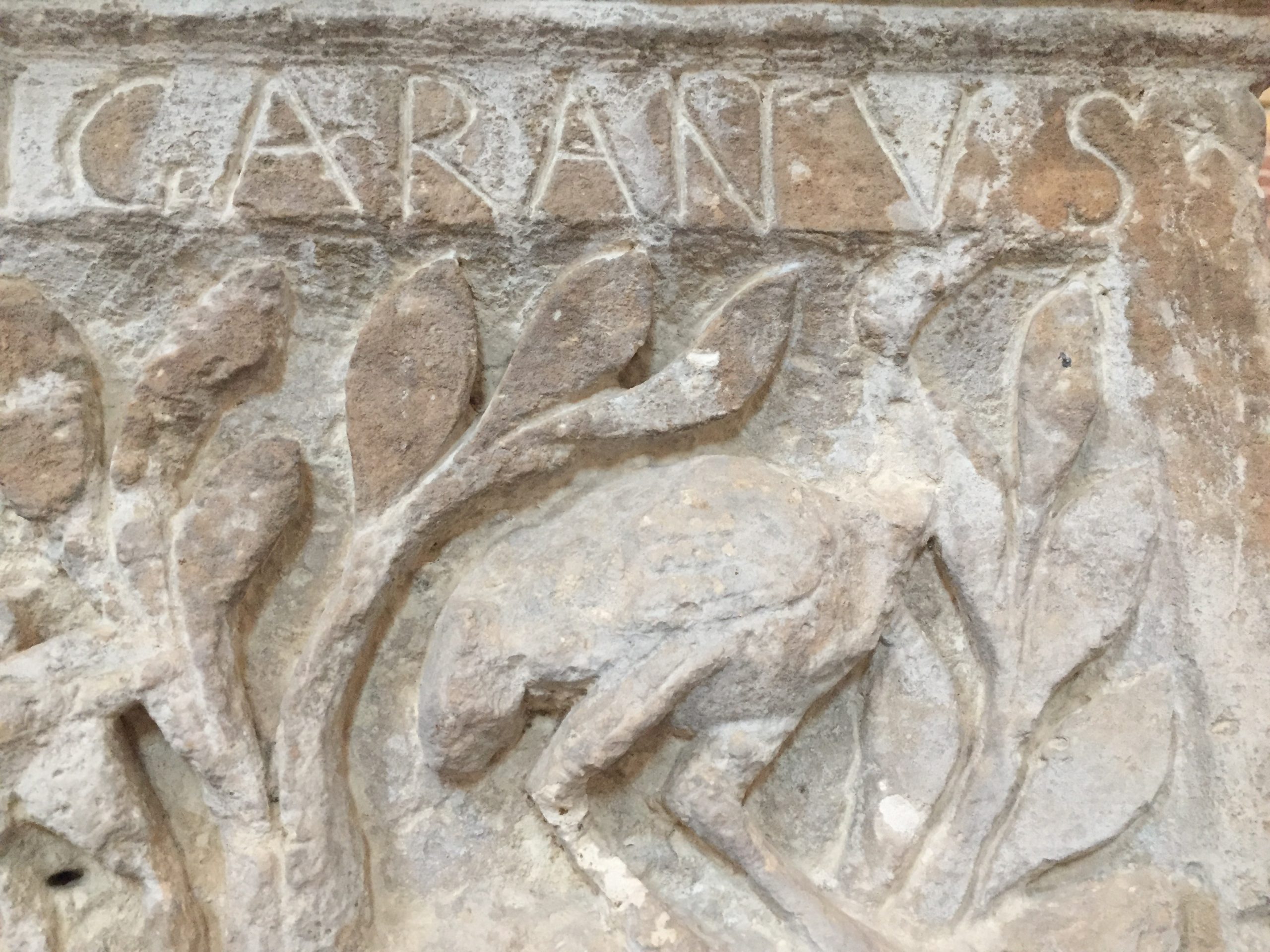
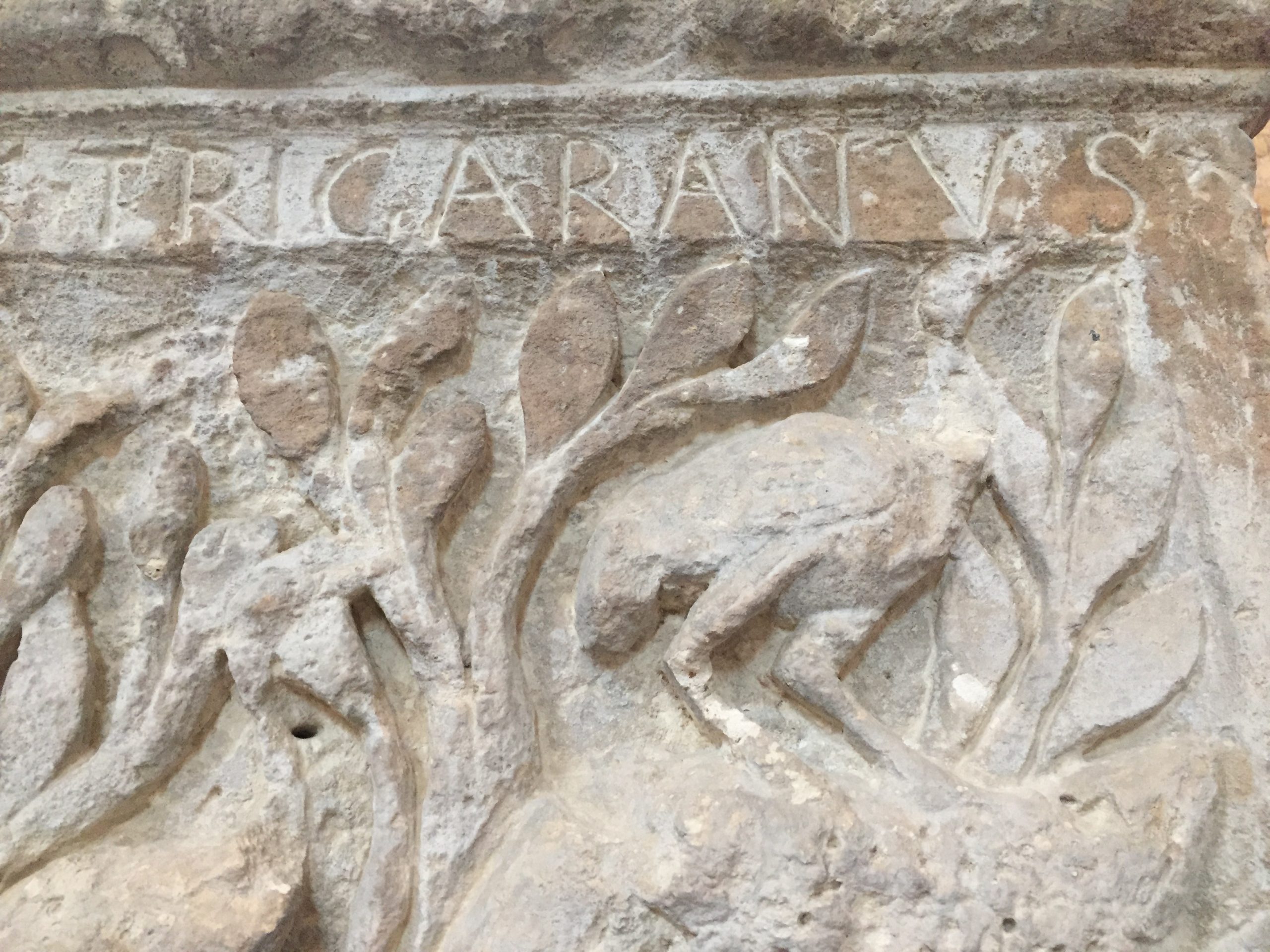
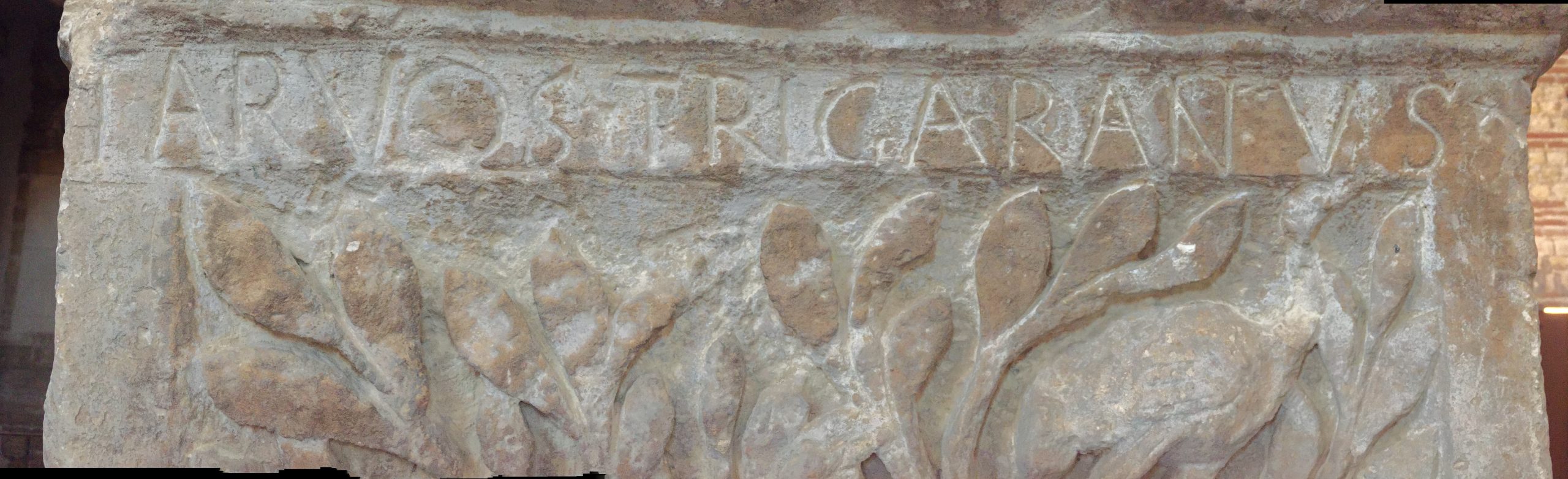
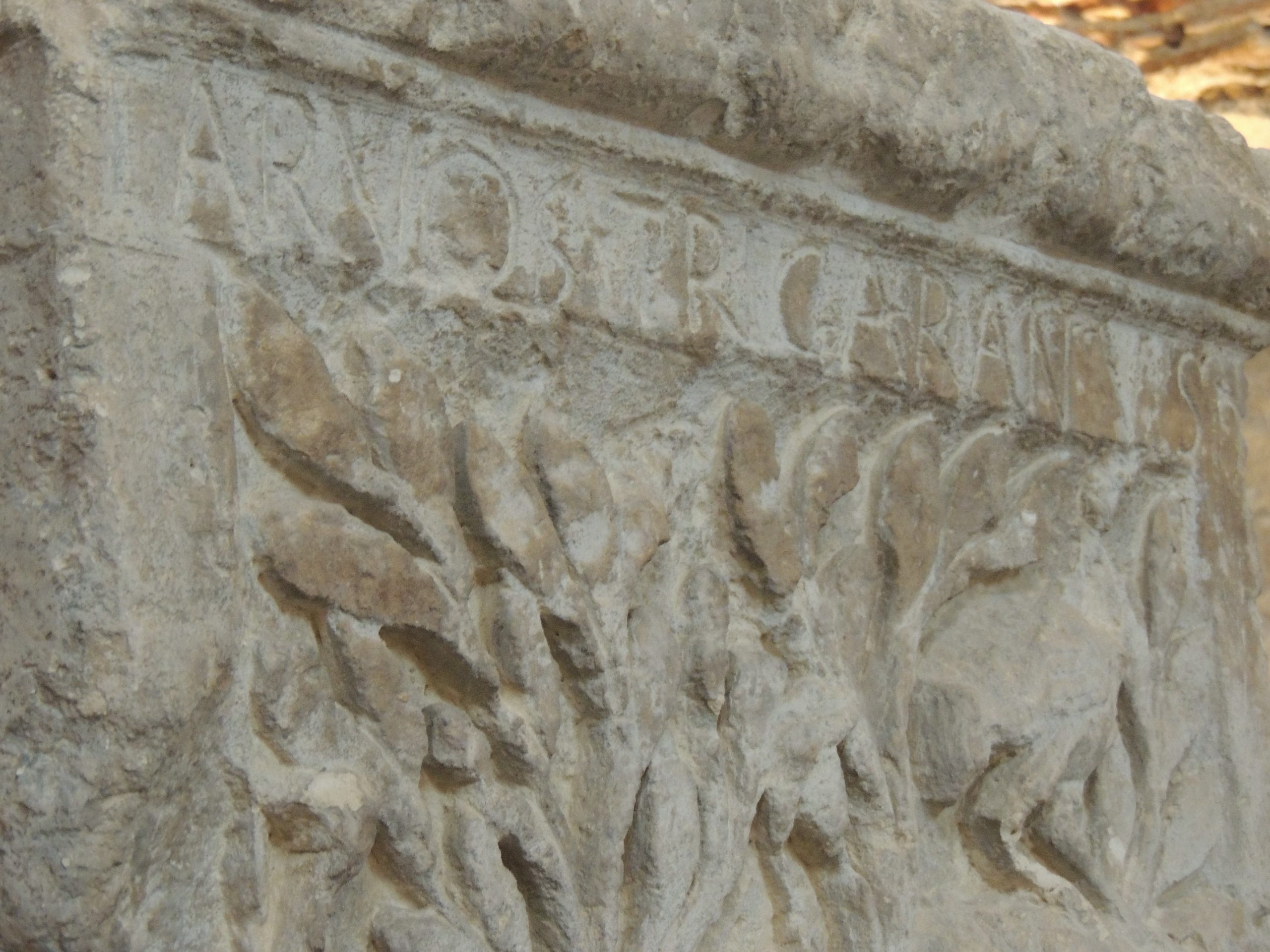
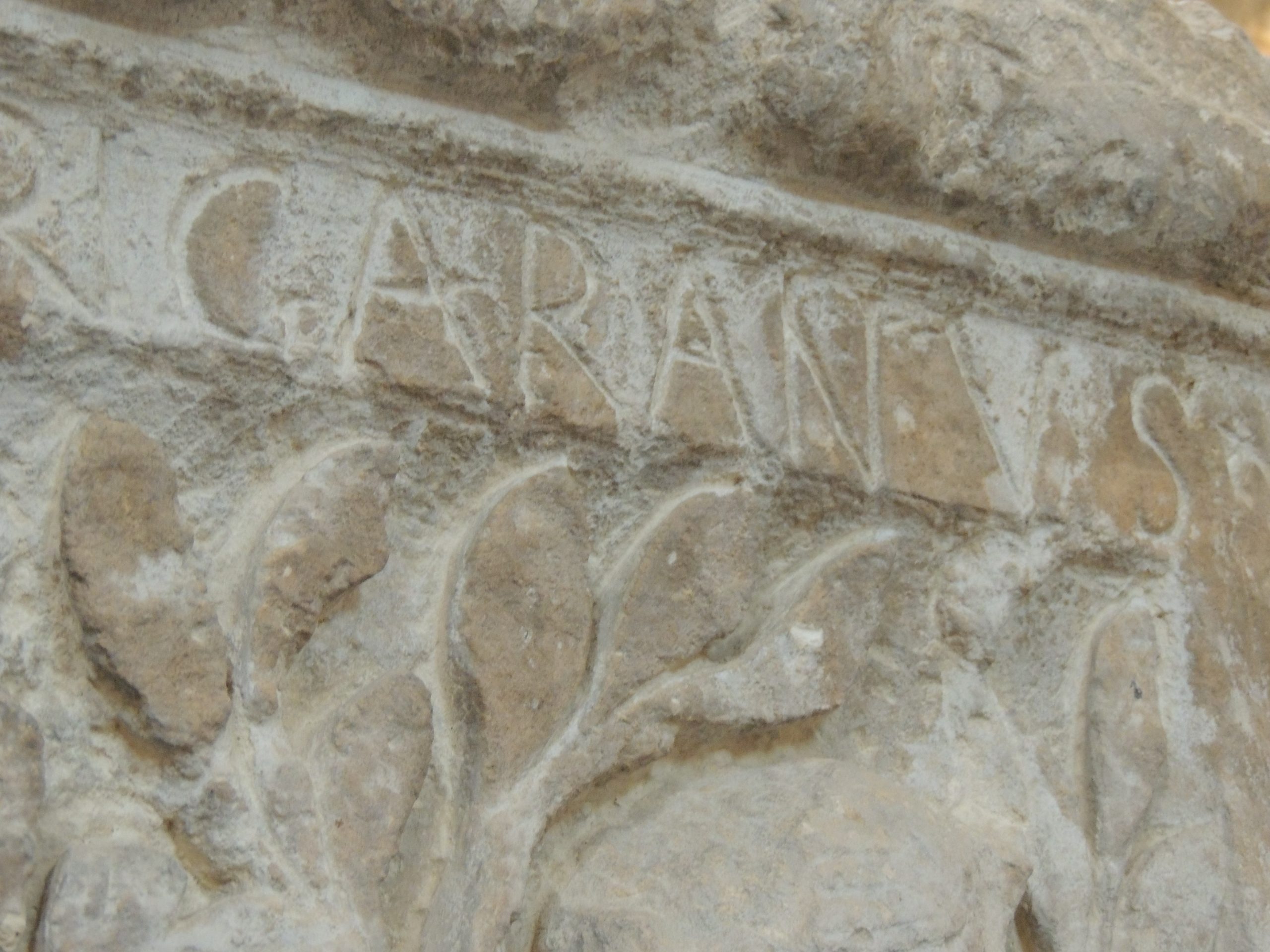
To the right around the block, we find Tarvos Trigaranus, “the bull with the three cranes.” Across the top is the name, TARVOSTRIGARANVS. On this face, the only face without a humanoid image on it, we see a bull standing in front of a willow tree (a tree of the same sort Esus works on, for sure), with three egrets, cranes, or herons on his back and head.
The bull may have a sheet or piece of cloth across its back, or the tree might be in front of the bull; unfortunately, because the block is damaged, it is difficult to discern. I believe the bull to be behind the tree, however, and not to have something draped across it.
It is worth noting, when determining if these are herons, egrets, or cranes, that while herons and egrets are of the order Pelecaniformes, and cranes are not related to either bird, being of the order Gruiformes. The primary visual difference between the two birds is in flight: herons and egrets fly with their necks retracted, while cranes fly with their necks out straight. Since all these birds are at rest, it’s hard to determine which they are (and we’ve already had some evidence that the artist might not have always gotten the details right). So, which are they? I like the word “cranes,” but others may prefer “egrets.” And, since our modern taxonomy is still generally difficult with these birds, I don’t see a deep need to argue at length about which exact birds they are; I expect our ancient forebears knew the difference between them without question, but the usefulness of the argument about which the artist intended seems moot.
We do know that the Esus and Tarvos Trigaranus images are related, though the myth is clearly lost. There is a second relief, in Trier, on the back of a Mercury altar that shows this myth at a different point; there, Esus works the tree, and the bull’s head, along with the cranes, are in the branches of the tree. The relief is housed at the Rheinisches Landesmuseum Trier. So, this is the second section of the column connected to the area around Trier.
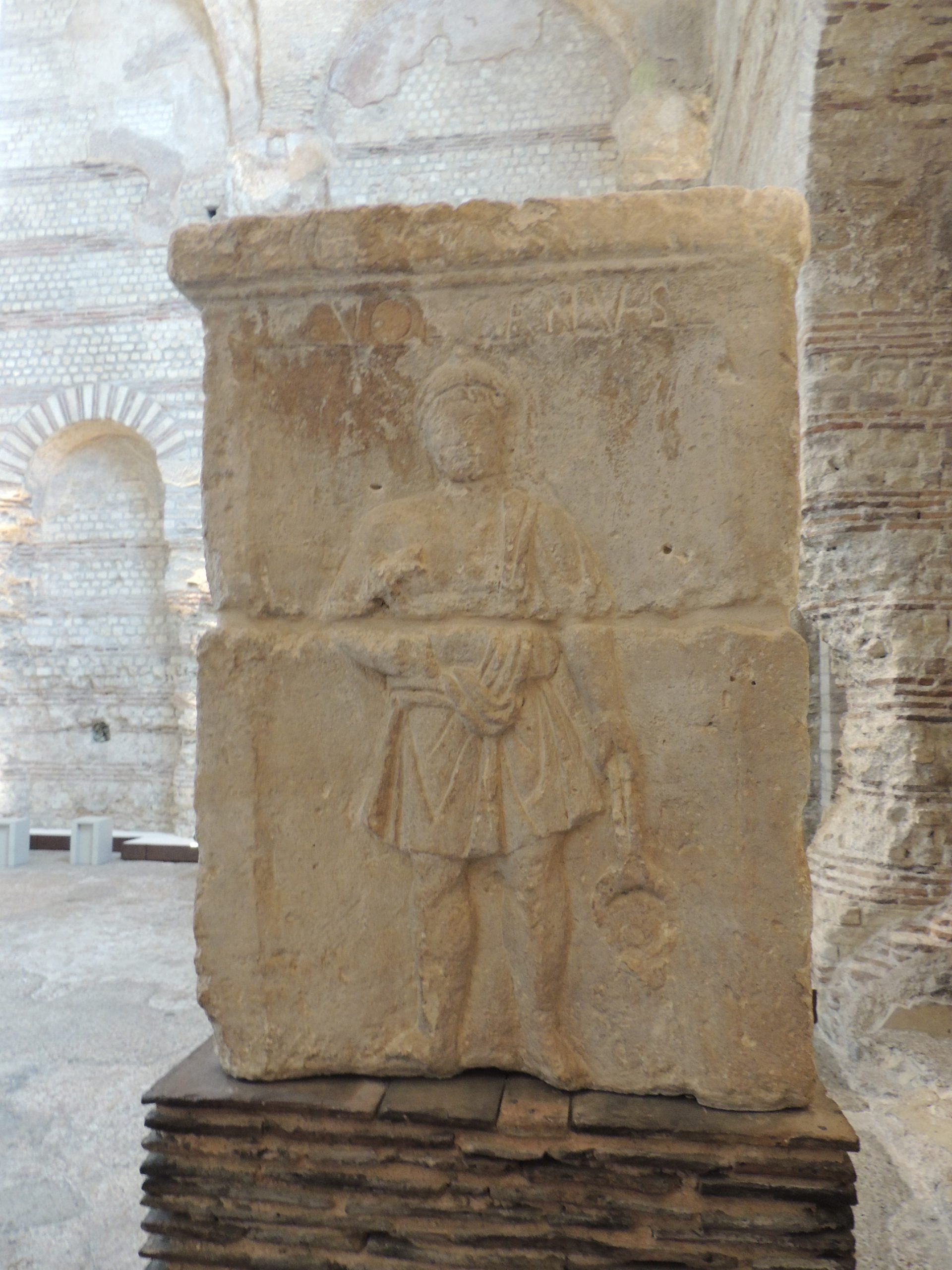
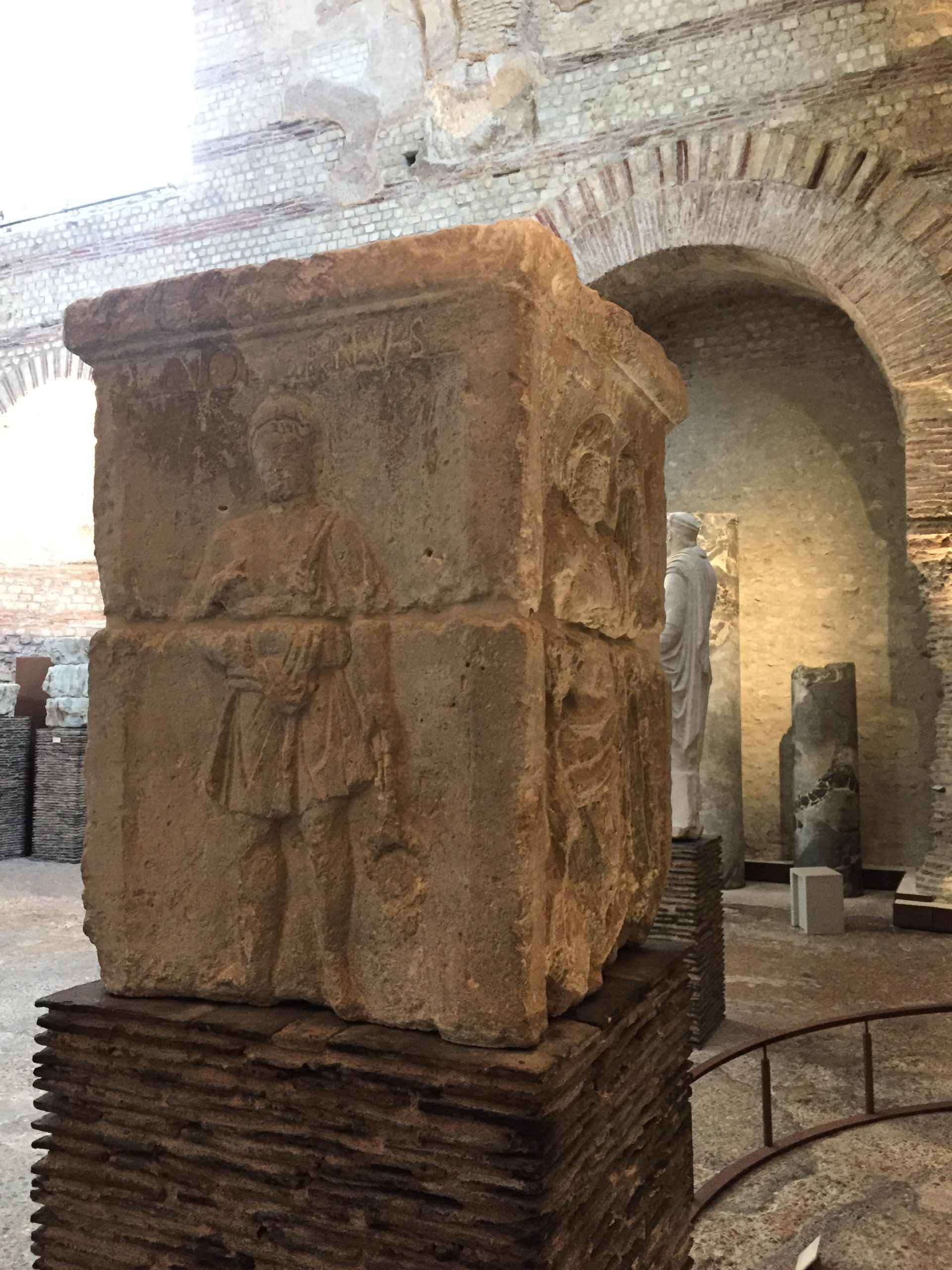
The Vulcan Face
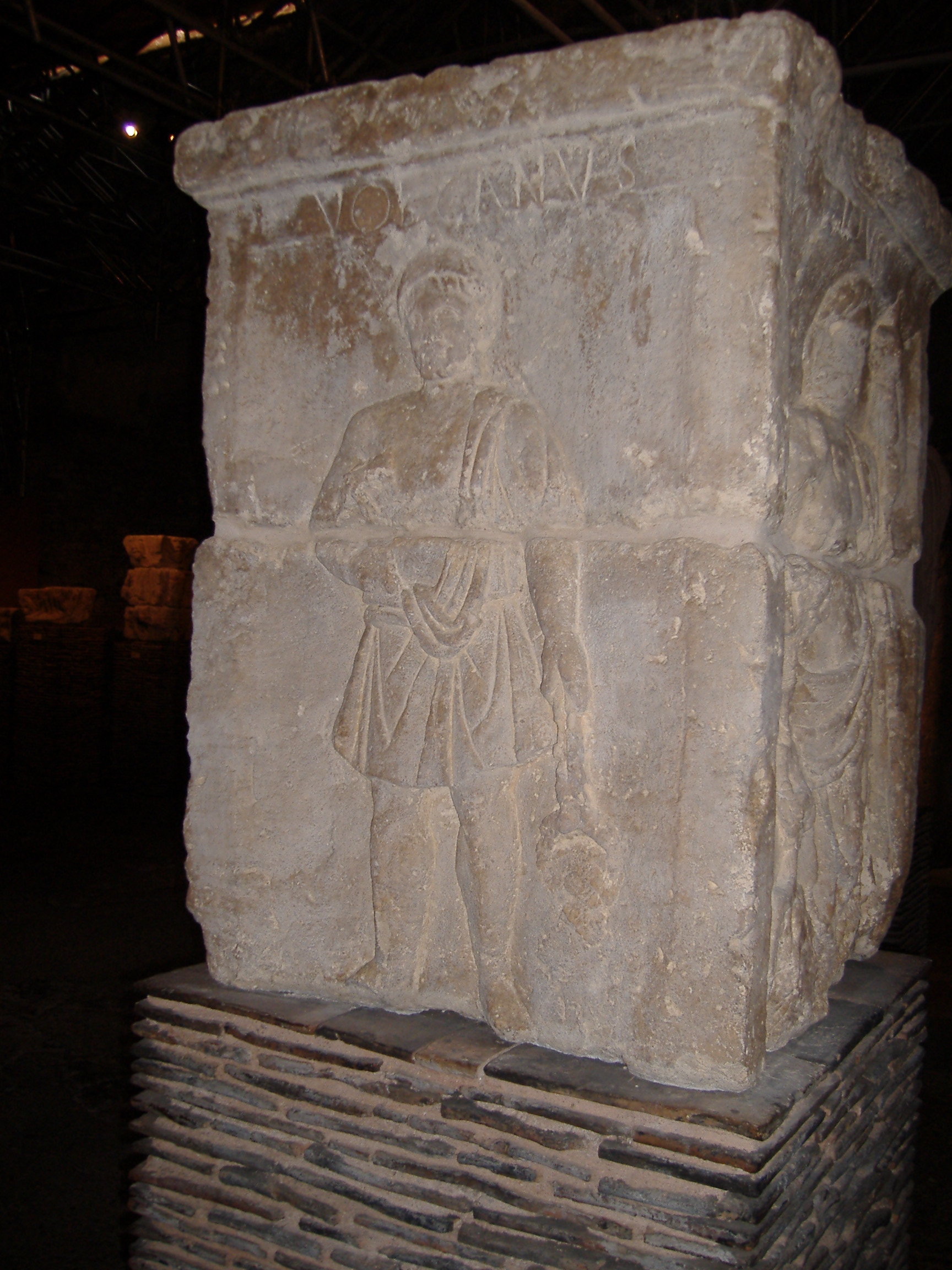
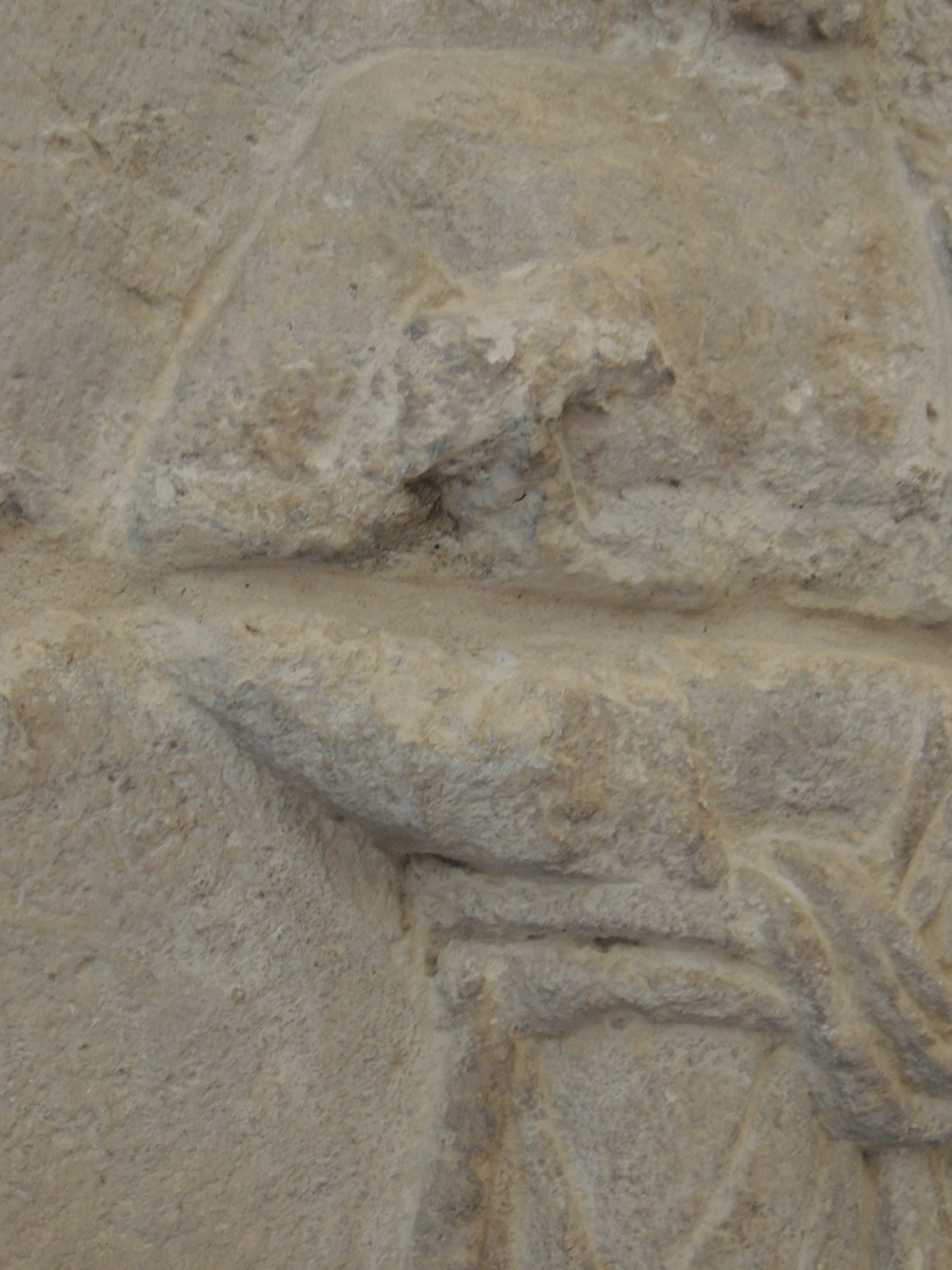
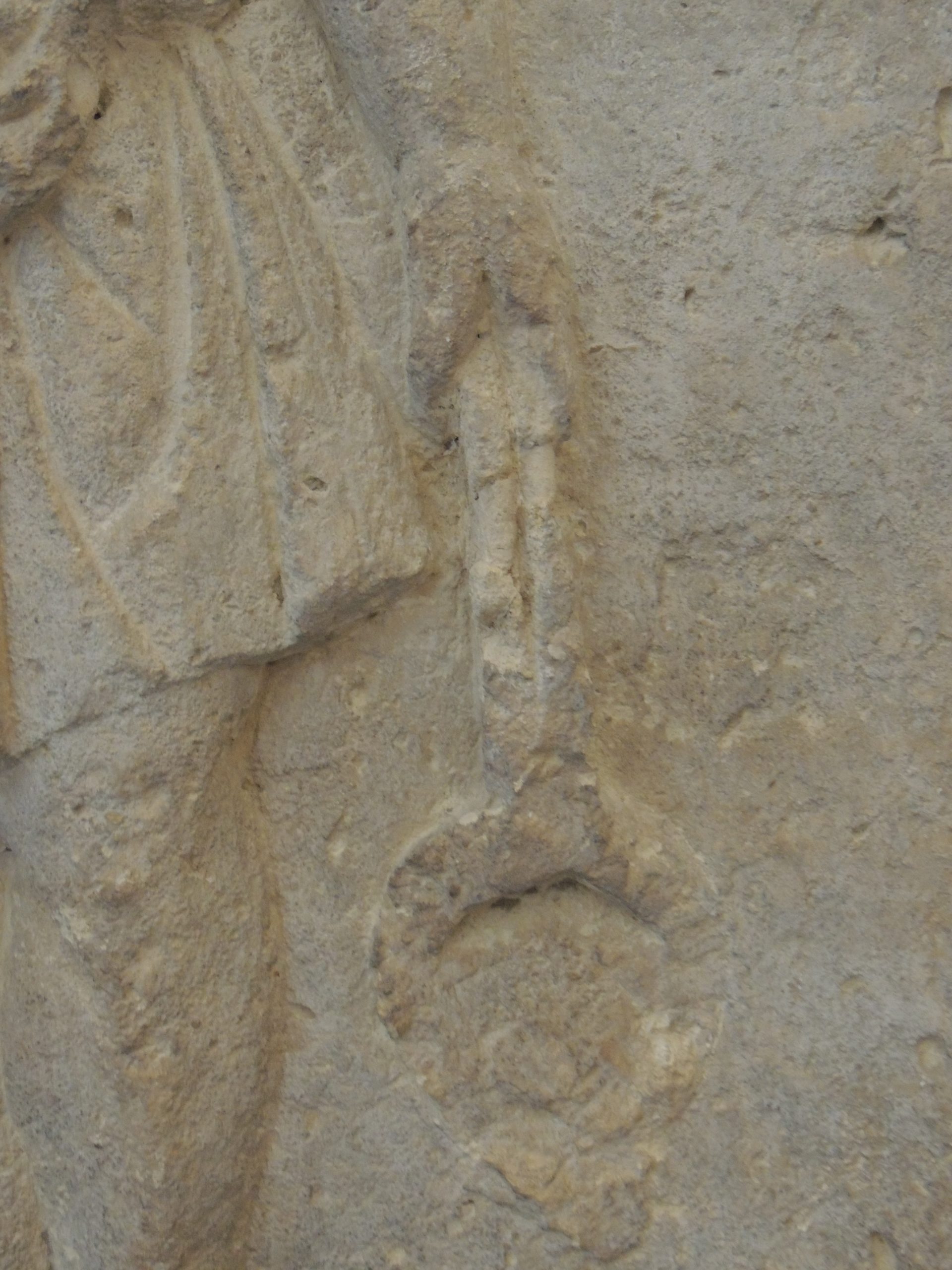
Continuing to the right once more, we come to the Vulcan face of the stone, where the name VOLCANVS is clearly legible, and his tongs in his left hand and the hammer in his right show his vocation.
It is possible that he carries something in his tongs, but the relief is fairly unclear regarding this. This relief is in good repair, and is generally well-preserved, otherwise.
The Jupiter Face
The Jupiter face is the most difficult to get a photo of: it is only a couple of feet from the wall, and while you can fit in and get a good, up-close look, it is hard to get a photo of the image because of the tight distance.
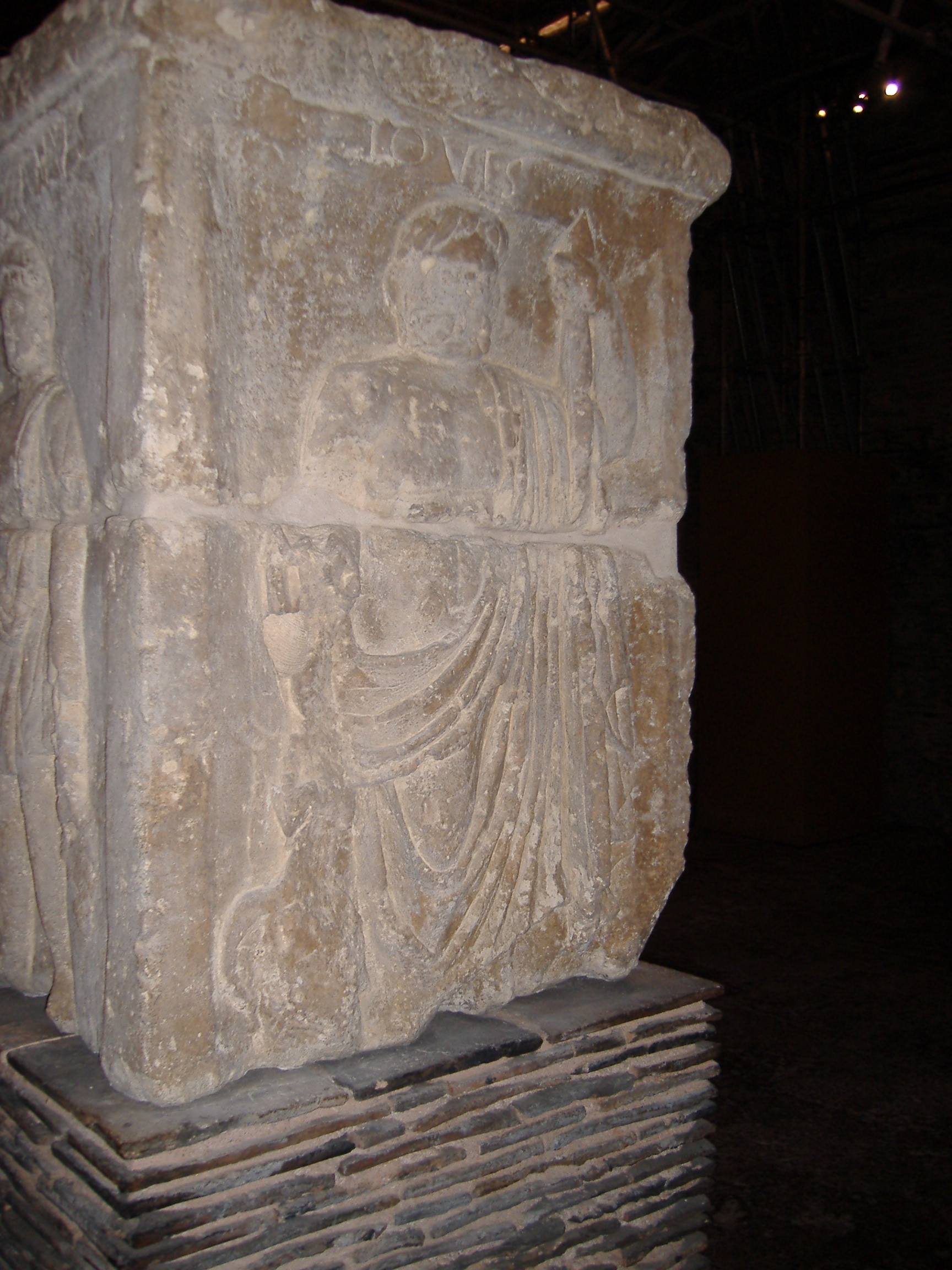
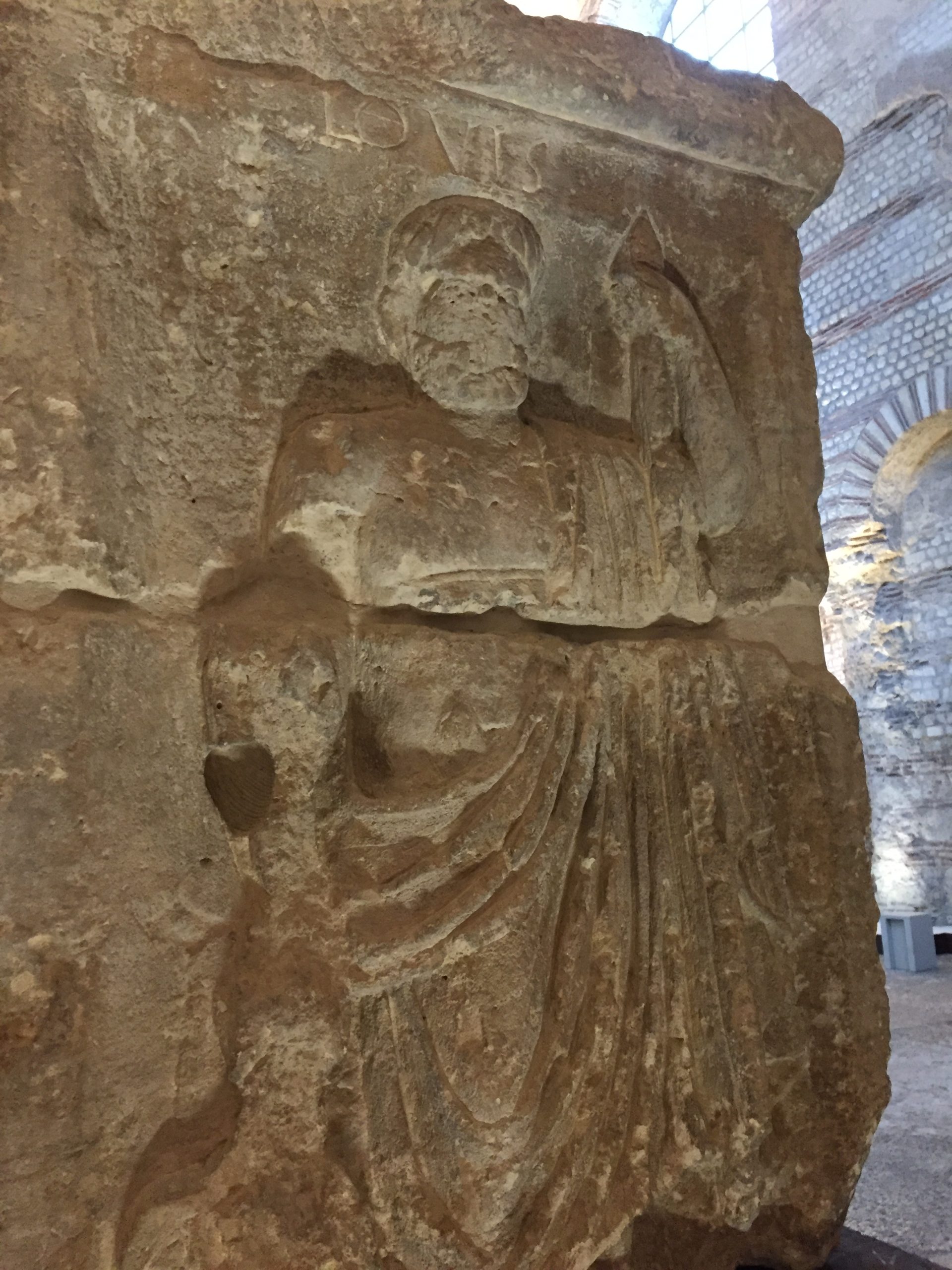
A bearded Jupiter stands here beneath his inscription, IOVIS (“Jupiter” in the genitive case), with his left hand on his scepter (or a spear) and his right hand on his thunderbolt, which he holds above an eagle. The eagle is particularly difficult to make out in photos, but it is on the ground beneath his right hand. Some drawings and interpretations describe this as a club, but I find that unlikely; the thunderbolt in hand with the eagle at his feet is a common iconographic experience, while clubs are decidedly non-Jovian in the iconography.
The inscription to “IOVIS” is interesting partly because during its time at the Museum of French Monuments, was damaged; according to Alexander Lenoir (1762-1839), in 1800:
a fanatic, angered to find in this monument proof of the idolatry of our ancestors, took it upon himself to add a stroke below the first letter of Iovis, the consonant “I,” and make it a capital “L” in order to substitute the word “Louis” for “Iovis,” and make people believe (through absurd deception) that the monument had been erected to one of the kings of France.
This bit of fanatical historical revisionism has since been filled back in, though not particularly gracefully; you can still see the scar from this vandal’s work.
The Dedication Block
The next block contains the pillar’s dedication, and what is likely a depiction of the celebration and the people who paid for the column; this stone gives us insight into the people who commissioned it and the values of the time.
The Dedication Face
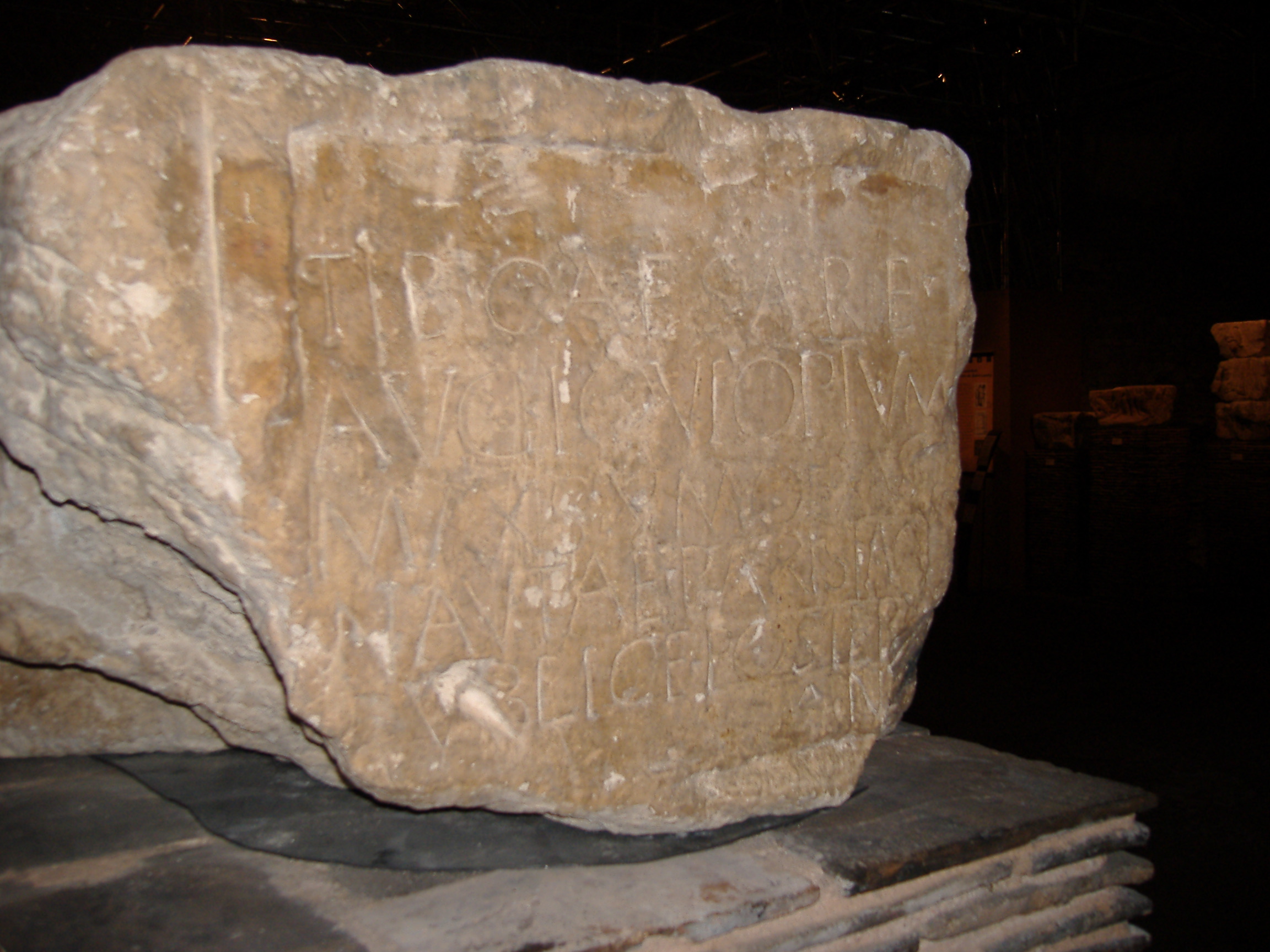
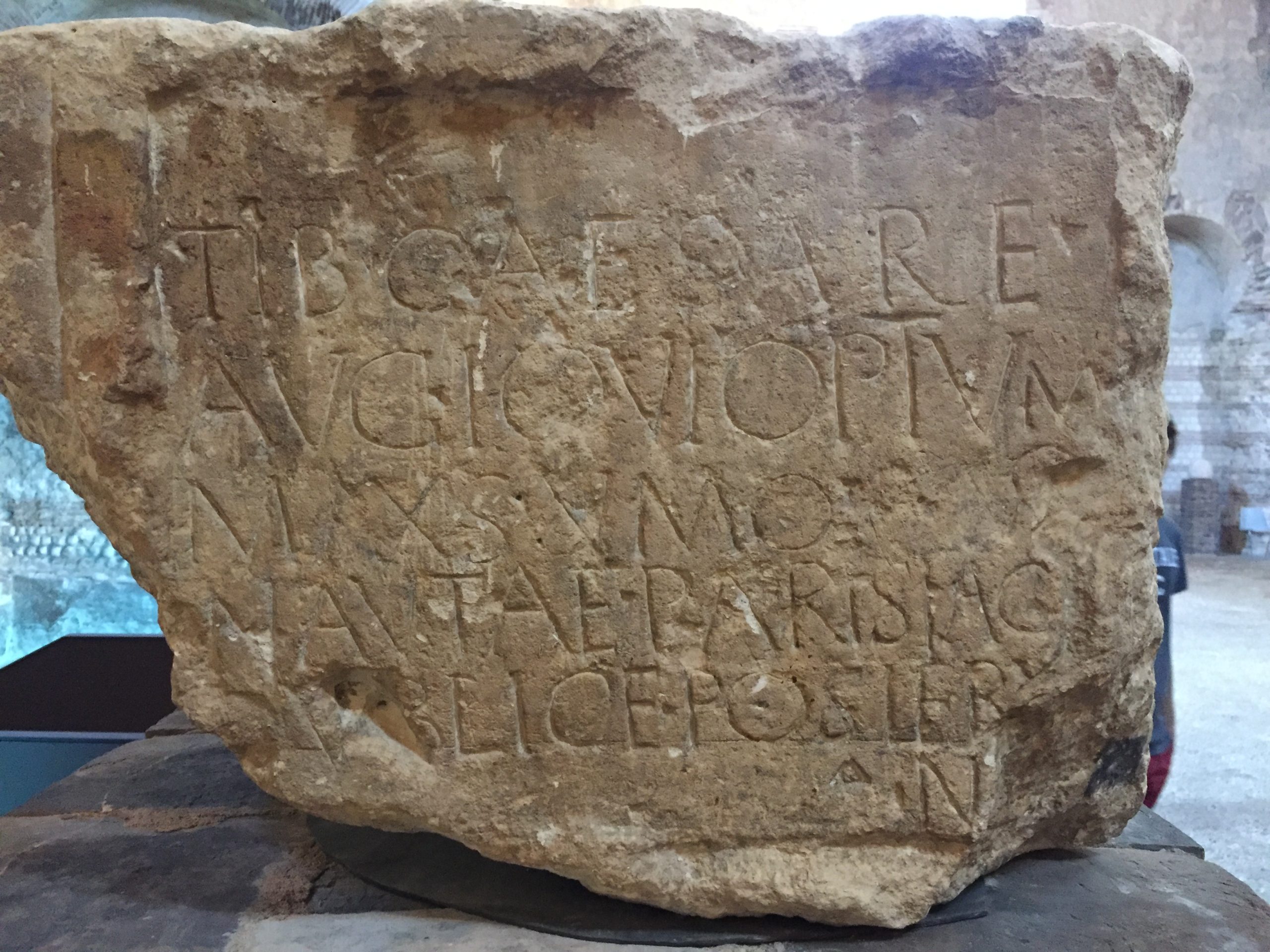
There are no figures here, only the inscription, which reads as follows:
TIB CAESARE
AVG IOVI OPTVMO
MAXSVMO
NAVTAE PARISIACI
PVBICE POSIERV
N
Or, standardized (with letters filled in between [ ] and “/” to mark the line breaks):
TIB[ERIO] CAESARE/ AUG[USTO] IOVI OPTUMO/ MAXSUMO/ NAUTAE PARISIACI/ PUBLICE POSIERU/N[T]
Translated, this means: “In the reign of Tiberius Caesar Augustus, to Jupiter, the most good, the most great, the boatmen of the territory of the Parisii, from the common treasury, erected this [monument]”
Depending on the grammar of the word “Casear” here, whether an archaic dative of attribution or a temporal ablative, this may honor both Tiberius and Jupiter (the former case), or only Jupiter (the latter case). This would be a very early deification of Tiberius as emperor if the former (and would place him above Jupiter), so it seems unlikely, but nonetheless, we can date the column to 14 CE – 37 CE through this reference.
The dedication text on this block is part of why we think this block was just above the Block of Eight Divinities; it had to be low enough to be read. It is also why we place the Block of Jupiter above it, instead of at the top: it makes sense to put Jupiter right above the dedication, as it is (after all) dedicated to him.
The Young Sailors Face
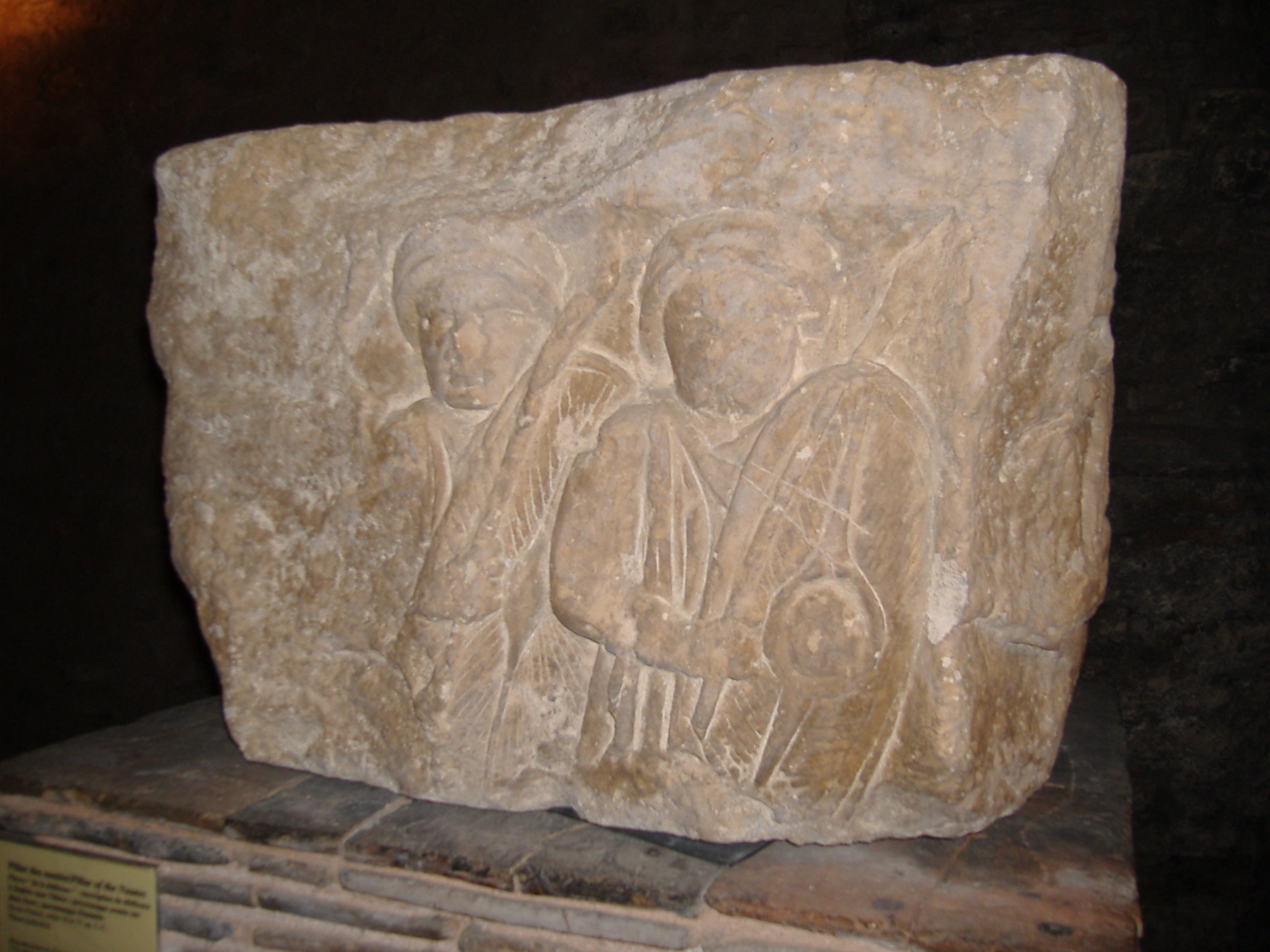
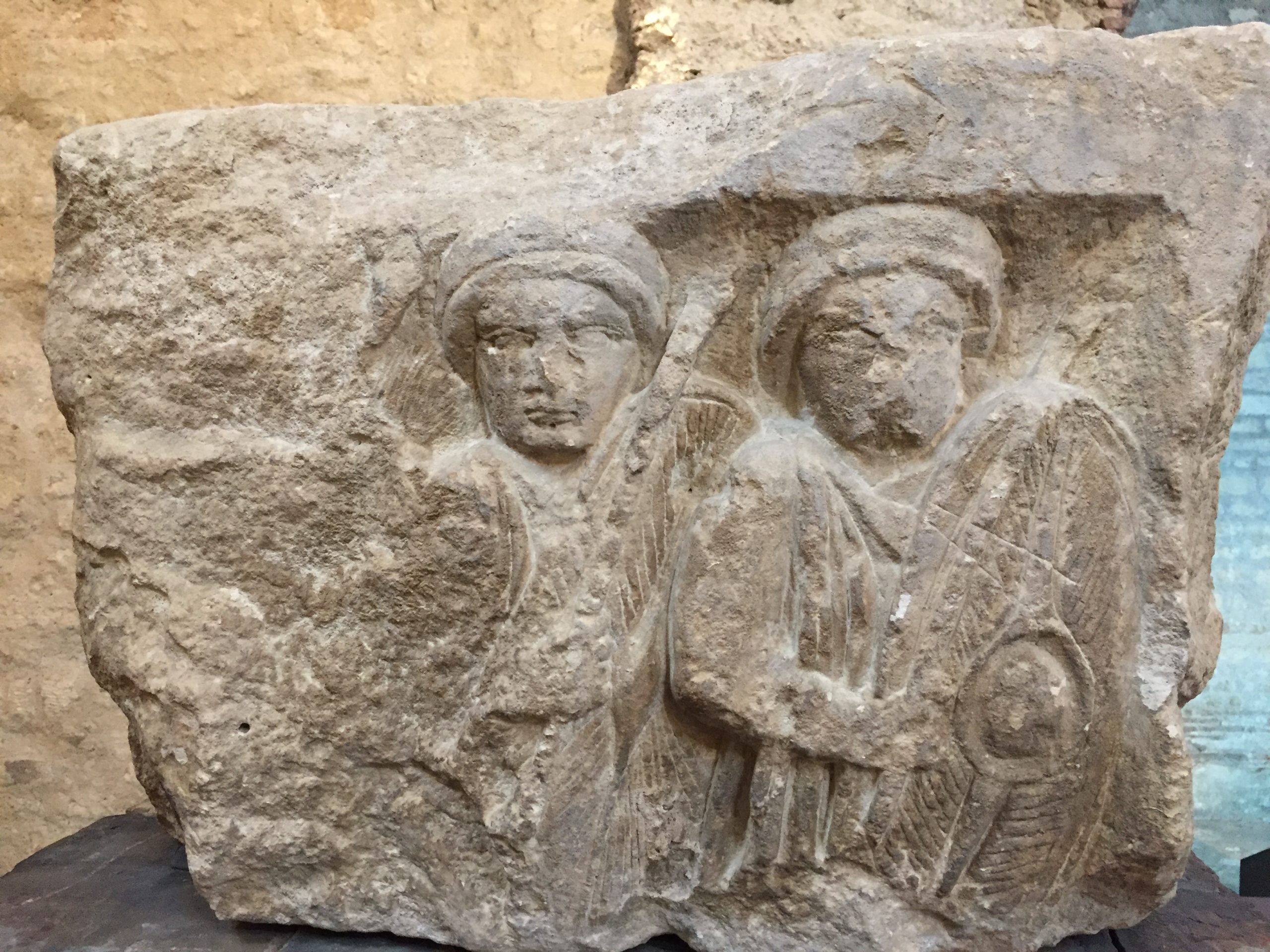
The next face to the right shows likely three beardless, armed men; probably, these are younger sailors, with rounded shields and spears. The men wear hats, not helms, which suggests their more civilian nature. Though the bottom of the relief is cut off, it is sometimes speculated they are on a boat, due to the next face.
The Old Sailors Face
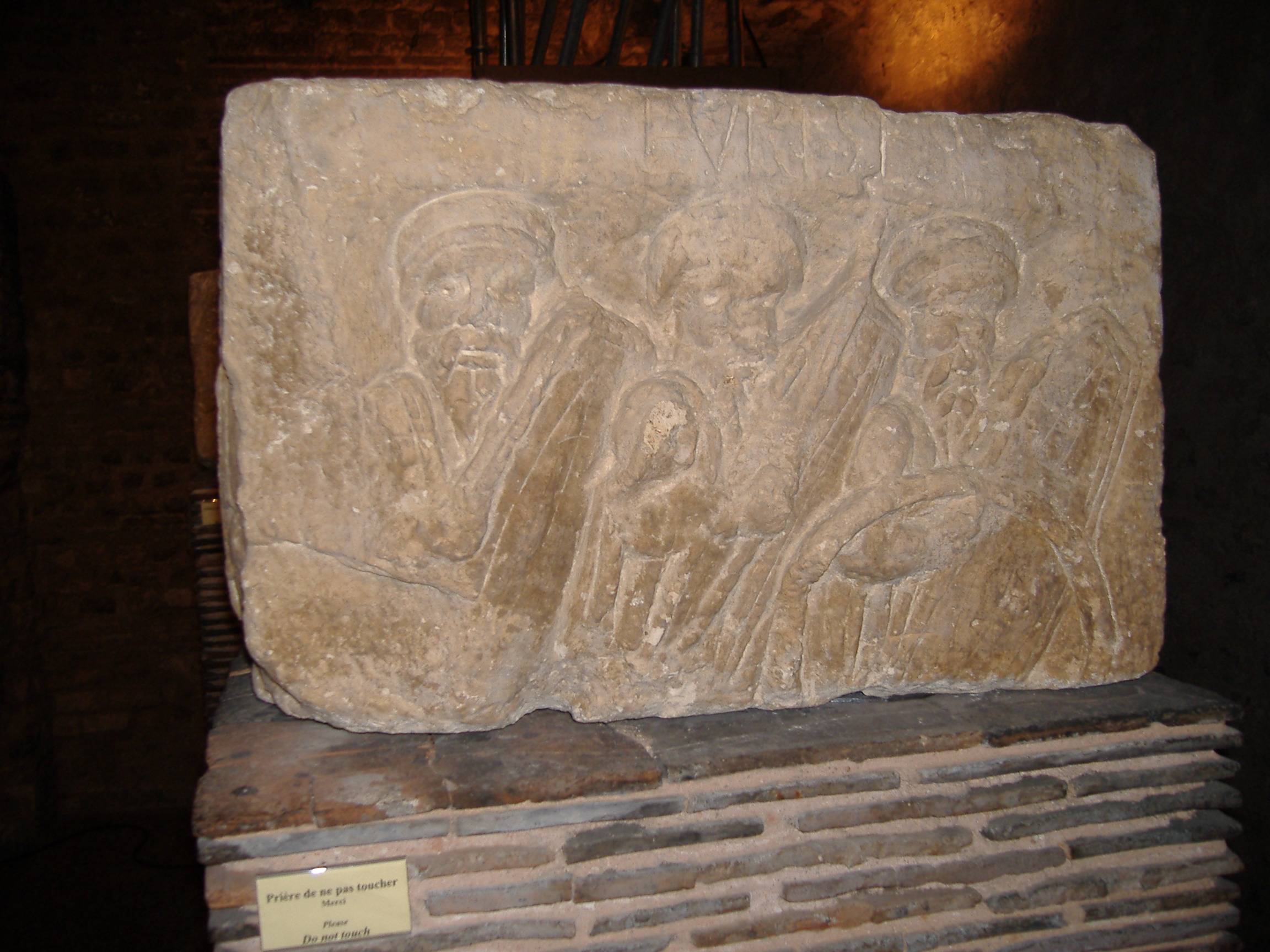
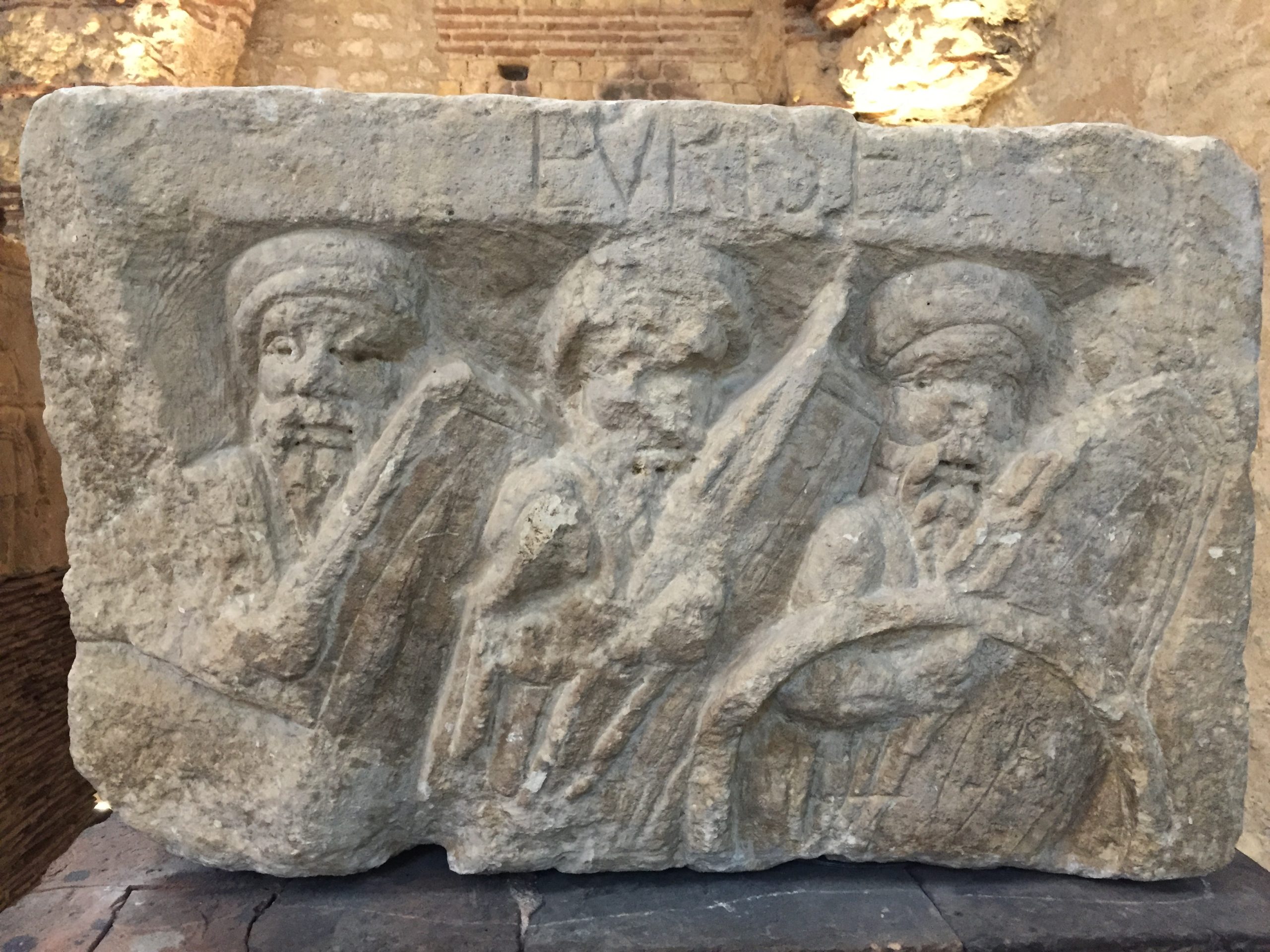
The inscription EVRISES is above three older men with hexagonal shields. The beards show them to be older than the clean-cheeked youth on the previous panel, and the word “Eurises” is likely a Gaulish word identifying them as the donors of the pillar (it seems to mean “wealth,” but I’m still working on this theory, and am open to other ideas).
The circular item at the lower right is often interpreted to be a boat’s wheel, or possibly a prow, which would place the men on a ship. That’s not a big leap for a pillar put up by people who describe themselves as sailors. Still, I wish that the bottom half of the block were available.
The Celebration Face
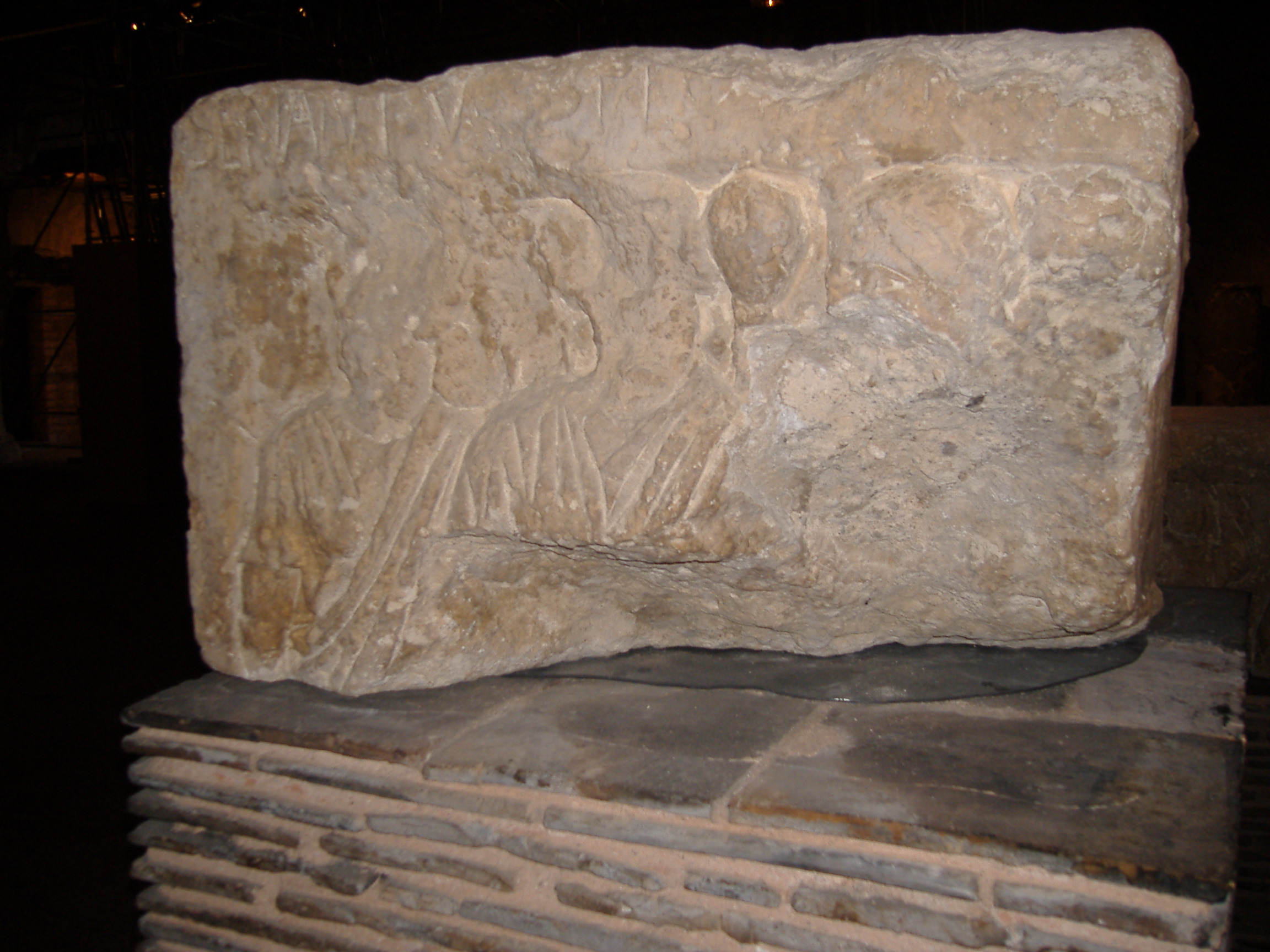
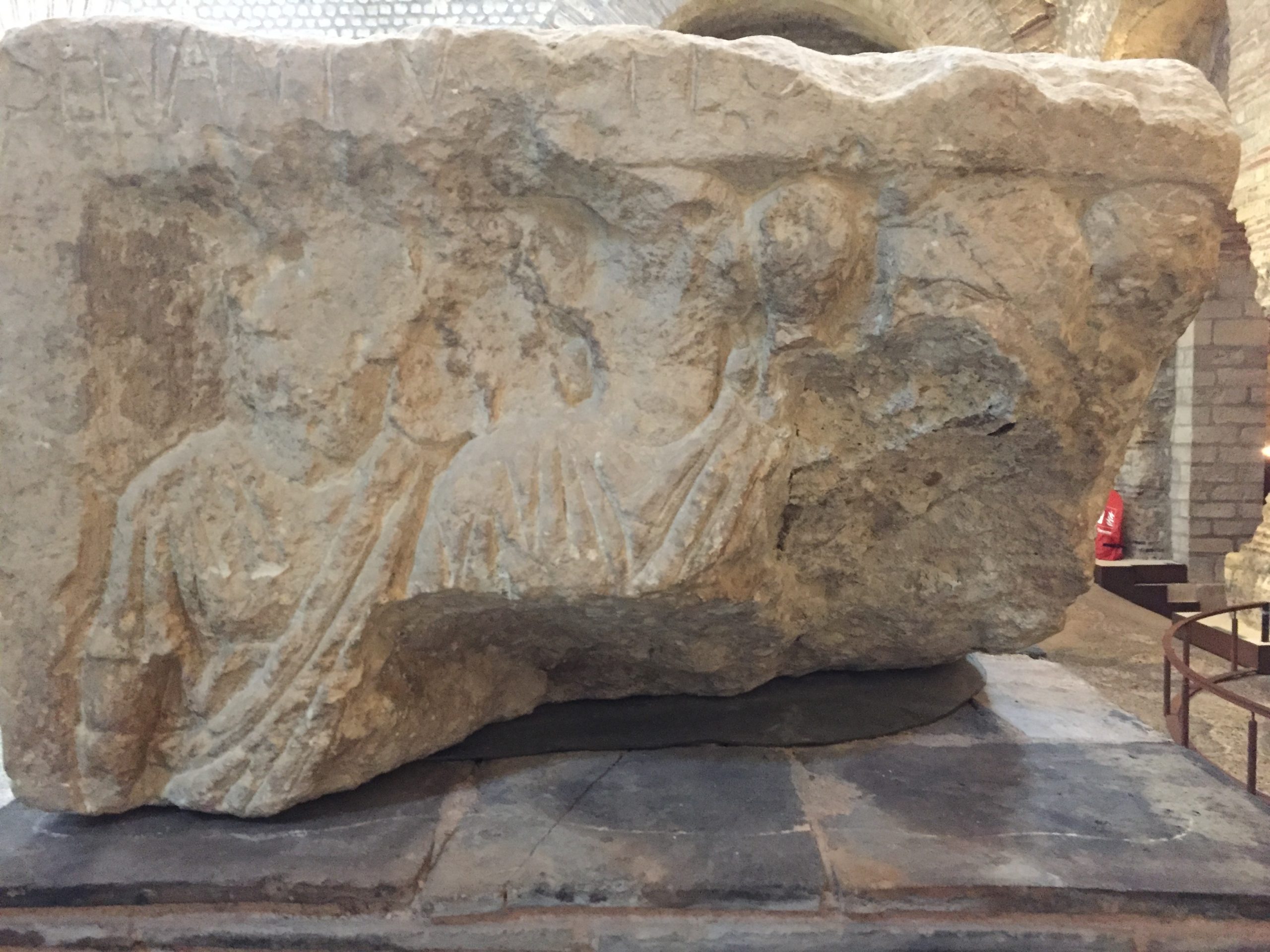
Likely depicting the celebration of this dedication, three figures once again appear on the stone, or what is left of it. Two figures are fairly clear, while the top of a head in profile, possibly wearing a crown makes the third. On either side of the profiled head on the right side, some sort of rounded devices can be seen; it could be that these are the finials on a throne, the ends of staffs, or heads of people further in the distance (I think this last item to be least likely). Could this last figure on the right have been Tiberius, symbolically attending the dedication? Perhaps, but we are unlikely to know.
The figure to the far left seems to be female, based on clothing and figure, though it is difficult to tell. Most sources that have looked at this figure tend to agree this is likely, though.
Across the top is an inscription in Gaulish, SENANT V[…], often transliterated and reconstructed as “Senant Usetiloni,” possibly “the great warrior.” like the word “Eurises” on the adjacent face, however, this is a tentative translation at best, but it would give some credence to that profile figure being Tiberius.
The Block of Eight Divinities
The last block, likely the bottom block due to its slightly wider size, was possibly set upon a stone to raise it above the ground a bit more. On this stone, we can generally identify one of the deities on each face with some certainty, but the accompanying deity is often open to interpretation.
Whether the deity we can identify is the Roman or Gaulish version of that deity is more up for debate, but given the mix of deities above, we might safely assume that each face might include some mixture of deities here. This stone would have been right at eye level for most of those seeing it, and I would think that the deities would have been instantly recognizable to those passing by.
This block has a different border than the others, giving the faces a sort of “matted frame” look that the others do not have. It does not have a cornice at the top that has survived.
The Mars Face
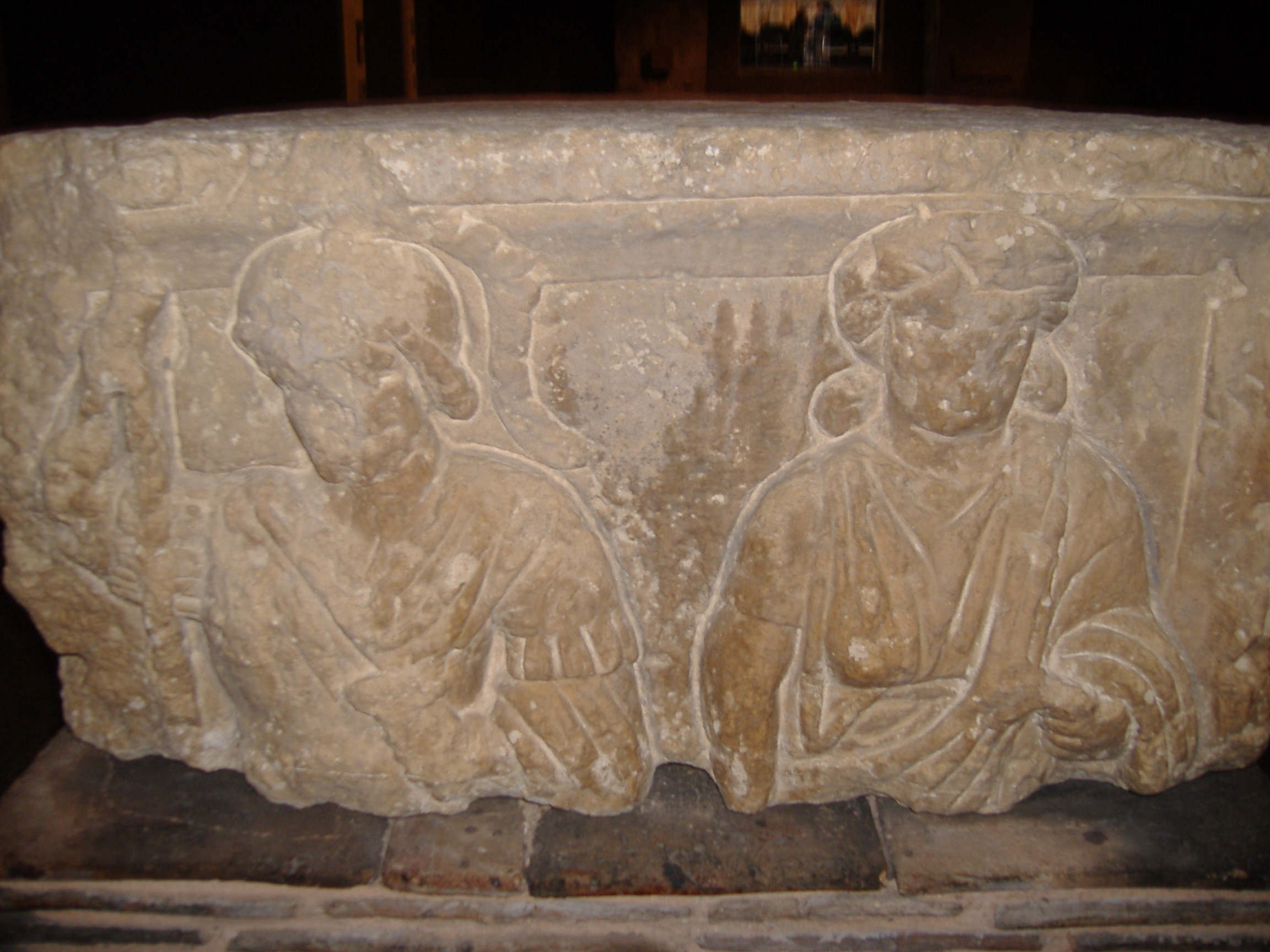
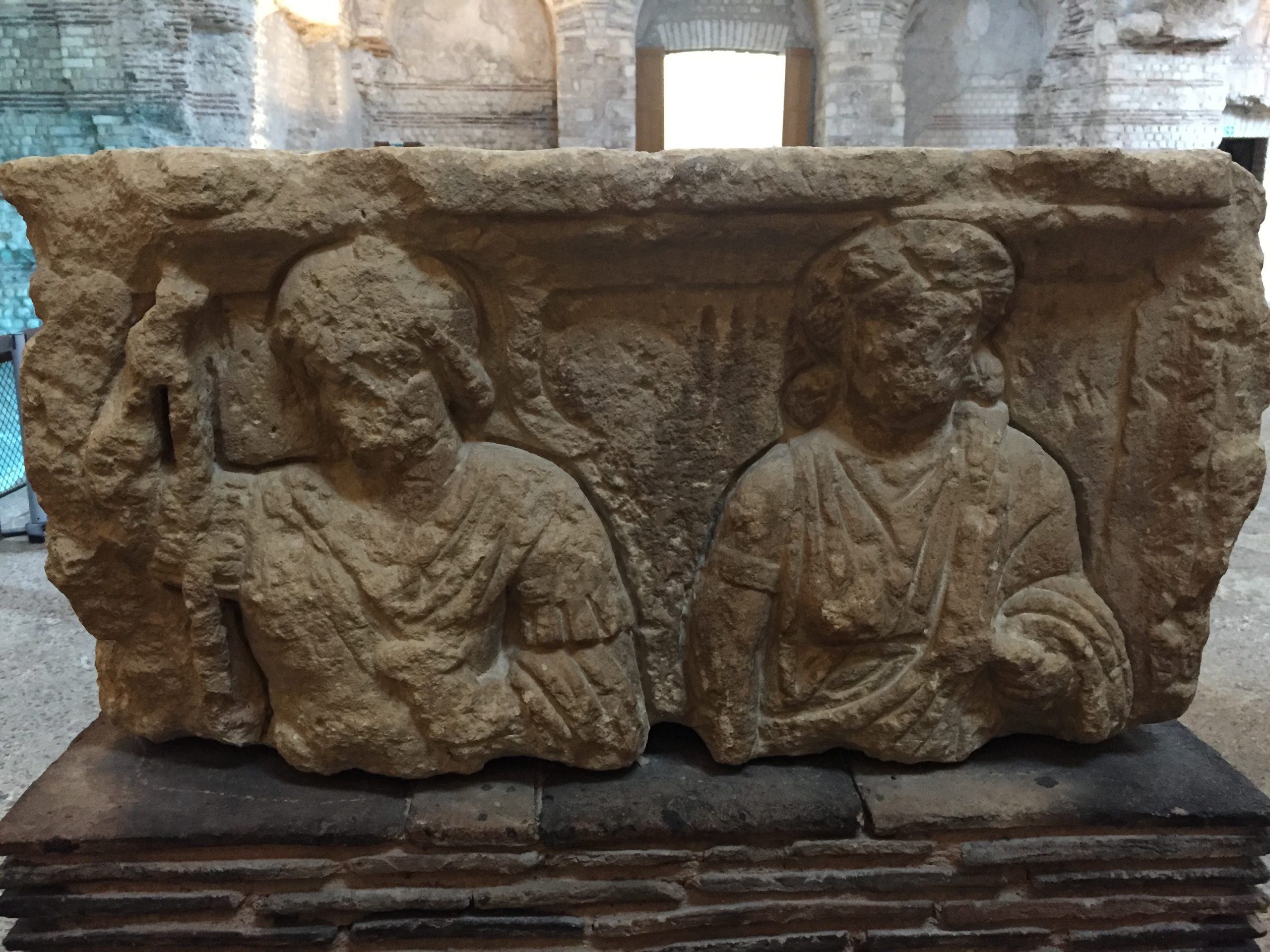
We’ll start with the Mars face because the deity shown on the left side of the face is clearly in armor and wearing a helmet and cloak that drapes over his arm; this is most likely Mars, carrying his spear in his right hand. Next to him stands a goddess we cannot identify with great confidence, as both the name is missing, and whatever she was holding in her left hand.
There is, just above her head on the left, the remnant of a “V,” but the rest of the word is gone. Some speculation suggests Vesta; the assumption that this is not Venus instead comes from the next face, often called the “Venus face.”
There are Gaulish inscriptions to Litavis, as well as attested names derived from her. She appears to be an earth and sovereignty goddess and consort of Mars Cicolluis; her attestations imply that she could have been found in this area with cult worship near the headwaters of the Seine, but the position of the V doesn’t seem to match up (not that we can really tell, since we don’t have the complete inscription to see where it “should” be).
The Venus Face
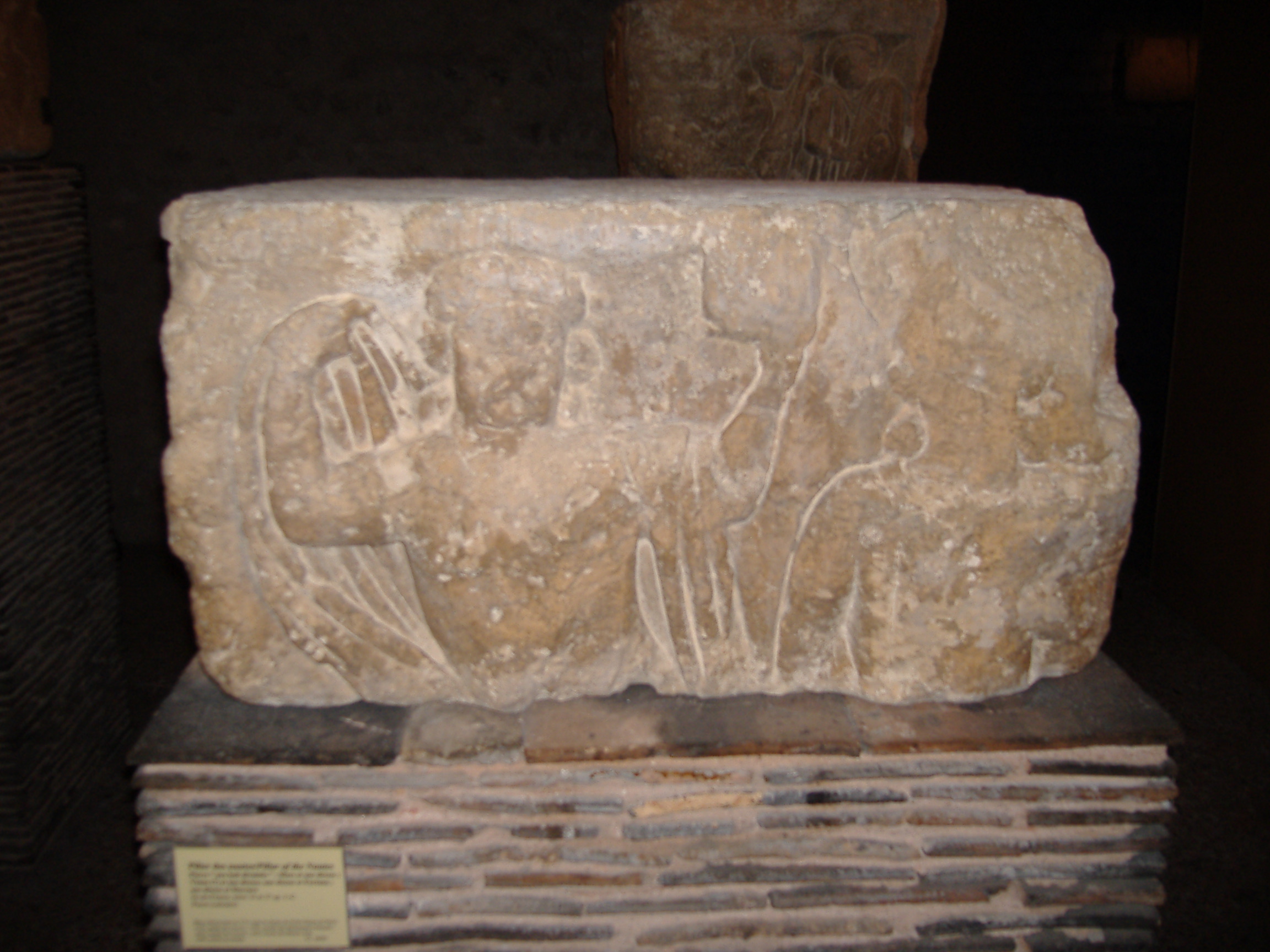
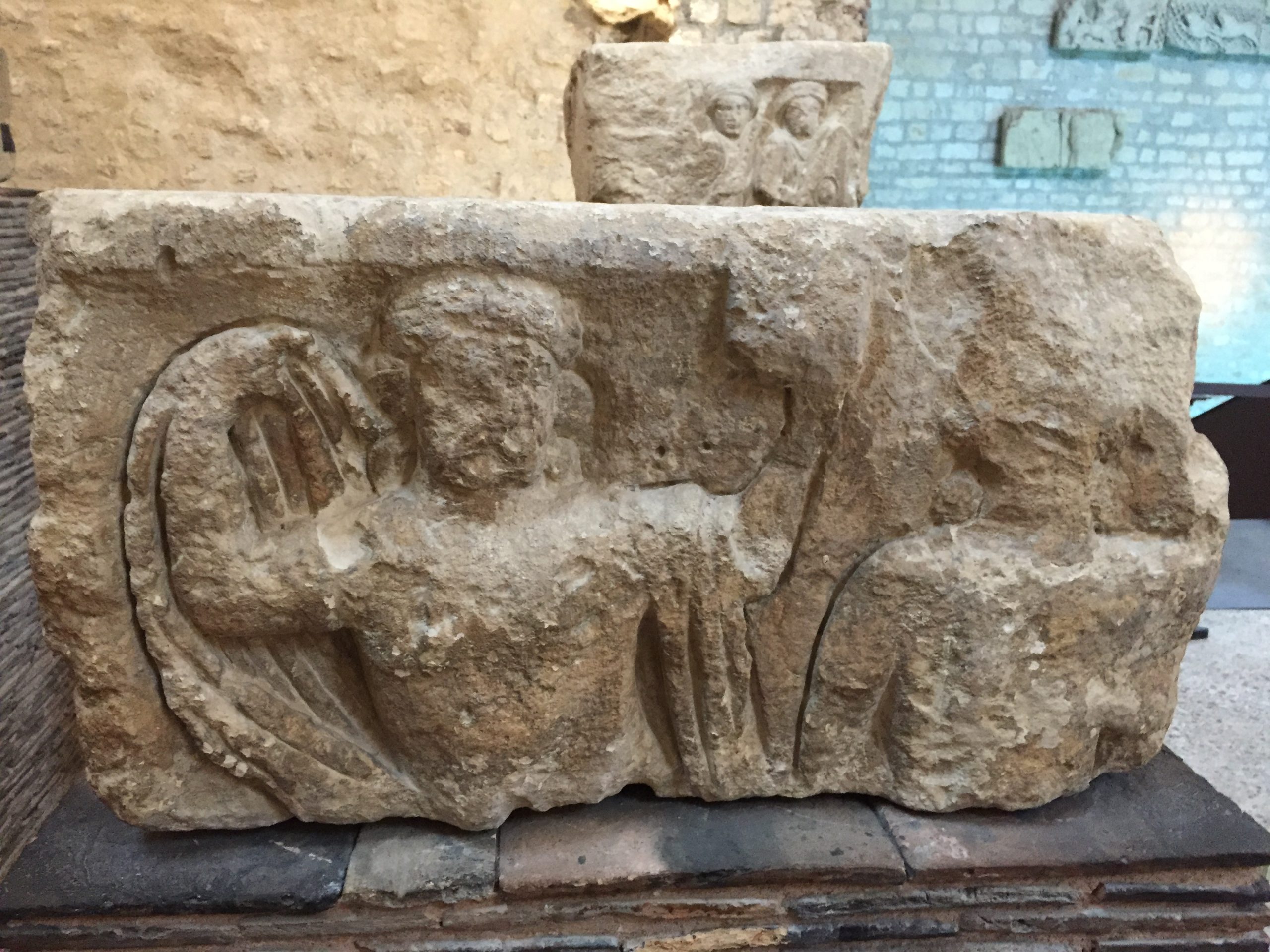
The deity on the left here is identified with Venus, which is why the “V” on the previous face is not identified with Venus; this goddess is nude and lifting a veil over her head, and the object she holds in her left hand is often speculated to be a square mirror (though, admittedly, most mirrors I have seen from the ancient world are round).
Next to her, the goddess shown wearing earrings remains entirely unknown, as much of the face and body have been sheared off over time.
The Fortuna Face
This face is heavily damaged as well, but we do have the letters FOR at the top of the piece. The object she carries is often identified as a cornucopia, which somewhat secures the identification of this goddess as Fortuna. It would be interesting to see the lower half of this block, and to see if she holds a ship’s rudder, too, which would be an interesting detail on a pillar set up by sailors.
The second goddess appears to be holding a staff or spear diagonally, but it is not clear what it is. We cannot reliably identify this goddess, unfortunately.
The Mercury Face
Even without a name, we can recognize Mercury on the right by his winged petasos (hat) and exomis (tunic), leaning on the caduceus. Mercury had a special place in Gaul, and was a quick import to the area, often appearing in his Roman regalia. I occasionally wonder, knowing that we’re at about 1/2 Roman and 1/2 Gaulish deities, if Mercury is the “Gaulish” deity on this face, rather than the “Roman” one.
On the left of the block is a female divinity, holding a spear or pole in her left hand. Again, with the bottom of the block missing, we are missing information that could help us identify her. If this is Rosmerta (often speculated due to her associations with Mercury), the object in her hand may be a scepter, the end of a butter churn, a long-handled ladle or spoon, or any number of other objects. We just don’t know.
Final Thoughts (So Far)
In all, this monument is a fascinating window into the early Roman empire’s history in Gaul; Tiberius ruled as emperor from 14 CE – 37 CE, just the second emperor after Augustus (and just barely within a single unlikely human lifetime after the conquest of Gaul; certainly familial memories of a free Gaul would have been available to some at this time). The Gaulish deities are not subsumed under a blanket of the Interpretatio Romana, but stand (literally) shoulder to shoulder with the Roman gods on the pillar.
We don’t know exactly where the pillar stood, but it seems likely it was erected on Île de la Cité (the island in the Seine that the Cathedral of Notre Dame stands now) and given a place of prominence in the city of the Parisii, which became the Roman city of Lutetia. It may have been dismantled to build the walls around the city around 307 CE, or it might have survived longer.
We know from the dedication that it was a group of sailors who came together as a cooperative group to erect and dedicate this massive stone (their reference to the “common treasury,” PUBLICE POSIERUN[T], directly refers to this sort of cooperation). By showing themselves in armor as soldiers, perhaps they were connecting themselves to Rome as a protector of their trade (and, at this time, it’s likely that Rome has granted them the privilege of carrying those weapons). The pillar is clearly an example of a group of folk (and not just men) coming together for the common good, and building something that spoke to the multiculturalism and acceptance of others in the city. Everything about this monument is a statement of tolerance and cooperation, and the power and safety that comes from that.