Today, I’m looking at the analog photos I took of the Mound at Wellspring this year. The Mound has always been my favorite thing to photograph at Tredara, and this year was no exception. I have an interesting sort of historical documentation of how it was created, how it’s changed over the years, and how we’ve interacted with it… and adding to that documentation this year was sort of fun.
The Mound lends itself to analog photography in a way that a lot of other things do not: it is permanent upon the land, inhabited by a connection between earth and starry heaven, and connected to us all as humans.
Much as an analog photo is silver activated by light, so too are we the interplay between heaven and earth: betwixt and between, connected, and centered.
Starting with Pinhole
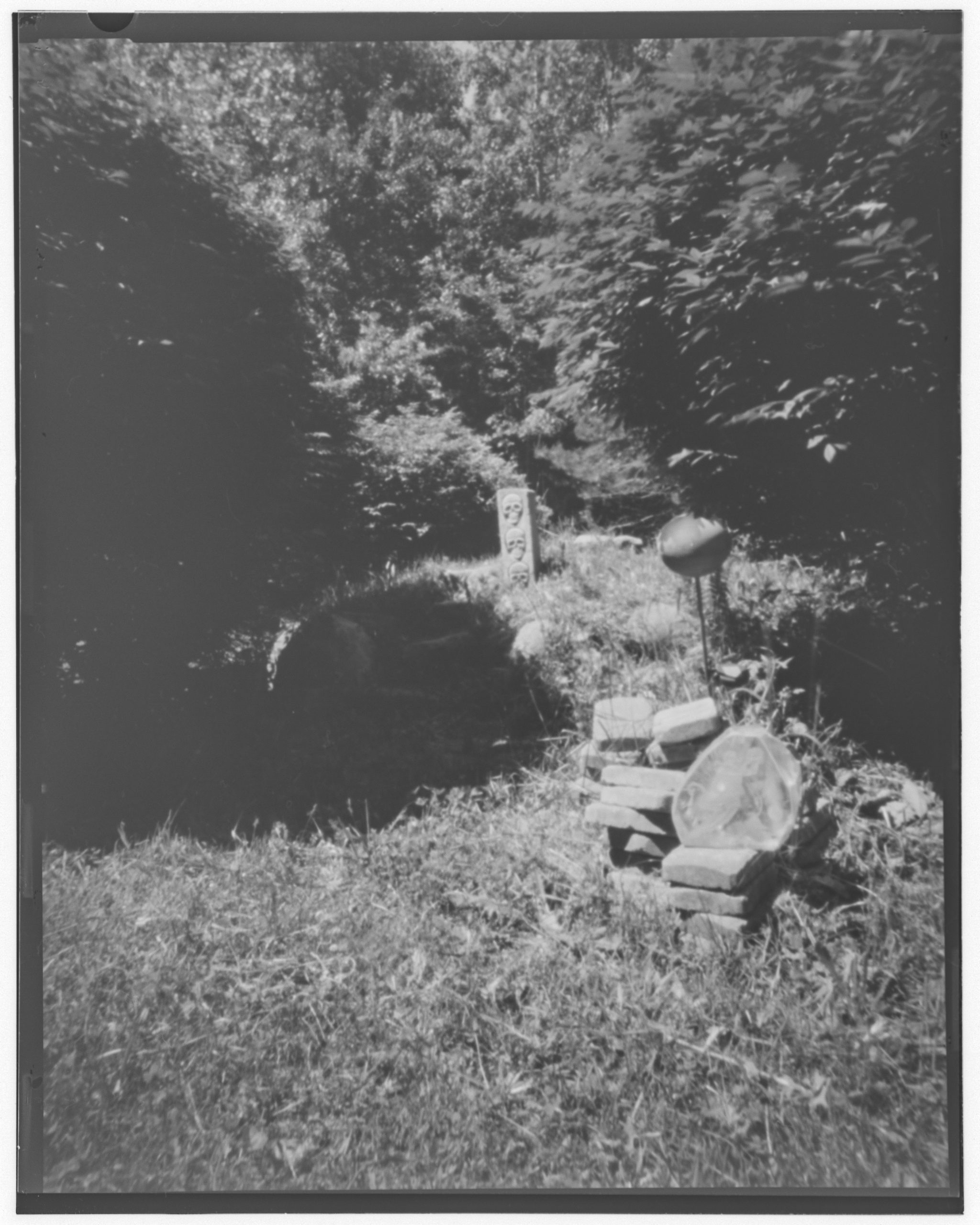
At the head of this entry is my favorite photo, which was a 1-minute exposure using my Lensless Pinhole Camera. This image, taken at f/231, 75mm, and 30 sec., looks like one of those old archaeological images of ancient sites; indeed, the technology is what an early archaeologist would have used to capture the space.
I also fine-tuned my process for recording photo exposure information, taking a photo on my phone of the stopwatch during the exposure, which provides me with the duration of the exposure, and also a set of GPS coordinates and the time I took the exposure. I’d further fine-tune this later by screenshotting the light meter app I use on my phone, but I’ll talk about that in a different post.
 [image: a stopwatch in focus with the mound behind]
I use a winding stopwatch, because of course I do. sort of have to use my phone’s stopwatch for exposures that go a lot longer than the stopwatch can reliably count (it’s a 15 minute stopwatch), but I love having the extra analog connection for the exposure.
This has turned out to be remarkably effective at making sure that I know what the exposure was when I finally develop the photos.
The Mound in Polaroid
 [image: a polaroid of the skull pillar atop the mound]
Probably the best shot I took on my Polaroid Impulse (600 speed film) was this one: the colors and the beauty of the shot make me quite happy, and it came out well. I’m reaching the tail end of the useful life of this film (it’s now over a year old), so I feel fortunate to have gotten this shot at all.
One of the best things about Polaroids is the question that everyone asks: “Is that a Polaroid?” Folks have fond memories of these cameras, even if they have those memories in spite of their frustrations with the fickle nature of these cameras. And they are incredibly fickle.
I read the subreddit r/polaroid, and the presentation of the photos in digital form is something various folks there are quite creative about. I really enjoy this sort of format, where the central image is spread out behind the physical photo, providing a border that matches well with the image.
A 35mm Window on Dead Guys
I had my Pentax ME Super as well, with my 50mm lens, and I decided to try and get a good shot of the Mound with that. This isn’t a pinhole exposure, and you can tell by the soft focus on the nearer foliage. I shot this at f/16, using the Sunny 16 rule: there wasn’t a cloud in the sky and I was in full sun.
 [image: a color shot of the Mound, well-exposed]
Shots like this help remind me that the light meter in this camera does a pretty good job keeping up with the conditions; if it were not working, this shot would likely be really dark, or really bright. As it stands, it’s a good middle-ground of a shot.
The Sun’s Path: Wellspring Solarigraph
When I arrived, I found a spot that I hoped would be entirely out of the way, but which would still expose with the Ancestor Mound in the frame. I lucked out and I just got the Mound in this shot; you can see the ancestor stele just right of center at the bottom of the image.
 [image: a round image with the path of the sun marked through the trees]
I find these images particular fascinating, because they provide a clear connection between the sun’s light and the fixed silver in the photo paper. I’m already thinking ahead to Summerland, and where to place the camera during the festival to capture both the sun and the ritual space.