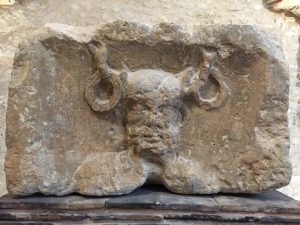
The Encyclopedia of Religion (edited by Mircae Eliade) has a few entries that refer to the Gaulish Esus, including one for the god himself. What follows are all the entries mentioning the continental Celtic god Esus from the 1987 version of the EoR (The entries are separated by paragraph; listed with a heading at the beginning of each paragraph is the encyclopedia, the name of the entry, the volume, and the pages that particular paragraph appears on):
Celtic Religion
The section on “Celtic Religion” includes a sectoin on “Gaulish Mars,” which is interesting to read through in context of Esus.
Encyclopedia of Religion, CELTIC RELIGION, Vol.3, p.153 - p.154
Gaulish Mars. A famous passage in Lucan’s Civil War refers to the bloody sacrifices offered the three Celtic gods Teutates, Esus, and Taranis. A later commentator on Lucan clearly illustrates the difficulty of identifying individual Gaulish and Roman gods, for one of his two main sources equated Teutates with Mercury, the other with Mars. But if, as seems likely, teutates is primarily a title (“god of the tribe”) rather than a name, then such confusion is explainable: the god of sovereignty and the arts, “Mercurius,” will also function as a warrior, while the god of war, “Mars,” will often function as the protector of the tribe. Consequently, their functions will sometimes overlap, and it may be a matter of chance or circumstance which is given preeminence in a given time or place. A further complication is that many of the Gallo-Roman dedications to Mars present him not only as a god of war but also as god of healing and guardian of the fields, but this may reflect an extension of his role in the Roman period and does not necessarily discredit Caesar’s description of him as god of war. So far as the insular tradition is concerned, a god of war does not come into clear focus, perhaps because fighting is a more or less universal, rather than a differentiating, feature in the heroic context. Thus one cannot easily define the role of Mars, and one cannot so easily assign him a pan-Celtic identity as one can Lugh.
Esus
The entry on Esus is fairly extensive, and refers to a lot of what we have available to us. The source citations at the end are interesting and worth tracking down.
Encyclopedia of Religion, ESUS, Vol.5, p.167
ESUS, a Celtic deity of uncertain attributes, was variously identified by the Romans with Mars and with Mercury. As a theonym Esus is unknown in Gallo-Roman writing except for a single inscription from the first century CE on the Altar of the Nautae of Paris, currently preserved at the Musée de Cluny (Corpus inscriptionum Latinarum, Berlin, 1863, vol. 13, no. 3026). But the name is indirectly attested in several godlike an-throponyms: Esumagius (“he who is as powerful as Esus”), Esugenus (“son of Esus”), and Esunertus (“he who has the strength of Esus”). There are also several ethnic names with related etymologies, such as Esuvii, Esubii, Esuii, and Esubiani (Vesubiani).
The name Esus appears in the Pharsalia of Lucan (1.444-446), at the center of the “Jupiterean” triad: “Et quibus inmitis placatur sanguine diro, / Teutates horrensque feris altaribus Esus / Et Taranis Scythicae non mitior ara Dianae . . . (“And those who appease ferocious Teutates with horrible bloodletting, hideous Esus in his savage sanctuaries, and Taranis, whose altars are no less cruel than those of Scythian Diana . . .”). Esus is also mentioned much later in the Bernese Scholia, which propose two successive interpretations of him. One reads: “Hesus Mars sic placatur: homo in arbore suspenditur usque donec per cruorem membra digesserit” (“Hesus-Mars is appeased in this mannner: they hang a man from a tree until his members fall off from the loss of blood”). The other reads: “Hesum Mercurium credunt, siquidem a mercatoribus colitur, et praesidem bellorum et caelestium deorum maximum Taranin lovem adsuetum olim humanis placari capitibus” (“They think that Esus is Mercury, although he is honored by the merchants, and as war leader and great god of the heavens they have Taranis-Jupiter, who was once appeased by human heads but who is now content with herds”).
The sculpture from the Altar of the Nautae shows him felling or pruning a tree, and he has often been called “woodcutter god,” which is a rather dubious interpretation. It is much more likely that the pruning or lopping off of the tree is associated with the birds of Tarvos Trigaranus (“bull of the three cranes”) depicted on the same monument. Esus also shows up on a monument in Treves, although here too one cannot be sure of a sound interpretation.
The etymology of Esus has for a long time been subject to doubt, and parallels from Sanskrit or Latin (e.g., herus, “master”) have been sought. But it would appear that the etymology is simply a case of the evolution of the stem *veso-s through the disappearance of the initial v-, as frequently happened in all the Celtic languages. In any case, the etymology is proved by the coexistence of the ethnic names Esubiani and Vesubiani. *Veso-s denotes “better, excellent,” and Esus is thus the Celtic semantic equivalent of the Latin Optimus, an epithet for Jupiter that also resembles the Irish Daghdha.
- Deonna, Waldemar. “Les victimes d’Esus.” Ogam 10 (1958): 3-29.
- Guyonvarc’h, Christian-J. “Der Göttername Esus.” Die Sprache (Vienna) 15 (1969): 172-174.
- Holder, Alfred. Alt-celtischer Sprachschatz, vol. 1. Leipzig, 1896.
- Le Roux, Françoise. “Des chaudrons celtiques à l’arbre d’Esus: Lucien et les Scholies Bernoises.” Ogam 7 (1955): 33-58.
Taranis
There is a mention of Taranis that refers to the Esus entry; I’m including it because it refers also to the Berne Scholia.
Encyclopedia of Religion, TARANIS, Vol.14, p.339
Taranis is cited in only one literary text, the Pharsalia of Lucan (1.444-446). [See Esus and Teutates.] Lucan’s Bernese Scholium identifies Taranis with Dis Pater and attributes to him sacrifice by fire: “Taranis Ditis Pater hoc modo aput eos placatur: in alveo ligneo aliquod homines cremantur” (“They appease Taranis Dis Pater in the following manner: they burn a certain number of men in a wooden cage”).
Teutates
Again, a reference to the Berne Scholia (and a more extensive reference to Esus than the one in the Taranis entry) leads me to include the Teutates entry here as well.
Encyclopedia of Religion, TEUTATES, Vol.14, p.409 - p.410
TEUTATES, a Celtic deity of uncertain attributes, was variously identified by the Romans with Mars and with Mercury. The theonym Teutates is attested in Lucan’s Pharsalia (1.444-446), together with Taranis and Esus: “Et quibus inmitis placatur sanguine diro / Teutates horrensque feris altaribus Esus / Et Taranis Scythicae non mitior ara Dianae” (“And those who appease ferocious Teutates with horrible bloodletting, hideous Esus in his savage sanctuaries, and Taranis, whose altars are no less cruel that those of Scythian Diana”).
Joseph Vendryes once explained the name by a haplology of *touto-tatis (“father of the tribe”). But this hypothesis is unnecessary: -atis is a suffix of anthroponymic, ethnic, and geographic derivation widely attested in all the Celtic languages. Etymologically it means “man of the tribe” or “man of the city,” or again, because of a morphological analogy duplicating a taboo, “the man from the north,” in which case the name is clear allusion to the Nordic and polar origins of Celtic tradition. It is with this sort of semantic reasoning that this god of the “community” can be better understood. But since there are no documents, it is difficult to say more about him. (Unlike Taranis and Esus, Teutates is not attested in Gallo-Roman iconography.) The Teutates-Esus-Taranis triad in Lucan still awaits a clear explanation beyond its evident Jupiter-like character.
- CHRISTIAN-J. GUYONVARC’H
Université de Haute Bretagne
Cernunnos; Daghdha; Druids; Epona; Esus; Filidh; Fomhoire; Lugh; Manannán mac Lir; Maponos; Matres; Nuadha; Oghma; Taranis; Teutates; Tuatha Dé Danann - FRANÇOISE LE ROUX
Université de Haute Bretagne
Cernunnos; Daghdha; Druids; Epona; Esus; Filidh; Fomhoire; Lugh; Manannán mac Lir; Maponos; Matres; Nuadha; Oghma; Taranis; Teutates; Tuatha Dé Danann