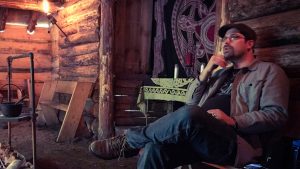
Find our new podcast, “Druids In Cars Going To Festivals,” on iTunes, Stitcher, and Google Play, or wherever you get podcasts!
We like to think that podcasts are accessible as they are: they play on all platforms, the aggregators and apps that play them are easy to navigate, and there are typically no images that need description.
But no format is accessible by default, and podcasts and audio miss an entire audience: those who are hard of hearing or deaf.
The way we interact with podcasts actually makes it easy to forget that accessibility is missing from the equation: for a hearing person, we don’t think about our music or playlists as inaccessible because the information they contain is so rooted in things we can’t possibly describe or provide easy accommodation for.
Podcasts, as a purely audio experience that most of us consider to be “just like music,” don’t seem to require anything special.
But podcasts (particularly spoken-word, conversation-heavy, or even guided meditation podcasts) convey a lot of descriptive information that a transcript can transmit to the consumer, even if they can’t hear what is said.
Podcasts need to come with a transcript of what is said, as best as it can be represented on the page, and as authentic to the audio experience as possible.
Even where there is only music, they should come with some form of linear notes. Musicians ought not rely on, “if they can’t hear it, they can’t get it.”
Aside from being good for the audience, transcripts are also good for the podcaster: a text file or transcript will allow search engines to find your content, too.
I’ll be the first to admit that transcripts, like closed captioning, are hard to create, especially if you are creating live content with little to no “staff.” They take time that could otherwise be used to create content for what appears (to an abled person) to be needed by a small target group.
But the difference it makes to that small audience is huge.
Make that difference.